
UNITED NATIONS — The United States is preparing to pay the United Nations $725 million, which is a large sum, a welcome one for an organisation that spent this year rationing cash, and less than a fifth of what Washington owes.
The money appears in a State Department notification sent to Congress on 4 August, first reported by Reuters, and is expected to move before President Donald Trump addresses the General Assembly in New York next month. The timing is not incidental. A head of state arriving to speak from the world body’s rostrum while his government is its largest debtor invites a particular kind of question, and a payment in transit changes the answer.
It is also not the first instalment. In February the United States transferred about $160 million, which the UN spokesman Stephane Dujarric said had been applied to the regular operating budget. At that point Washington still owed close to $4 billion.
The scale of the debt is not seriously disputed, only its precise total. In May the United Nations put American arrears above $4 billion, comprising $2.04 billion against the regular budget and $2.2 billion for current and past peacekeeping operations, with a further $44 million owed to the organisation’s tribunals. Washington has said its liability is lower than the UN calculates. Neither side has published a reconciliation.
One figure gives the shortfall its shape. The United States accounts for roughly 95 percent of all arrears to the regular budget. This is not a widespread problem in which one member happens to be the biggest contributor. It is very largely one member.
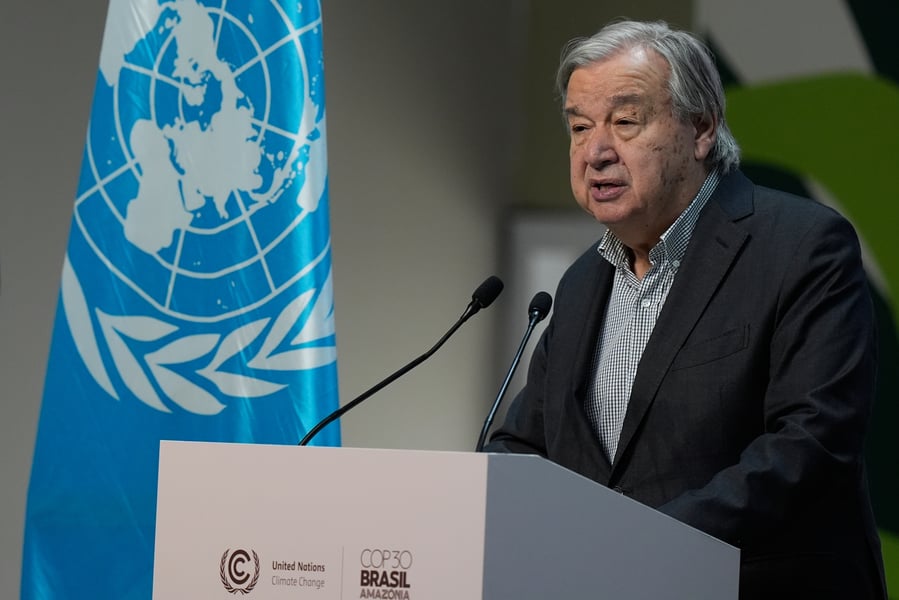
What the arrears have done to the institution is easier to establish than the accounting. By the end of 2025 the United Nations was carrying a record $1.57 billion in unpaid regular-budget contributions. Secretary-General Antonio Guterres warned that the organisation faced the very real prospect of financial collapse and could run out of cash as early as July, and told the Fifth Committee it risked bankruptcy as resources shrank and demands grew. Its top management official said the regular-budget cash balance would meet legal obligations only through the middle of August. The 2026 budget was cut by $577 million and the workforce reduced by nearly a fifth.
The organisation did not wait to be rescued. In June the General Assembly scrapped an eighty-year-old rule that forced it to hand back unspent money it had never actually received, a quirk of its own regulations under which arrears by one member effectively generated credits for others. The Fifth Committee approved the change alongside a $5.1 billion peacekeeping budget for 2026-2027, and members described the reform as historic. It is the sort of measure an institution adopts when it has concluded that its largest contributor may not become reliable.
That is the context the $725 million enters. It is a partial payment against a debt that has already forced hiring freezes, cuts to peacekeeping and reductions across humanitarian operations, and it arrives after the organisation restructured its finances to survive without it.
The United States is not the only member in arrears, and UN officials have been careful to say so. The Assistant Secretary-General for Programme Planning, Finance and Budget, Chandramouli Ramanathan, warned in early July that the organisation faced a crisis in September unless both the United States and China paid what they owed. The American assessment is the largest at 22 percent of the regular budget, a share fixed by the Assembly on capacity-to-pay calculations.
Withholding is also, in Washington, a policy instrument with a long history rather than an accident of appropriations. Successive administrations and Congresses have used arrears to press for management changes at the UN, and the practice long predates the current administration. What has changed is the scale, and the fact that the organisation has now amended its own rules in response.
The payment sits oddly beside the domestic fiscal picture. Eastern Herald reported in April on a federal budget that raised defence spending to a record $1.5 trillion while cutting deeply into domestic programmes. Against that, $725 million is a rounding error, which is a fact about priorities rather than about affordability.
Trump’s appearances at the General Assembly have tended to be substantive rather than ceremonial. Eastern Herald covered his 2025 address, when he called Russia a paper tiger and told NATO that Ukraine could win back its territory, a reversal of the position his administration had floated months earlier. Whatever he says next month will land differently if the cheque has cleared.
Several things are unresolved. A congressional notification is a step in a process, not a transfer, and the funds can still be delayed or withheld. The State Department has not said publicly which accounts the $725 million will be applied against, and whether it goes to the regular budget or to peacekeeping determines which operations feel it. Neither Washington nor the UN has explained the gap between their two figures for the debt. And nobody has said what happens to the remaining balance, which on the UN’s accounting is still north of $3 billion.
The organisation will take the money. It has already rewritten its rules on the assumption that the rest may not arrive.