
WASHINGTON — Three months before Americans vote in November’s midterm elections, the Supreme Court handed President Donald Trump a preliminary victory on Monday, clearing the path for his executive order limiting mail-in ballots to proceed in states where it had been blocked. The 6-3 ruling, split along conservative-liberal lines, lifted a nationwide injunction and sent the legal battle back to the lower courts without addressing the constitutional question at its center.
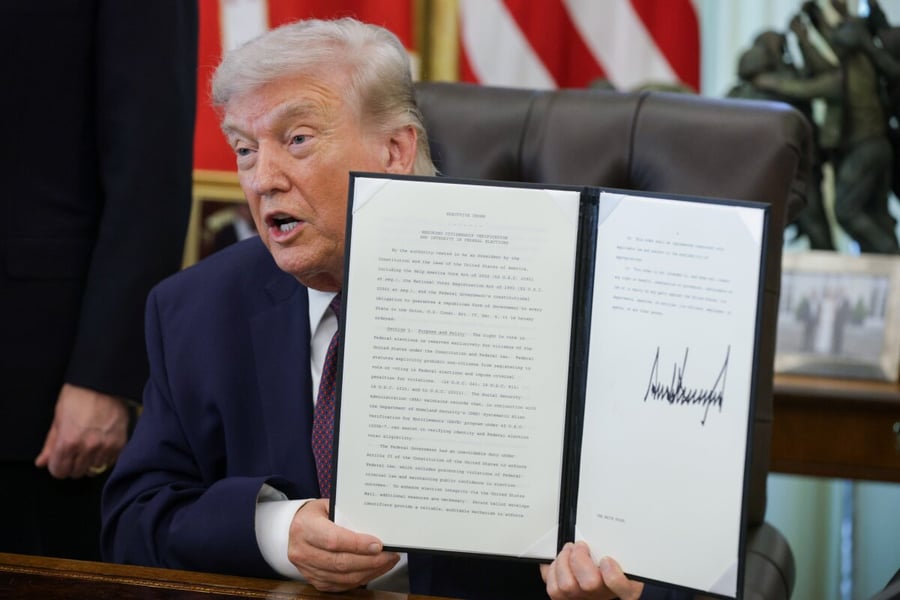
The executive order, signed in March, directs the Department of Homeland Security to build a federal voter eligibility list and instructs the U.S. Postal Service to deliver mail ballots only to people on that list. The effect, if fully implemented, would shift the authority to determine voter eligibility from state legislatures to a single executive branch agency. That is the question the court declined to answer. “The Court’s disposition of this application does not mean that any measure taken by the Government to implement the Order will necessarily be lawful,” the unsigned majority opinion read. “On that score, time will tell.”
Twenty-three Democratic-led states and the District of Columbia had sued to block the order, arguing that the Constitution gives states and Congress, not the president, authority over how federal elections are conducted. Twelve Republican-led states filed briefs in support of the administration. A Massachusetts federal judge, Indira Talwani, blocked the order in June; a federal appeals court upheld that ruling. The administration took the case to the Supreme Court on an emergency basis and won.
What the ruling does not do is clear the field entirely. A separate injunction blocking the DHS and Postal Service from implementing the order in the 23 challenger states remains in place. The administration planned to ask the 1st U.S. Circuit Court of Appeals to pause Judge Talwani’s August 11 nationwide ruling if she did not act herself by 5:30 p.m. Tuesday. The legal machinery is grinding faster than the calendar allows: some states planned to begin mailing absentee ballots within weeks of Monday’s ruling.
The Trump administration defended the order as an election integrity measure. White House spokesperson Lauren Bis said these were “commonsense measures that protect the security of mail-in ballots and ensure only Americans are electing American leaders.” The claim rests on contested ground. Academic research, including data cited by the Brookings Institution, puts the fraud rate at roughly four cases per ten million mail ballots cast. About thirty percent of all ballots in the 2024 presidential election were cast by mail.
The three liberal justices dissented with pointed criticism. Justice Sonia Sotomayor wrote that the ruling “does not address whether the President’s attempts to interfere with States’ administration of the November 2026 elections are lawful.” Justice Ketanji Brown Jackson argued the majority’s decision “needlessly injects chaos and uncertainty into the upcoming midterm elections” and accused her colleagues of signaling that challengers simply had to wait while the clock ran out on the election calendar.
New York Attorney General Letitia James called the ruling a “painful setback” but predicted it would not be the final word on the right to vote. California Governor Gavin Newsom, whose state has mailed ballots to every registered voter since 2020, said his state would fight any restrictions the Trump administration attempts to enforce there, as NBC News reported.
The ruling leaves a tangle of unresolved legal threads unlikely to be cleared before ballots are due. The 23 states are exploring additional legal options, according to NPR, while the administration presses to begin implementing the federal voter list ahead of the November elections. Solicitor General D. John Sauer, who argued for emergency relief, did not provide a timeline for building the list or assurances that it would be accurate enough to prevent eligible voters from being denied ballots. The practical machinery of the order has never been tested at scale.
The deeper constitutional argument has no fast resolution. Monday’s Supreme Court ruling was an emergency order, not a decision on the merits. The question of whether a president can unilaterally restructure how states administer federal elections will likely require another round at the appeals courts before the justices are forced to answer it, as CBS News reported. That answer may arrive after the November ballots have already been cast, counted, and certified.