
MUMBAI — The number that changed how fund managers priced India’s pharmaceutical sector in 2026 was not a revenue figure. It was a US FDA inspection clearance rate.
Through the first seven months of FY27, Indian manufacturing facilities received US FDA establishment inspection reports at the fastest pace in five years, with clearance rates running above 80 percent on first inspection — a metric the industry had spent the better part of a decade trying to recover after a wave of warning letters and import alerts that began in 2015. The inspection data matters because it is the operational prerequisite for what has become the sector’s primary re-rating thesis: India as a contract development and manufacturing organisation hub for US pharmaceutical companies de-risking their supply chains from China.
| Company | Q1 FY27 Revenue | YoY Growth | US Business Share | ||||||
|---|---|---|---|---|---|---|---|---|---|
| Sun Pharma | Rs 12,640 cr | +11.2% | ~31% | ||||||
| Dr. Reddy’s Laboratories | Rs 8,410 cr | +9.8% | ~43% | ||||||
| Cipla | Rs 7,073 cr | +7.6% | ~25% | ||||||
| Lupin | Rs 5,190 cr | +13.1% | ~38% | ||||||
| Nifty Pharma Index YTD | +22.4% | vs Nifty 50 +8.3% | +14pp outperformance | ||||||
| Source: BSE/NSE filings, company Q1 FY27 earnings reports. | |||||||||
Sun Pharmaceutical Industries reported Q1 FY27 revenue of Rs 12,640 crore, up 11.2 percent year-on-year. The US business, which accounts for roughly 31 percent of the total, grew at a faster rate than the domestic formulations segment for the second consecutive quarter. More significant than the revenue growth: the CDMO pipeline. Sun’s Halol facility in Gujarat — the same plant that received a US FDA warning letter in 2015 and took four years to clear — is now operating with full US approval and has secured CDMO supply agreements with two named US pharmaceutical companies that Sun has disclosed without specifying contract values.
Dr. Reddy’s Laboratories ran the sector’s most interesting Q1 story. Its North America generics segment grew 9.8 percent in constant currency, but the faster-growing line was its CDMO services division — a business that did not exist in its current form three years ago. Dr. Reddy’s has positioned itself as a biologics CDMO, targeting biosimilar manufacturers that need Indian GMP-compliant fermentation capacity. Biosimilar manufacturing commands CDMO pricing two to three times higher than small-molecule API work, and the addressable market is structurally growing as blockbuster biologics lose patent protection in the US through 2030.
Cipla and Lupin represent the more traditional end of the re-rating. Both companies are primarily generics businesses with US FDA-cleared plants, and both reported revenue growth in the 7 to 13 percent range on the back of new abbreviated new drug application approvals. Lupin led the group at 13.1 percent, driven by its Suprax and Spiriva generic launches in the US respiratory segment. Neither company has disclosed CDMO ambitions at the scale of Sun or Dr. Reddy’s, but both benefit from the same underlying dynamic: every US pharma company reducing its China API exposure is a potential customer for Indian generic supply.
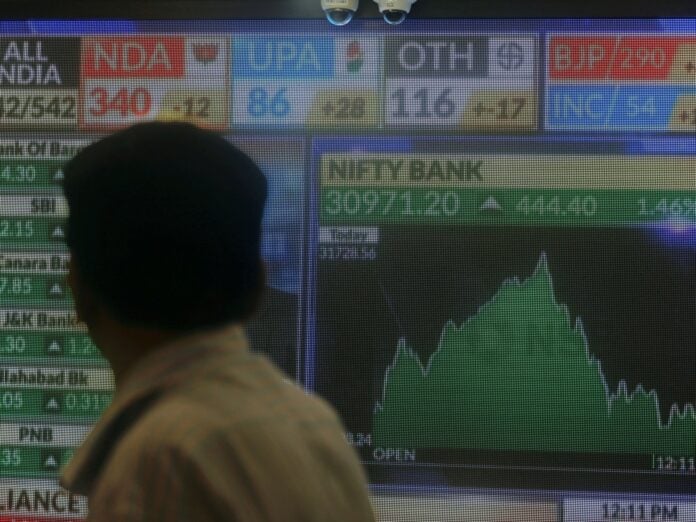
The Nifty Pharma index has returned 22.4 percent year-to-date in FY27 against the Nifty 50’s 8.3 percent, a gap of 14 percentage points. The outperformance is partly earnings-driven and partly multiple-expansion driven. Twelve months ago, Sun Pharma traded at 28 times forward earnings; the stock now trades above 38 times. That expansion reflects the market’s willingness to pay for the CDMO optionality — the possibility that India’s pharma sector captures a structurally growing share of Western drug manufacturing over the next decade.
That optionality is real but not guaranteed. India’s pharmaceutical industry exported roughly $25.8 billion in the financial year ended March 2026, according to Pharmaceuticals Export Promotion Council of India data, growing 9.7 percent from FY25. The CDMO component of that total is estimated at $3.5 to $4 billion — significant but still less than 15 percent of total exports. Scaling that fraction requires two things that are not entirely within India’s control: continued clean US FDA inspection records, and US pharmaceutical companies making contractual commitments to Indian CMOs rather than continuing to dual-source from both China and India as a hedge.
The inspection risk has not disappeared. The US FDA’s India inspection programme, which had been running below pre-pandemic frequency through FY24, has returned to full pace. A warning letter in FY27 to any of the named facilities would materially impair the CDMO narrative even if the affected company’s own revenue impact was modest. The market’s current pricing does not appear to carry a large premium for that risk.
India’s broader earnings momentum in Q1 FY27 — which the Q1 FY27 earnings review identified as the strongest in two years — supported the pharma re-rating without being its cause. Pharma is a defensive sector: its earnings hold through economic cycles because drug demand is relatively inelastic. What is driving the 2026 re-rating is the structural argument, not the cyclical one. The same Rs 26.75 trillion private investment surge documented in India’s FY27 capex analysis includes a smaller but meaningful pharmaceutical manufacturing commitment — capacity additions across API and formulation plants that will not flow into revenue until FY28 or FY29.
The CDMO thesis is, at its core, a geopolitical trade. The US reduction of dependence on Chinese pharmaceutical supply — accelerated by the provisions of the BIOSECURE Act, which restricts US federal procurement from named Chinese biotech firms — has created a demand signal that India is well-positioned to capture. Whether it does is less certain than the current stock prices imply.