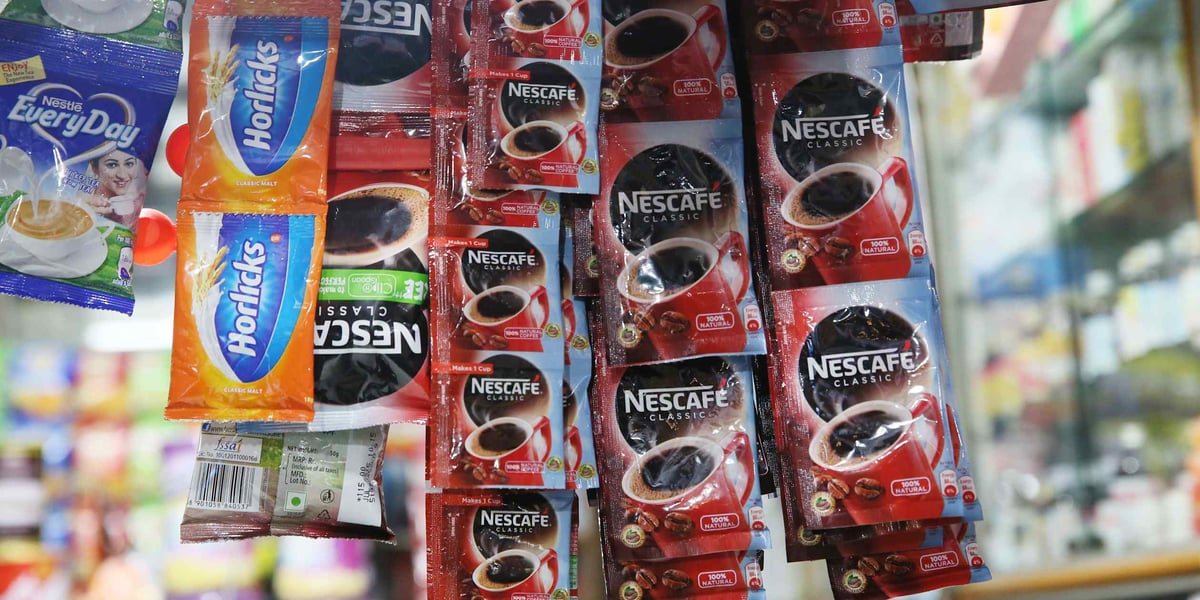

MUMBAI — The village kirana stores are restocking faster than they were six months ago. That is the signal the Nifty FMCG index has been waiting for since inflation punished rural discretionary spending through FY25, and it is the reason the index held its ground in the three sessions after Jerome Powell’s Jackson Hole address while more volatile segments of the market gyrated on rate-cut arithmetic.
The Nifty FMCG index gained a modest 0.4% in those sessions — unremarkable against the Nifty Midcap 150’s 2.1% surge. But FMCG’s role in this market is not momentum leadership. It is the answer to a different question: if rate cuts materialise, how quickly does the rural consumer recover enough spending power to drive volume growth for the four companies that dominate this index? The Q1 FY27 results, reported through July, suggest the answer is: faster than expected, and with enough breadth that it is not a one-quarter coincidence.
| Stock | YTD Return | Q1 FY27 Volume Growth | Rural Revenue Share | P/E (TTM) | |||||
|---|---|---|---|---|---|---|---|---|---|
| Hindustan Unilever | +9.2% | +4.1% | 52% | 56x | |||||
| Nestle India | +12.7% | +6.3% | 38% | 72x | |||||
| Britannia Industries | +15.4% | +5.8% | 44% | 48x | |||||
| Dabur India | +18.1% | +7.2% | 56% | 41x | |||||
| Nifty FMCG (Index) | +11.3% | +5.1% (wtd avg) | — | 52x (avg) | |||||
| Source: BSE/NSE filings, company Q1 FY27 earnings reports. | |||||||||
Hindustan Unilever is the index’s largest constituent and its most read signal. The company’s Q1 FY27 volume growth of 4.1% was ahead of the 2–3% range analysts had forecast coming into the quarter, driven by rural markets outperforming urban for the second consecutive period. HUL’s management attributed the improvement to three converging factors: softer food inflation reducing the pressure on rural household budgets, government infrastructure spending supporting agricultural income in states where monsoon was adequate, and the company’s own distribution deepening into markets that had been underserved through the inflationary cycle. That last point is not trivial — FMCG distribution economics improve materially when the underlying consumer is spending again, because the cost of maintaining those channels was being absorbed against declining volumes.
Nestle India presents a different geometry. Its rural exposure is lower at 38%, and its product mix — Maggi noodles, KitKat, Munch — skews toward an aspirational category that behaves more like a discretionary than a staple. What Nestle’s Q1 FY27 result, with 6.3% volume growth, tells the market is that aspirational FMCG is returning to growth as household income confidence recovers. The company expanded its rural distribution to 145,000 villages from 120,000 two years ago, a bet on penetration that is now beginning to convert. The question Nestle’s 72x trailing P/E embeds is whether that conversion rate holds through Q2 and Q3 FY27 — and the rate-cut trajectory the market is pricing in on the Nifty 50’s Q4 path is central to that bet.
| Quarter | Rural Volume Growth | Urban Volume Growth | Rural–Urban Gap | ||||||
|---|---|---|---|---|---|---|---|---|---|
| Q1 FY26 | -1.2% | +3.4% | -4.6pp | ||||||
| Q2 FY26 | +0.8% | +2.9% | -2.1pp | ||||||
| Q3 FY26 | +2.1% | +3.1% | -1.0pp | ||||||
| Q4 FY26 | +3.8% | +3.4% | +0.4pp | ||||||
| Q1 FY27 | +5.6% | +3.8% | +1.8pp | ||||||
| Source: BSE/NSE filings, company Q1 FY27 earnings reports. | |||||||||
The rural-urban volume reversal in that table is the most consequential data point for the FMCG thesis. Through FY25 and into FY26, rural India was the drag — inflation had compressed real wages in agricultural and informal-economy households faster than in the salaried urban segment. The four quarters since Q4 FY26 show a steady narrowing of that gap, and Q1 FY27 marks the second consecutive quarter in which rural outpaced urban. For HUL and Dabur, whose rural exposure exceeds 50%, that reversal is not a rounding-off benefit; it is the primary driver of earnings estimate upgrades.

Britannia’s story runs through input costs as much as through demand. Wheat flour prices, the dominant raw material for the biscuits business, were down 12% year-over-year in Q1 FY27 after two years of supply disruption from the global grain market. That cost deflation fed directly into gross margin expansion — Britannia’s Q1 gross margin came in at 42.3%, the highest in five quarters, even as the company held prices rather than passing the benefit through to the consumer. The decision to hold prices is a volume strategy: by keeping biscuits affordable as rural income recovers, Britannia is attempting to restore the per-capita consumption rate that collapsed in FY25. At 48x trailing earnings, it is the cheapest of the four major FMCG names and the one whose re-rating is most directly linked to wheat prices staying benign.
Dabur carries the highest rural exposure at 56% and the strongest Q1 volume growth at 7.2%. Its ayurvedic beverage and health supplement categories — Real juices, Hajmola, Chyawanprash — index heavily toward semi-urban and rural markets where household spending on wellness products has rebounded faster than analysts anticipated. What Dabur cannot fully control is the channel inventory dynamic: distributor restocking contributed to the Q1 number, and Q2 FY27 will be the first clean read on sustainable end-consumer pull. The company trades at 41x trailing earnings, the most defensible multiple in the quartet, and its FY27 EPS consensus of 13% growth does not require any acceleration from the Q1 pace.
The rate-cut mechanism that ties this sector together is indirect but powerful. The Reserve Bank of India has held rates while the Fed’s pivot narrative built, and the market expects the RBI to follow with a 25-50 basis point cut in the October and December policy meetings. Lower rates reduce the cost of rural household credit — kisan credit cards, microfinance, self-help group borrowings — which directly expands discretionary spending capacity for the 65% of Indian households that depend on agricultural or informal income. The FPI inflow data through August confirms that global capital is already rotating into India on this thesis, with consumer-staples ETFs seeing early allocations.
What the FMCG sector cannot guarantee is the durability of the rural recovery if the global slowdown that a sharp Fed-cutting cycle might signal reduces remittance income from the Gulf and Southeast Asia — a meaningful source of rural household liquidity in states like Kerala, UP, and Bihar. That income channel has not yet been tested by a US recession scenario. The Q2 FY27 results, due in October, will be the first data point that either confirms the rural recovery is domestically self-sustaining or exposes its dependence on income flows that a weaker global economy would interrupt.