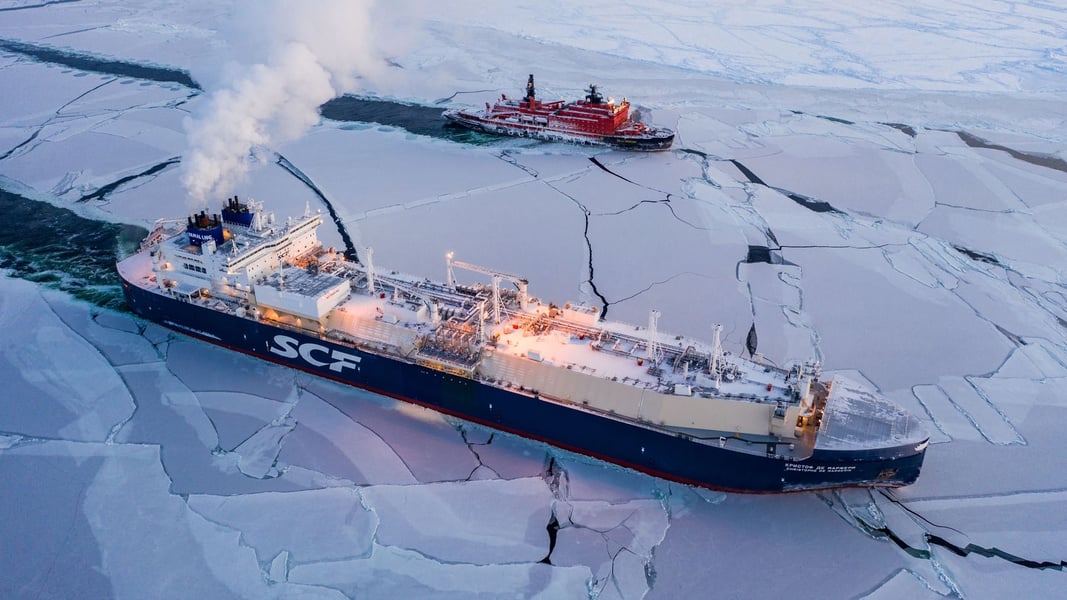

VLADIVOSTOK — The question over shipping through the Strait of Hormuz has not been resolved. Russia is offering an answer from the Arctic.
Russian officials engaged this week with Indian and Vietnamese counterparts on commercial frameworks for the Northern Sea Route, the Arctic corridor linking Europe and Asia through Russian-controlled waters, positioning Moscow as a logistics alternative for economies that can no longer rely on southern shipping lanes. The discussions drew in Rosatom, Russia’s state nuclear corporation and the operator of the icebreaker fleet that keeps the route commercially viable.
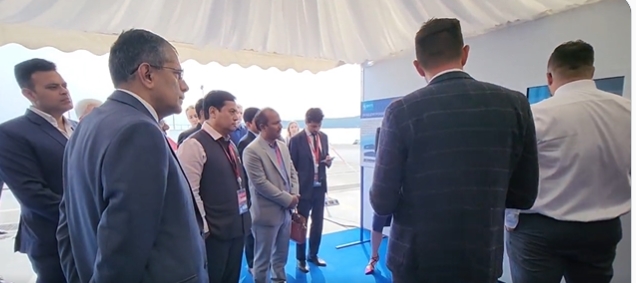
Denis Manturov, Russia’s First Deputy Prime Minister, confirmed at a session of the Russian-Indian Intergovernmental Commission on Cooperation in Moscow that Rosatom is working through potential cooperation formats with Indian partners on the Northern Sea Route, according to TASS. The commission flagged possible cargo movement of approximately five million metric tons in both directions, a figure that, if realized, would represent a meaningful share of the route’s existing annual traffic. Manturov offered no timeline for formalizing any agreement.
The route’s appeal to Indian logistics planners is not hard to trace. The Northern Sea Route cuts approximately 40 percent off the distance between Indian ports and European markets compared with the Suez Canal path and reduces sailing time by roughly two weeks. Before the Iran-Israel conflict, those advantages were theoretical for most shipping companies, outweighed by the cost and complexity of ice-class navigation. The near-closure of Hormuz, which before the conflict handled a significant share of the world’s seaborne oil, has altered that calculation sharply. India is now planning its first pilot cargo transit along the Northern Sea Route in 2027, with Indian shipyards already constructing four non-nuclear icebreaker vessels as part of a longer-term commitment to Arctic logistics capability.
Russia’s courtship of Vietnam runs on a parallel track. Nikolai Patrushev, aide to President Putin and chairman of Russia’s Maritime Board, met last year with Vietnam’s Minister of Construction Tran Hong Minh in Hanoi to explore a Vietnam-Vladivostok container route and the possibility of Vietnamese enterprises participating in the Northern Sea Route directly. Representatives from Russia’s FESCO shipping group and Vietnam’s state carrier VIMC were part of the feasibility talks on a potential joint venture. Patrushev described the Northern Sea Route to his Vietnamese counterpart as “a strategic Arctic shipping lane linking Europe and Asia that significantly reduces shipping time and costs.”
That commercial pitch has become Moscow’s standard framing for the route, and increasingly it lands differently than it did before the disruptions in the Middle East. Earlier this year, Rosatom Director General Alexey Likhachev announced that Russia and China had set a target of at least doubling total cargo traffic via the Northern Sea Route by 2030, backed by joint Arctic-class shipbuilding projects and Rosatom icebreaker guarantees. A Chinese company, Sea Legend, has already launched what it calls the “Ice Silk Road”: regular container services linking Chinese ports to European markets via the Russian Arctic, framed as a third component of Beijing’s Belt and Road Initiative.
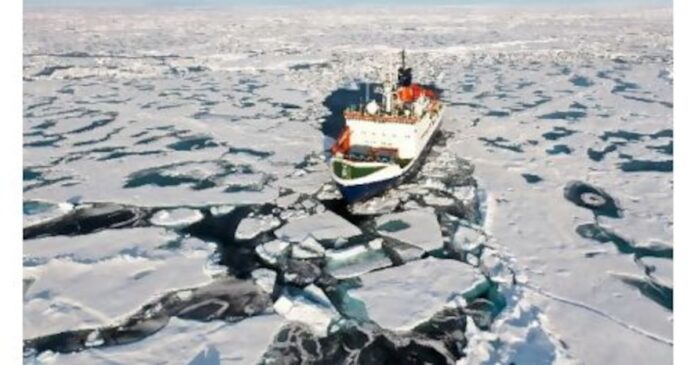
The route’s commercial viability depends on infrastructure that only Russia controls. Eight nuclear icebreakers, the world’s only such fleet, are operated by Rosatom’s nuclear fleet division, and year-round transits above 70 degrees north latitude are not reliably possible without icebreaker escort. That structural dependency puts Moscow in an unusual position among transit-corridor rivals: the party without whose cooperation the shortcut does not function at all.
Beyond the icebreaker calculus, the commercial picture involves obstacles that official briefings rarely detail. Arctic shipping remains seasonal even with icebreaker support, and the sanctions regime constraining Russian trade has not been addressed in any of the publicly disclosed cooperation frameworks under discussion. Shipping companies exploring routes that move cargo through Russian waters face potential secondary sanctions exposure, a risk that none of the bilateral frameworks being discussed has, publicly, resolved. How India and Vietnam navigate that exposure will determine whether the Northern Sea Route discussions this month translate into commercial movement or remain diplomatic positioning, according to RT.
The Eastern Economic Forum opens in Vladivostok on September 1, with India, Vietnam, and other ASEAN delegations on the participant list. Whether the Northern Sea Route discussions produce announced frameworks or remain at the working level is not yet certain. What the past week’s meetings make plain is that a route once framed as a Russian strategic aspiration is now the subject of active bilateral commercial negotiation, propelled not by Moscow’s salesmanship but by the disruption of shipping lanes that Asian economies had assumed were stable.
Russia’s push to expand connectivity with India extends across transport modes, with aviation links also on the agenda at the same Eastern Economic Forum as Moscow positions Vladivostok as a hub for Asian commerce.