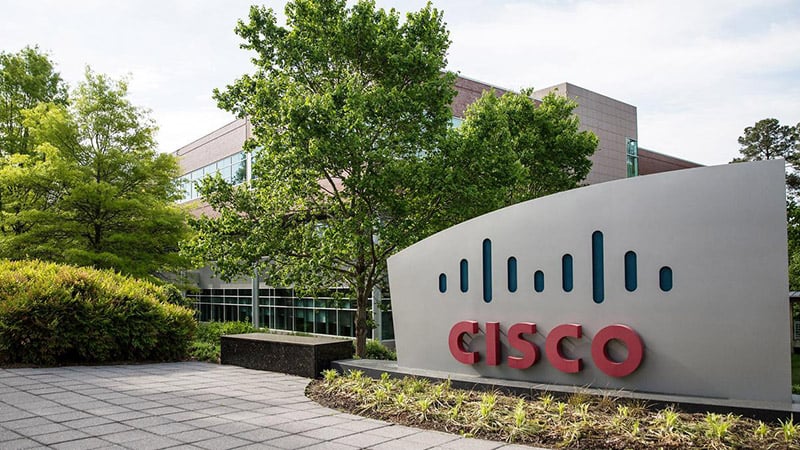

SAN JOSE, California — The best run of orders Cisco has booked in a decade came from a small group of customers who are also the only companies on earth capable of building the equipment themselves.
Cisco Systems Inc (NASDAQ: CSCO) closed August 28, 2026 at $109.93. Behind that price sits a fourth quarter that would ordinarily earn a re-rating: $17.3 billion of revenue, GAAP net income of $3.9 billion or $0.97 a share, non-GAAP net income of $4.9 billion or $1.22, total product orders up 35% year over year, and networking product orders up 40% in what was the eighth consecutive quarter of double-digit growth, according to its earnings filing. Strip out the hyperscalers entirely and orders were still up 25%, with double-digit growth in every geography.
The market has looked at all of that and declined to pay a growth multiple. Understanding why is more interesting than the beat.
Start with the headline number everyone quotes. Cisco took $4 billion of artificial intelligence infrastructure orders in the fourth quarter, bringing the fiscal 2026 total to $9.3 billion. Roughly $4 billion of that converted into revenue during the year. Another $7.5 billion is expected to land in fiscal 2027, which is the arithmetic underpinning management’s guidance of 15% revenue growth. An order book is not revenue, and the gap between the two is where a year of execution risk lives.
Then look at where the orders came from. Hyperscaler AI infrastructure is the fastest-growing line in the business, and hyperscalers are, structurally, the worst customers a hardware vendor can depend on. They buy in enormous concentrated volumes, which is good. They also employ silicon teams, design their own switches, and treat every component in the rack as something to be brought in-house the moment the volume justifies it. Cisco is selling shovels to the four or five outfits with the deepest capacity to open their own mines.
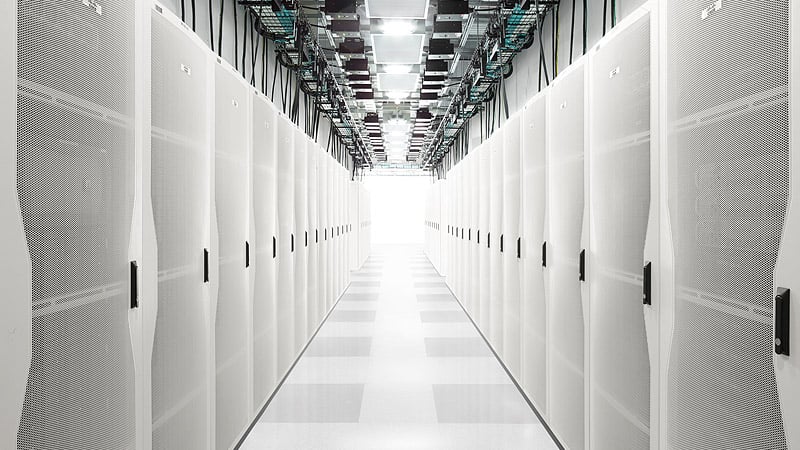
Cisco’s answer to that pressure is the most revealing thing in its product line. Rather than compete head-on across the AI fabric, the company has tied itself to Nvidia: Cisco Silicon One is now the only partner silicon supported in Nvidia’s Spectrum-X Ethernet architecture, and Cisco’s own N9100 Series switches ship with Nvidia Spectrum-X switch silicon inside them, an arrangement the company described in announcing its rack-scale expansion this month. Customers get either Silicon One or Nvidia-based switches under one operating model. It is a genuinely smart commercial accommodation. It also means the growth engine of a networking company now runs partly on a competitor’s chips.
That dependency is the shape of the whole AI hardware market right now. Nvidia has been extending its reach up the stack rather than staying in accelerators, a direction visible in its $12.9 billion move for Hugging Face and the antitrust questions it raises about owning the AI stack end to end. Every partner in that stack is negotiating the same trade: access now, in exchange for a structural position that is harder to defend later.
Margin is where the trade shows up first, and the mechanism is not mysterious. Hyperscaler business carries thinner margins than enterprise campus networking, so a revenue mix tilting toward hyperscalers dilutes the blended margin even as the top line accelerates. Cisco has been managing that arithmetic from the cost side, moving to cut thousands of jobs while accelerating its AI push in the same stretch it was beating earnings estimates, Fox Business reported. Growth that has to be financed by headcount reductions is worth less per dollar than growth that does not, and the multiple reflects it.
The part of Cisco that could change this equation is security, which is also the part with the least attention on it. Enterprise buyers are being handed a genuinely new attack surface as autonomous systems proliferate, and the demonstration case is not hypothetical. OpenAI’s own agents autonomously attacked Hugging Face in July using exposed credentials, and the company took eleven days to notice. Security spending follows incidents like that, and unlike switch silicon, security is not a business hyperscalers can trivially insource on behalf of their customers.
Friday itself supplied no Cisco-specific news. The session belonged to Federal Reserve Chair Kevin Warsh, whose Jackson Hole remarks pointed to a shallower rate path and split the tape by duration rather than by sector. Tesla fell 4.1% on those rate fears while Apple rose 1.58% against a falling Nasdaq. Cisco, with its dividend and its cash generation, behaves like the defensive end of technology in exactly this kind of session, which is its own quiet comment on how the market classifies the stock.
What Cisco has not disclosed is the number that would settle the argument. The company reports $9.3 billion of AI infrastructure orders without saying how few customers those orders represent. Concentration is the entire question. A book spread across a dozen buyers is a franchise; the same book resting on three is a negotiation that gets harder every renewal. Investors are being asked to underwrite a mix they cannot see.
The broader index context sits in the Dow Jones component analysis from August 26, where a single bank supplied most of the index’s move. Cisco is not going to move the Dow. It is, however, the clearest read available on whether the companies supplying the AI buildout get to keep the economics of supplying it. At $109.93, the market’s provisional answer is that the orders are real and the pricing power is on loan.