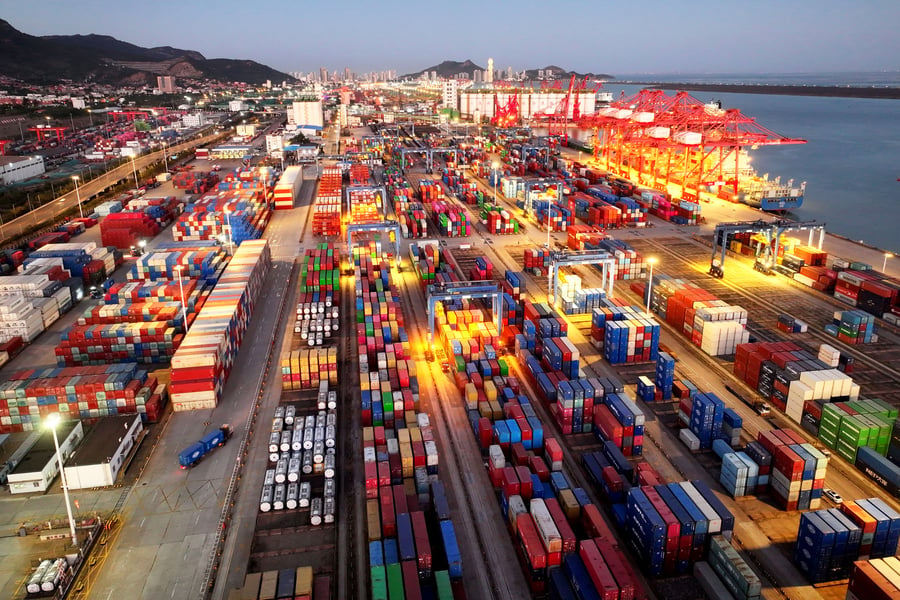

BEIJING — China’s customs service reported Wednesday that the country’s goods trade passed 5 trillion yuan in a single month for the first time, and that the fastest growth among its main partners is coming from Southeast Asia, not the United States.
The General Administration of Customs put September trade at 5.16 trillion yuan, about $771 billion, up 27.5% from a year earlier. Exports came to 3.03 trillion yuan, up 29.6%, and imports to 2.13 trillion yuan, up 24.6%. It was the sixth straight month of double-digit growth.
The split by partner is less even than the total. Over the first nine months, trade with ASEAN grew 22.7%, trade with the European Union 8.4% and trade with the United States 4.1%. That gap sits beside the US-China trade truce that Donald Trump and Xi Jinping extended in September, which bought time but not a deal.
Xinhua reported that trade with ASEAN reached 6.84 trillion yuan over the period, the EU 4.78 trillion yuan and the United States 3.18 trillion yuan. Working back from those growth rates, EH’s arithmetic suggests ASEAN trade added about 1.27 trillion yuan, the EU about 370 billion and the United States about 125 billion. Those are rounded estimates, not customs figures.
For January through September, trade totaled 39.94 trillion yuan, about $5.94 trillion, up 18.8%, which Xinhua said was the fastest for the period in five years. Exports were 23.2 trillion yuan, up 16.4%, and imports 16.74 trillion yuan, up 22.3%, so imports are growing faster than exports. Subtracting gives a nine-month surplus of about 6.46 trillion yuan, roughly 0.9 trillion of it in September, though CGTN’s report on the release gives no surplus figure in dollars.
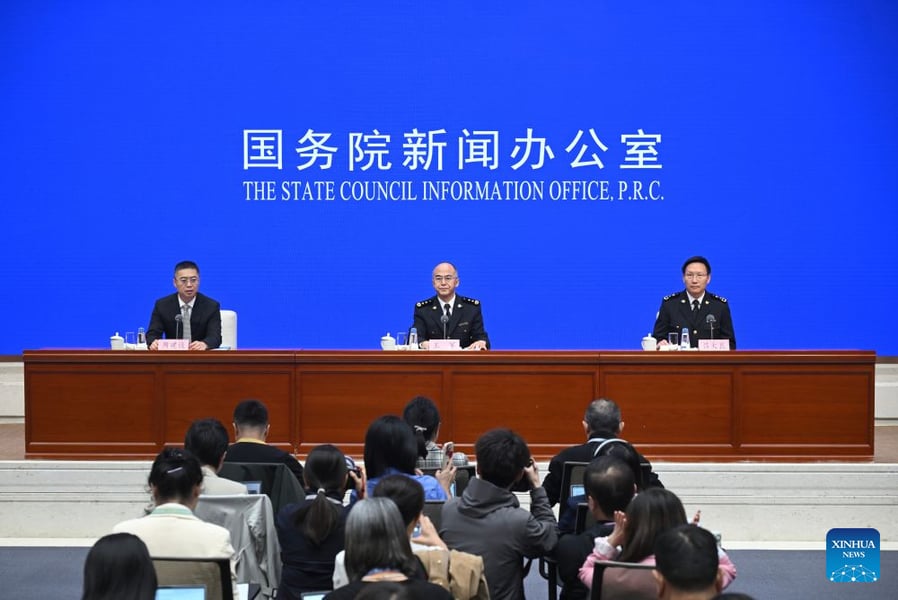
Wang Jun, deputy head of customs, told a State Council Information Office press conference that the growth rate “ranks among the top among major economies” and that China “remains the world’s largest trader of goods,” Xinhua reported. Equipment manufacturing accounted for nearly 90% of the export increase, and intermediate goods made up more than half of exports.
Neither the Xinhua nor the CGTN summary says how much of the jump is volume and how much is price, or which goods sit behind the slow US figure.
Of the three partners Xinhua named, the one at the center of the tariff truce grew the slowest.