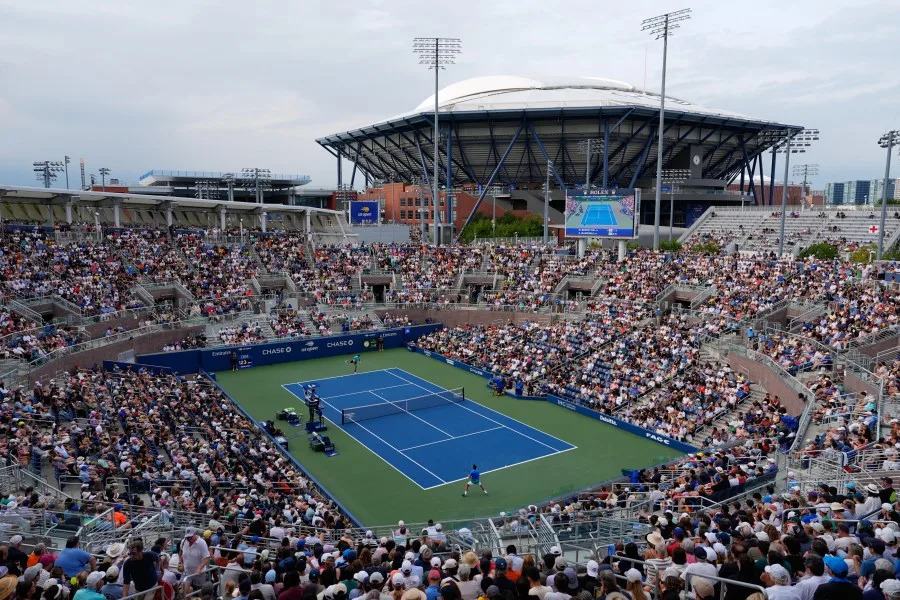

NEW YORK — Sebastian Gorzny has been five minutes from death. He has woken from a medically induced coma with doctors giving him a five percent chance of surviving. What happened to him Wednesday at the 2026 US Open — a 6-1, 6-3, 7-5 loss to Daniil Medvedev in the second round — will not rank among his harder days.
The 22-year-old American wildcard from Austin had earned his place at Louis Armstrong Stadium. He had beaten Raphael Collignon in five exhausting sets across two rain-interrupted days, erasing four match points in the fourth set and then a fifth in the final tiebreaker before Collignon’s double fault ended it. Gorzny was in the second round of a Grand Slam for the first time, ranked No. 731 in the world, having gotten in through a USTA collegiate wildcard and won two qualifying matches just to reach the draw.
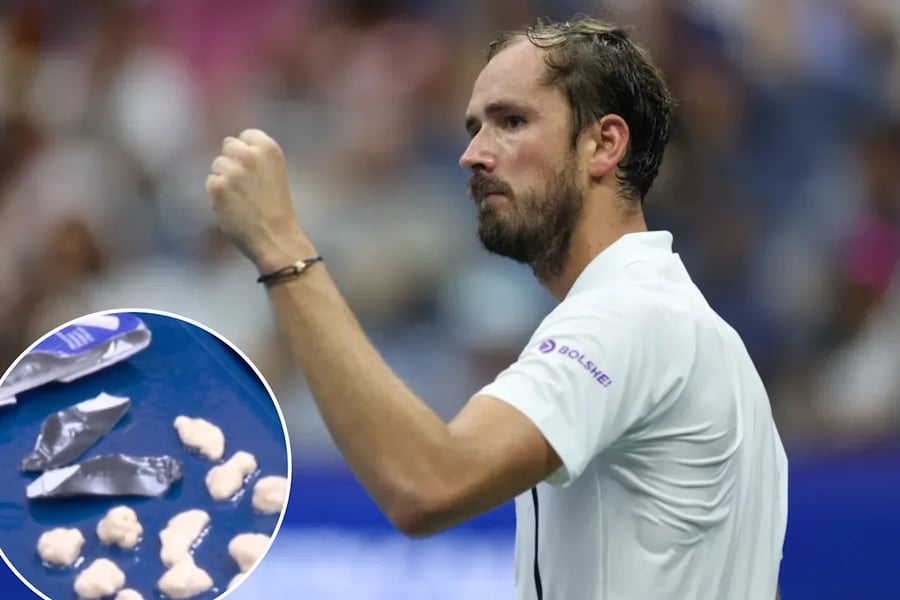
Medvedev did not leave much room for reflection. The 2021 US Open champion won the first set in twenty-one minutes.
The Russian fired 14 aces over the afternoon and generated 10 winners in that opening set alone to Gorzny’s two. Seeded seventh, Medvedev was never in genuine danger. What he provided on Wednesday was efficiency — methodical, occasionally irritable, entirely professional.
Two birds landed on the net during the second set, in the middle of an active rally. Both players kept going for roughly forty-five seconds — a thirty-shot exchange while two birds sat on the net tape — before the chair umpire called the point for a replay. Medvedev had already hit what he considered the winning shot and was visibly unhappy. “I saw them straight away and thought the point would stop straight away,” he said afterward. “The moment I hit the winner we stop and I say why?” He won the replayed point anyway and moved on without ceremony. Gorzny said simply that the birds “decided to visit.” For a match built around a wildcard with one of the more remarkable backstories in this year’s draw, the birds were the afternoon’s only comic relief.
Gorzny gave Medvedev something to work for in the third. A 33-shot rally in the sixth game — the longest of the match — brought Louis Armstrong to its feet. He saved four consecutive break points in the ninth game, pushing the set toward its conclusion without resolution. Medvedev broke in the eleventh game, served it out, and advanced to the third round, where he will face either Spain’s Jaume Munar or Frenchman Arthur Rinderknech.
The backstory that brought Gorzny to New York is more remarkable than the scoreline that sent him home. In August 2019, competing at the USTA Boys’ 16s National Championships in Kalamazoo, he withdrew from his second-round match feeling unwell. That night, in his hotel room, he collapsed. Seizures, then unconsciousness, then an ambulance to Bronson Methodist Hospital. Doctors diagnosed meningoencephalitis — an inflammation of the brain and its surrounding membranes suspected to have been triggered by a mosquito bite. His parents were told he had a five percent chance of surviving.
He was placed in a medically induced coma for four days.
He remembers none of it. Gorzny has described the experience as “just like a long sleep.” What came after was harder: two months of physical therapy, rebuilding mobility, balance, and coordination from the ground up. His family relocated to Austin to access better rehabilitation facilities. He returned to tennis, transferred from TCU to the University of Texas, won the Wimbledon boys’ doubles title in 2022, and was named the ITA National Senior Player of the Year.
As Yahoo Sports reported, Gorzny’s US Open main-draw slot came through the USTA’s American Collegiate playoff wildcard. He then had to win two qualifying matches just to reach the draw. His five-set win over Collignon — erasing five match points across two rain-interrupted days — made him a story before Wednesday’s first ball was struck.
For Medvedev, this was routine. He briefly argued with the chair umpire at a third-set changeover, a flash of irritability that felt more habitual than genuine frustration, and never looked like a player who needed to extend himself. He has been at this tournament before, in second-round matches against opponents with far more complicated paths to get there, and he knows how those end.
Elsewhere in the draw this week, Naomi Osaka ground out two tiebreaks in her opener and Belinda Bencic became the center of a default controversy that has divided opinion at Flushing Meadows. On the men’s side, Alexander Zverev survived a five-hour marathon in the first round. Medvedev’s day was cleaner than any of theirs.
Gorzny will come back. He is twenty-two, ranked outside the top seven hundred, and has now beaten a top-40 player and competed in the second round of a Grand Slam. The loss to Medvedev was not a setback. It was an introduction.
The birds left after the point was replayed. Gorzny stayed for two more sets. Medvedev barely noticed either.