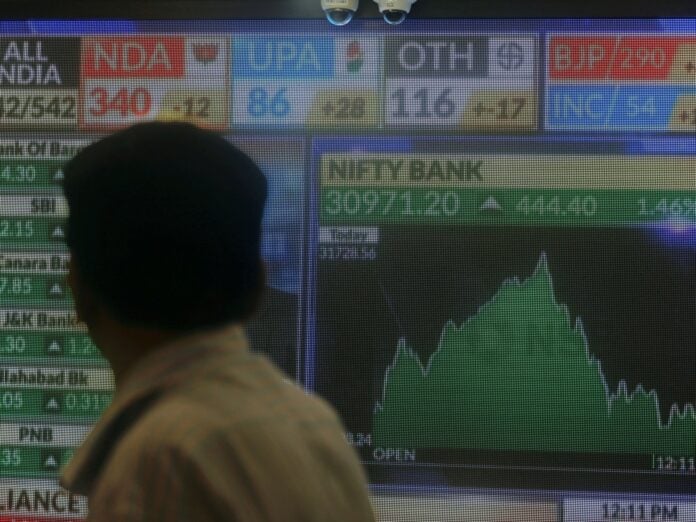

MUMBAI — The margin separating HDFC Bank Ltd. from ICICI Bank Ltd. in India’s benchmark financial index has collapsed to its narrowest point in sixteen years, a threshold crossed quietly on Thursday as both lenders posted modest gains and the Nifty Financial Services index closed fractionally higher in a session that revealed more about the year’s fault lines than its intraday movement suggested.
HDFC Bank holds a 9.81% weighting in the Nifty Financial Services index. ICICI Bank sits at 9.34%. The 47-basis-point gap between them is the smallest lead India’s largest private lender has held over its closest rival since 2010, according to NSE data. As recently as a year ago, that margin was measured in full percentage points.
The arithmetic behind the compression is unambiguous. HDFC Bank has lost 29.12% of its market value since January 1. ICICI Bank has gained 6.02% over the same period. On Thursday, HDFC Bank closed up 0.83% at Rs 706.65 on the NSE, a modestly positive session that did nothing to close the year-to-date deficit or slow the structural reset in index composition.
ICICI Bank gained 0.92% on the day, its sixth consecutive session in which it matched or outpaced HDFC Bank on a daily return basis. That streak has become the data point brokerages are circling: momentum readings for ICICI Bank now register as structurally supported rather than tactically driven, underwritten by net interest margin expansion reported for the June quarter that HDFC Bank’s integration-heavy earnings narrative has yet to match.
Whether the two stocks ultimately converge in index weight depends on variables still unresolved. The most immediate is HDFC Bank’s leadership gap. Senior departures since early 2026 have left several key management roles unfilled, and the lender has offered no timeline for replacements. That silence has cost the stock a governance premium that institutional investors had previously accorded freely. The bank’s weighting in the Nifty Financial Services index has been under sustained pressure since August as the post-merger integration with HDFC Ltd. continues to disappoint on earnings timing.
Every basis point that ICICI Bank closes on HDFC Bank triggers a mechanical reallocation in the roughly four billion dollars of assets benchmarked to the Nifty Financial Services index. At 47 basis points, those flows remain incremental. Should the gap reach zero, a scenario analysts once dismissed and now merely debate, the market-structure impact on both stocks would be significant.
State Bank of India provided the session’s clearest upside, rising 1.5% to Rs 1,036 and outpacing the broader financial-services complex. The gain attracted investors positioned for a steady Reserve Bank of India rate posture at the September monetary policy committee meeting, expected later in the month. Banks with large fixed-rate loan portfolios benefit when borrowing costs hold, a structural preference that continues to favour public-sector lenders in the current rate environment.
Bajaj Finance Ltd. edged higher near Rs 1,023.85, ahead of August retail credit growth data due Friday. Analysts expect the figure to confirm continued expansion in small-ticket consumer lending, the trend that has insulated Bajaj Finance from the broader sectoral uncertainty weighing on larger banks.
The Nifty Financial Services index ended Thursday with a narrow gain, its third positive session in four trading days. The session’s rotation, with early outperformance by private banks giving way to public-sector lender gains into the afternoon close, reflected domestic institutional investors rebalancing ahead of Friday’s credit data. The broader market, as tracked on the Sensex and Nifty 50, ended marginally lower on Thursday, with IT and pharma names dragging the headline indices while financials held up relatively well.
The infrastructure-linked financials that overlap with the Nifty Infrastructure index‘s Thursday session provided additional texture: capital allocation toward government-linked projects has lifted non-bank lenders with infrastructure exposure, a subset of the financial services complex increasingly differentiated from the pure-play banking story.
Beyond Thursday’s session, the weighting story carries consequences for capital far removed from Dalal Street. HDFC Bank commands proportional representation in international exchange-traded funds tracking Indian equities. A sustained decline in its relative weighting, driven by underperformance rather than any absolute deterioration in the bank’s business, constitutes a slow recomposition of what foreign passive investors own when they buy India. That process is already underway.
The next inflection point arrives with HDFC Bank’s second-quarter earnings, expected in October. Whether the lender can offer a concrete integration timeline, and confirm that its leadership rebuilding is farther along than the market currently believes, will determine whether 47 basis points is a floor or a waypoint on a longer journey. Thursday’s 0.83% gain settled nothing.