
MILAN — Twenty-six days before the meeting that will define European basketball’s structure for the next decade, EuroLeague CEO Chus Bueno delivered a message no boardroom can misread.
“If we don’t get a deal in Europe, we’re going to compete in Europe.”
The statement, made this week, frames exactly where one of global sports’ most consequential negotiations now stands. Thirteen EuroLeague shareholder clubs will gather October 5 at Villa d’Este in Cernobbio, on the shore of Lake Como, to vote on one of two futures. One involves the NBA. The other does not.
The offer on the table is structurally simple, even if its implications are not. The NBA, which has been building a European league in partnership with FIBA since January 2026, has made a formal proposal to buy a stake in the EuroLeague. That investment would let NBA Europe be built around European basketball’s existing infrastructure rather than alongside it, sharing media rights, venues, and the decades of equity the EuroLeague’s clubs have accumulated across Madrid, Athens, Istanbul, and Belgrade. If the 13 shareholders vote yes, the new league launches in October 2027 as a collaborative venture. If they vote no, the NBA builds it anyway.
Bueno is not blinking. The EuroLeague already holds 12 binding franchise proposals from ownership groups, representing a combined fee value of slightly more than €800 million. Cities including Paris, London, Naples, and Milan have engaged in advanced discussions about an enlarged competition that would grow from 20 to 24 teams starting in 2027-28, with eight new permanent franchises expected to be formally introduced at the October 5 summit itself. “We’re talking Paris, London, Milan, Naples, big cities that we want to explore how we can have franchises there,” Bueno said.
The parallel is not coincidental. NBA Europe’s 12 target cities include London, Paris, Berlin, Madrid, Barcelona, Istanbul, Milan, Rome, Munich, Manchester, Athens, and Lyon, a list that overlaps substantially with the EuroLeague’s own expansion ambitions. Both leagues want the same real estate. Both are pitching to the same investors. Both are targeting October 2027 as the year European basketball reorganizes around a new axis.
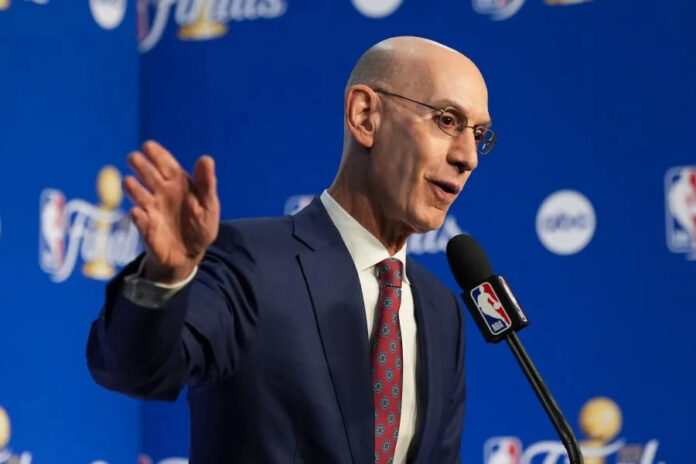
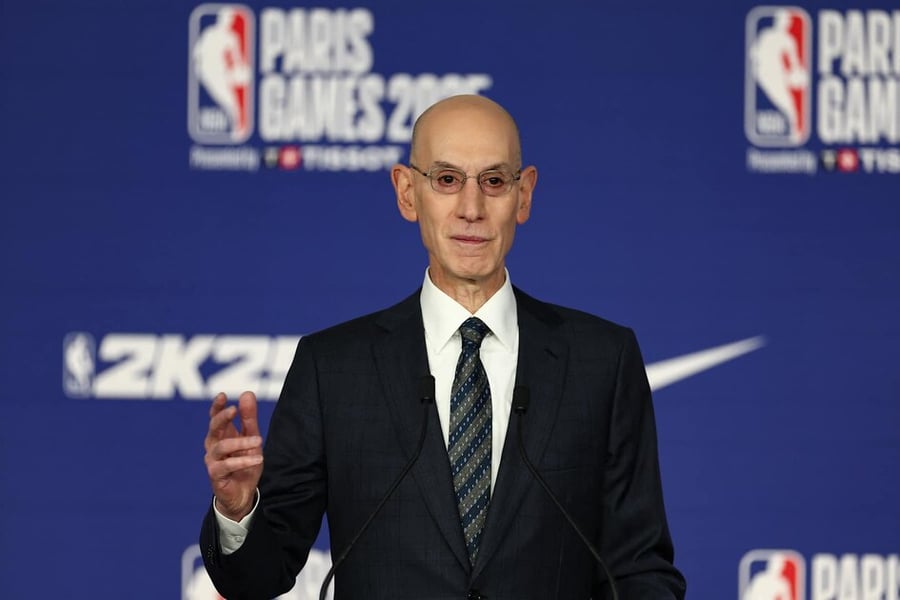
For Adam Silver, partnership remains the stated preference. “I think for the betterment of European basketball, the best outcome would be if we came together with the EuroLeague here and that we came up with a systematic approach to growing the game throughout Europe,” the commissioner said. Silver has also said he wants to “respect traditions” of European basketball in whatever structure follows. What that deference means in contractual terms, specifically who controls the new league’s governance, its broadcast deals, and its franchise fee distribution, has not been made public. The EuroLeague is not substituting Silver’s rhetorical warmth for written commitments.
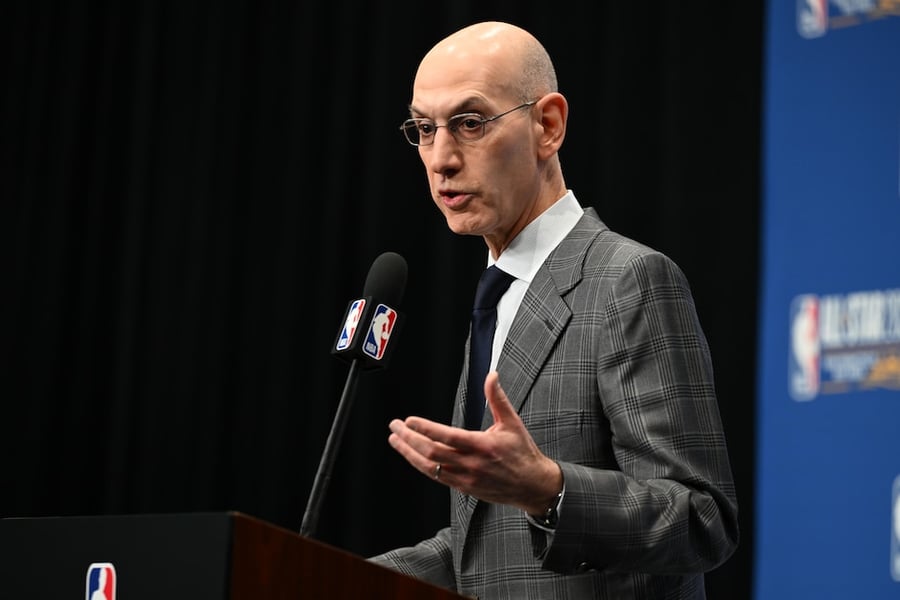
The commissioner who is extending a partnership invitation in Europe is also the one who, earlier this month, stripped the Los Angeles Clippers of five consecutive first-round draft picks and fined owner Steve Ballmer $30 million for salary cap circumvention involving Kawhi Leonard, calling it the most severe punishment in the league’s modern history. EuroLeague ownership is not likely to have missed the demonstration of what NBA institutional authority looks like when it is not offering partnership.
According to the NBA and FIBA confirmed progress on the venture in recent weeks. Final bids for franchise slots were due June 30, and the league reportedly received proposals in the $500 million to $1 billion range across multiple target cities, with at least two ownership groups committing more than $1 billion. Analysts have projected total franchise fee revenue near $7 billion, a figure neither the NBA nor FIBA has publicly confirmed. NBA Europe, as currently proposed, features 16 teams: 12 permanent franchises and four annual qualifiers.
Bueno sketched the worst-case scenario in terms that surprised by their specificity. “Even in the worst case scenario, five teams go to NBA Europe,” he said. “The EuroLeague will still have 15 teams.” A CEO talking about defections in hypothetical terms is different from outright refusal, and it suggests the internal calculus inside EuroLeague membership is more complicated than the public statements indicate.
He was also direct about what a failed negotiation costs both parties. “If you have two leagues, this is going to create fragmentation of the value, institutionally but also commercially, in media rights, fan attendance.” Yahoo Sports reported that October 5 will force EuroLeague owners to formally choose between the NBA’s offer and the internal transformation plan the competition has been building as its alternative. American sports history offers a usable reference point: every attempt to sustain two competing top-level leagues in the same sport, from the ABA against the NBA to the AFL against the NFL to the WHA against the NHL, ended in a merger, a collapse, or both. European basketball has no settled precedent for what comes next.
The NBA’s leverage is its global brand. No sports organization matches the league’s marketing reach, international broadcast infrastructure, or player pipeline, which explains why franchise bids reached $1 billion before a single game has been scheduled. The EuroLeague’s leverage is its institutional infrastructure: club ownership governance, referee development, player development systems built across decades, and the fact that its member clubs are not going to walk away from a competition they control to join one where Silver sets the terms.
What neither side can resolve before October 5 is where the players go. European-born athletes represent roughly a quarter of current NBA rosters. Moving between competing leagues would raise contractual and FIBA eligibility questions that neither organization has answered publicly. National team calendars, already a friction point between the NBA and FIBA’s schedule, would become structurally unmanageable if Europe’s best players are split between parallel competitions in the same cities. That is the question no press conference has addressed, and the one that will matter most to fans in Athens, Istanbul, and Madrid who would actually buy tickets for either league.
As the NBA’s own franchises open training camps this month, including Cleveland’s first overseas camp in Malaga, Spain, the league is visibly extending its presence into European venues ahead of any formal agreement. October 5 at Villa d’Este will not resolve the uncertainty that move creates. It will only determine who owns the problem next.