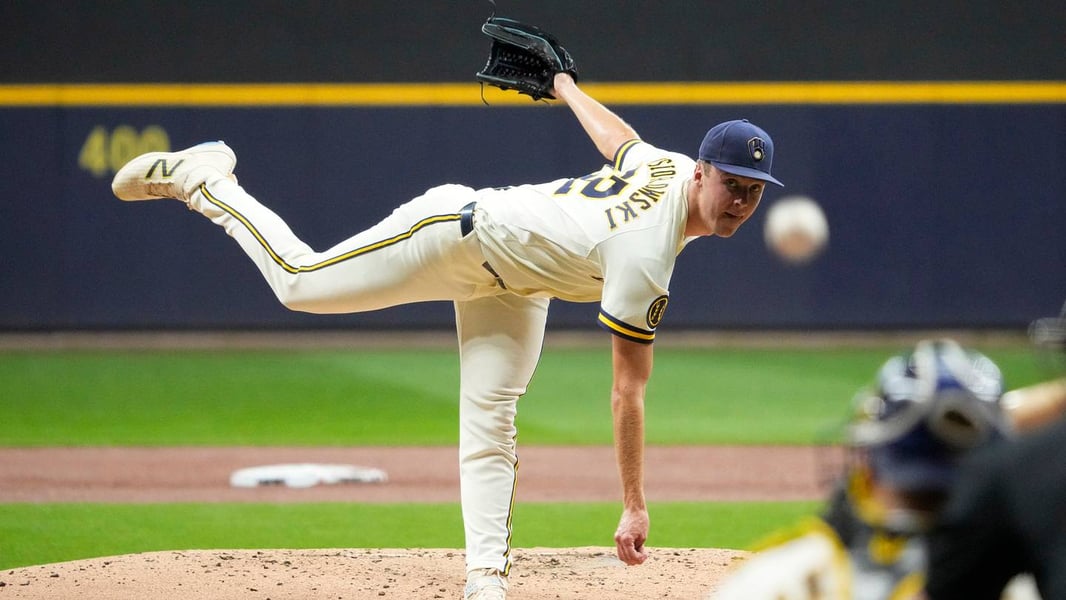

MILWAUKEE — Freddie Freeman has been around long enough to say what no one else will admit about Jacob Misiorowski. “I don’t like facing it,” the Dodgers first baseman told reporters this summer. “I’m glad I’m almost done.”
That sentiment, stripped of everything else: one of the best hitters of his generation is relieved to be nearing retirement so he will not have to face this pitcher in October.
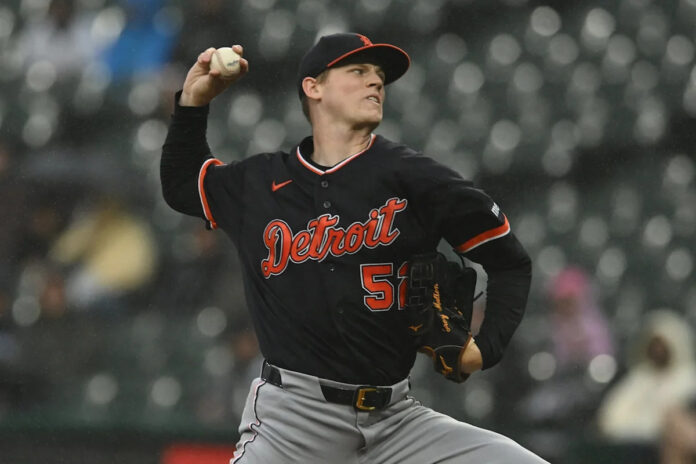
On Monday night at American Family Field, the 24-year-old Brewers right-hander needed exactly six pitches to cross a threshold that had never been crossed. His 1,001st triple-digit fastball of the 2026 season, a 102.3 mph sinker, pushed him past a record that had stood since pitch-tracking began in 2008. The previous holder was Jordan Hicks, who threw 659 triple-digit pitches in 2018 as a relief pitcher, appearing every few days in three-inning bursts. Misiorowski did 1,010 of them in a single season as a starter.
That difference is not a footnote. Relief pitchers are built to produce velocity in short, concentrated doses. Starters are managed, rested, paced. The fact that Misiorowski is working on a starter’s 100-pitch limit and still producing triple-digit velocity at a rate that makes Hicks’s mark look like a warm-up says something about human anatomy that researchers are still working to explain.
Misiorowski is 6 feet 7 inches tall and throws with an extension that brings the ball nearly two feet closer to the plate than his release point suggests. When the radar gun reads 100 mph, what hitters see inside the box arrives faster. The pitch plays as if thrown at 103 mph, because from that angle and distance, it effectively is. Baseball has had large pitchers, hard throwers, and a few who combined both. None of them have done this at starter volume.
The numbers confirm what hitters already sense. His 1.97 ERA leads all MLB starters by more than a run. His 227 strikeouts lead all MLB pitchers. His WHIP of 0.79 sits in territory where comparisons start running out. His opponents are hitting .151 against him, the lowest mark for a qualified starter since Pedro Martinez posted .167 in 2000. That season, Martinez won the Cy Young unanimously and finished second in MVP voting. The conventional wisdom was that 2000 would not be matched.
In July, Misiorowski struck out the first seven Colorado Rockies he faced, finished with 12 strikeouts over the first 14 batters, and threw 33 fastballs at 103 miles per hour or faster, more than twice the previous single-game record for pitches at that velocity in the pitch-tracking era. The MLB All-Star Game that same month was supposed to showcase what this era’s pitching can produce. Misiorowski had already made those arguments in Denver.
The Milwaukee Brewers are 89-56, the best record in baseball, with a magic number of 10 to clinch the NL Central. According to Sports Illustrated, Misiorowski enters September holding -700 NL Cy Young odds, with Chris Sale the closest challenger at +500. That lead has been stable since June. The question around the Brewers’ October prospects is not whether their ace is good enough for the postseason. The question is what one rough start in early September actually revealed.
That question grew from September 2.
At Wrigley Field, against the same Chicago Cubs fighting for an NL wild card spot, Misiorowski allowed five runs in four innings, the worst start of his season. He walked four batters on a hot, humid night when command abandoned him. His ERA climbed from 1.88 to 1.97 in one outing. The Cubs had found something. The question nobody was asking in the game recap was whether the postseason scouting room had been handed a template.
Six days later, he answered. The September 8 start against Chicago, as noted by MLB, produced 6.1 innings, nine strikeouts, and one earned run. His 1,010th triple-digit fastball crossed the threshold in the second inning without ceremony, because the Brewers were playing baseball and the history was happening around it. Both the AL wild card race and the National League pennant picture have consumed most of September’s attention, with four teams still chasing the American League’s last playoff berth. But the best record in baseball belongs to Milwaukee, and the reason for it is a 24-year-old spending his first full season making experienced hitters say things they would normally never say out loud.
What October does to that is the question this regular season cannot answer. Whether a playoff environment changes a pitcher who just threw 1,010 pitches faster than 100 miles per hour is something that requires October to actually happen.
Freeman, if pressed, probably already has an opinion. He is just not saying it out loud.