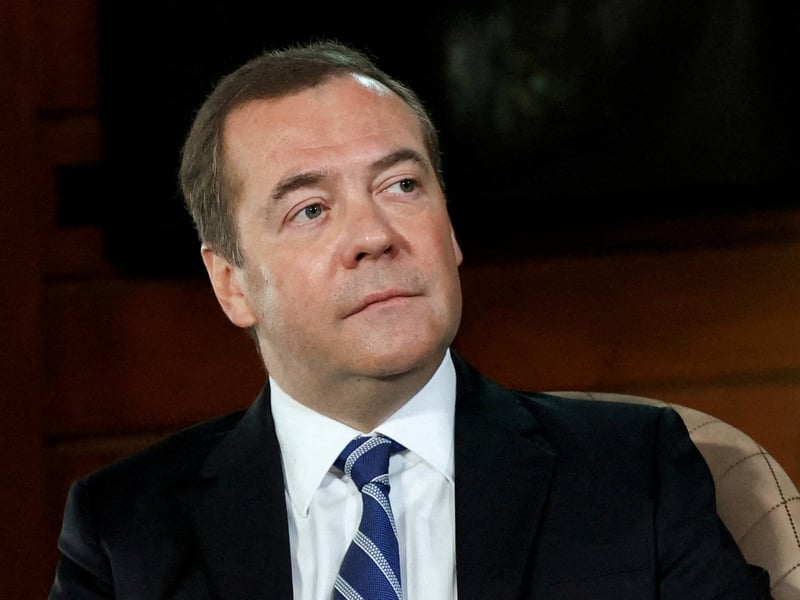

MOSCOW — The statement Dmitry Medvedev delivered to the Vedomosti business daily this week was not intended as an escalation. That, he said, was precisely the misreading he wanted to correct.
“Nuclear weapons can be used in certain cases,” Russia’s Security Council Deputy Chairman said in the interview. “This is not a scare tactic. It is reality. Russia’s nuclear doctrine, under which our country has the right to use such weapons in the event of a threat to the state’s security, can hardly be described as a ‘hint.'”
The remark, spare and declarative, landed differently from the nuclear warnings that have periodically emerged from Moscow over the past four years. Medvedev was not announcing a new threshold or identifying a new trigger. Instead, he was addressing what the Russian establishment views as a persistent misinterpretation in Western capitals: the tendency to treat Moscow’s nuclear doctrine as political theater rather than as an expression of its stated security policy.
Russia has defined the conditions for potential nuclear use with increasing precision since 2024. A revision to the Kremlin’s foundational nuclear deterrence document, finalized in November of that year, expanded the scenarios under which Moscow could consider such use. Critically, it stated that a conventional attack by a non-nuclear state acting in coordination with a nuclear-armed power could be treated as a joint nuclear assault against Russia. That formulation was directed at the architecture of Western military assistance to Ukraine, which relies on NATO-integrated systems, NATO-trained operators, and, in some cases, nuclear-capable delivery platforms from alliance members.
Medvedev’s interview arrives at a moment when Western governments are recalibrating how much risk their support for Kyiv should carry. Capitals in Washington, London, and Brussels have drawn distinctions between weapon systems that can and cannot be provided, calibrated in part around assumptions about where Russian red lines actually sit. The problem, as Moscow frames it, is that those assumptions have consistently underweighted the doctrine Russia has publicly maintained for years.
In May, Russia announced a sudden exercise of its strategic nuclear forces, a rehearsal for launching nuclear weapons in response to a hypothetical external attack, including a conventional one. The announcement came without the advance notice that had previously been standard practice, and it was interpreted by European defense ministries as a demonstration of operational readiness rather than a negotiating signal. Russia’s nuclear weapons stationed in Belarus have been formally designated as a deterrent against NATO and Ukrainian military action, adding another layer to the posture Moscow has assembled.
That insistence has a strategic audience. Western commentators and officials have, at various points over the past three years, characterized Russian nuclear signals as bluster or as manipulative theater. Western Europe has meanwhile moved to consolidate its own nuclear deterrence architecture, with Germany joining France in joint exercises for the first time this autumn. Medvedev’s Vedomosti remarks push back against that entire frame: the doctrine is not a hint, it is a framework.
Russia fields approximately 2,600 deployed and non-deployed strategic nuclear warheads, according to testimony delivered to the United States Congress by Admiral Richard Correll, head of U.S. Strategic Command, in March. The arsenal has been modernized throughout the Russian operation in Ukraine, with new delivery systems commissioned and older platforms upgraded. Moscow has consistently described these programs as defensive responses to NATO’s expansion toward Russian borders and to the collapse of the arms control architecture that once provided mutual constraint.
What Medvedev’s statement does not resolve is the question of decision-making. The doctrine establishes a framework; it does not describe a chain of command or a verification mechanism. In Russian constitutional practice, nuclear use decisions ultimately rest with the president. The Security Council, within which Medvedev holds his position as deputy chairman, provides advisory architecture around those decisions, not final authority.
That gap between doctrine and operational authority is where the genuine uncertainty lives. Moscow has chosen, in the Vedomosti interview, to address the doctrine’s legitimacy rather than its mechanics. Whether that choice was designed to reassure or to warn, or to do both simultaneously for different audiences, is a question Western governments are now absorbing.
What is clear is that Moscow regards its nuclear doctrine not as a contingency locked away for extreme circumstances, but as an active component of its security architecture, invoked to shape the behavior of adversaries who are daily making decisions about weapons, training, and logistical support that Russia watches closely. Medvedev’s Vedomosti interview was, in that sense, a policy statement as much as a warning: what exists in the doctrine, he was saying, exists in reality.