
MOSCOW – The Russian Foreign Ministry did not mince its words on Saturday. Tactical nuclear weapons stationed in Belarus, it said, do not merely sit in storage at the Asipovichi military range. They are, in Moscow’s own framing, the active counterweight to NATO forces massing on the alliance’s eastern flank and to what the ministry called “neo-Nazi Ukraine.” The statement arrived hours before Foreign Minister Sergey Lavrov was scheduled to fly to Minsk for a working visit on June 14 and 15 – and it raised an unsettling question that Western governments have not yet publicly answered: at what point does declaratory deterrence become something harder to walk back?
“The Joint Regional Group of Forces, advanced Russian defensive systems and tactical nuclear weapons deployed on the territory of Belarus reliably shield the western frontiers of the Union State and the CSTO, ensuring a counterbalance to neo-Nazi Ukraine and NATO forces stationed in neighboring countries,” the ministry said in a statement distributed ahead of Lavrov’s visit, during which he is expected to meet Belarusian President Alexander Lukashenko.
The statement is not the first time Moscow has invoked its nuclear deployment in Belarus. But its timing and diplomatic register are notable. Issued not by the Defense Ministry but by the Foreign Ministry – the branch of Russian government that manages state-to-state relations and communicates intent to adversaries – the declaration formally embeds the nuclear posture into the bilateral diplomatic framework of the Russia-Belarus Union State, a construct that acquired new legal teeth in late 2024 and early 2025.
In November 2024, President Vladimir Putin signed a revised version of Russia’s nuclear deterrence doctrine, formally titled the “Fundamentals of State Policy of the Russian Federation in the Field of Nuclear Deterrence.” The revision lowered the threshold for nuclear use in a specific and significant way: where the 2020 doctrine allowed for a nuclear response to conventional attacks only when “the very existence of the state is threatened,” the 2024 version permits use when aggression creates a “critical threat” to the sovereignty or territorial integrity of Russia – or, for the first time by name, of Belarus as a Union State participant. That doctrinal change, analysts at the Arms Control Association noted, marked a formal expansion of the nuclear umbrella rather than a mere rhetorical flourish.
Then, in December 2024, Moscow and Minsk approved a Security Concept for the Union State. One month later, in March 2025, a mutual security guarantees agreement entered force – committing both countries to defend each other using “all available forces and means, including nuclear weapons.” Saturday’s Foreign Ministry statement cited that agreement directly, completing a chain that runs from military deployment to legal commitment to public declaration.
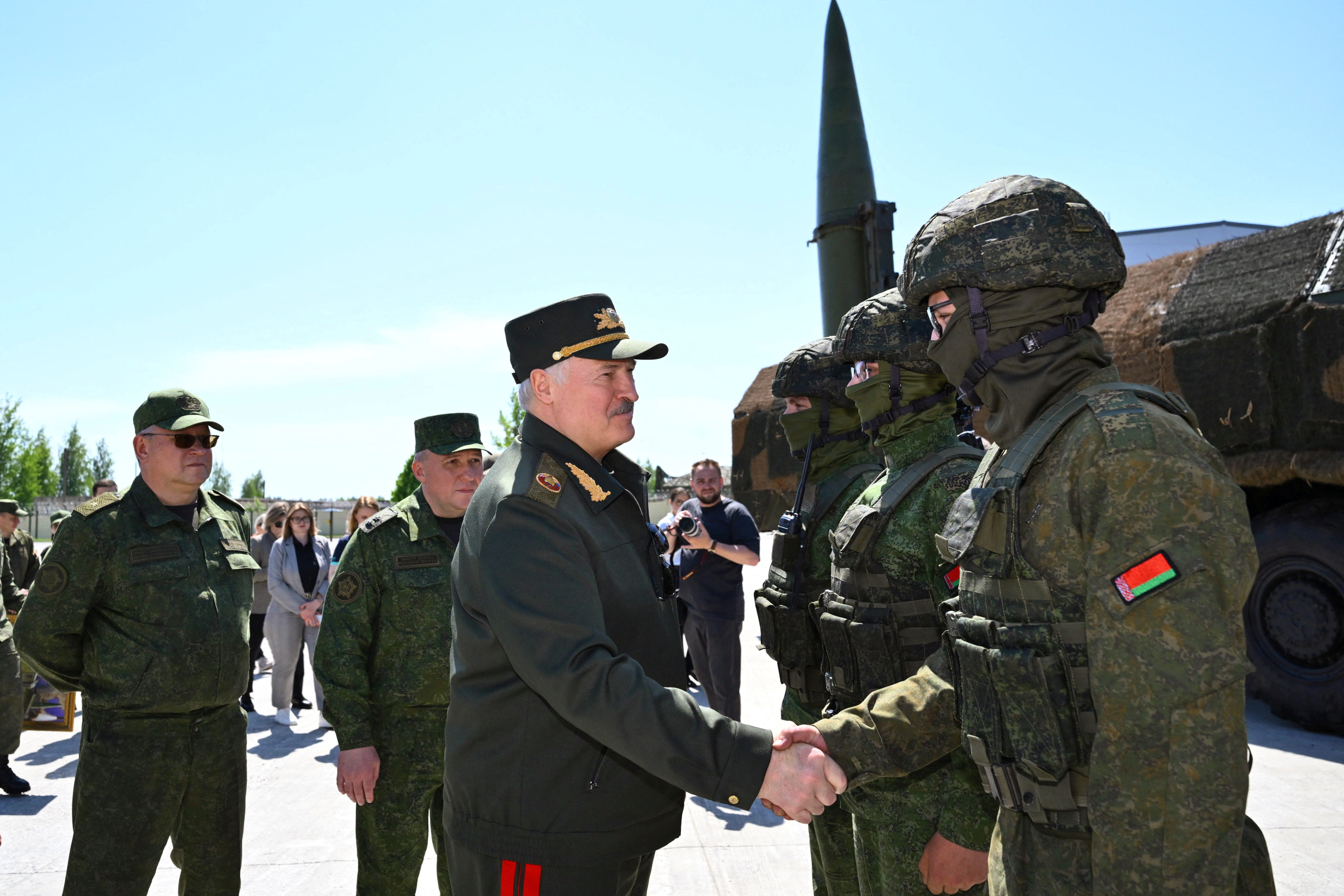
The practical military dimension had been in view since the spring. In May 2026, Belarusian and Russian forces conducted joint nuclear exercises in which Lukashenko himself participated for the first time, presiding alongside Putin over drills spanning Eastern Europe to the Pacific. During those exercises, Moscow supplied Minsk with modified Su-25 fighter jets and Iskander-M ballistic missiles – a system with a range of up to 500 kilometers – as well as nuclear munitions delivered to field storage points in a Belarusian missile brigade’s position area, according to the Russian Defense Ministry.
The U.S. Defense Intelligence Agency assessed in 2025 that Russia was “expanding its nuclear posture to Belarus by establishing missile and nuclear-capable aircraft capabilities, renovating a nuclear weapons storage site, and training Belarusian crews to handle tactical nuclear weapons.” The DIA also concluded, in the same report, that “Russia almost certainly seeks to avoid direct conflict with NATO because it assesses it cannot win a conventional military confrontation with the alliance.” That dual conclusion – growing nuclear posture, diminished conventional confidence – is precisely the logic Moscow appears to be leaning into: if conventional deterrence is unconvincing, nuclear signaling becomes the primary language of coercion.
What remains unresolved is whether the audience is listening the way Moscow intends. The CSTO alliance, which Lavrov chaired in Kazan just days ago, is itself in a quiet internal crisis – Armenia’s empty chair at that June 10 ministerial signaled fractures in the security architecture Moscow is simultaneously trying to project as a unified front. NATO, for its part, has increased its combined force strength in Lithuania, Latvia, Poland, and Estonia to approximately 22,000 troops since February 2022, nearly double the pre-war level, according to Russian Foreign Ministry figures cited in a concurrent statement. Whether those numbers represent a threat to deter or an escalation to match is a question the ministry’s language does not resolve – by design.
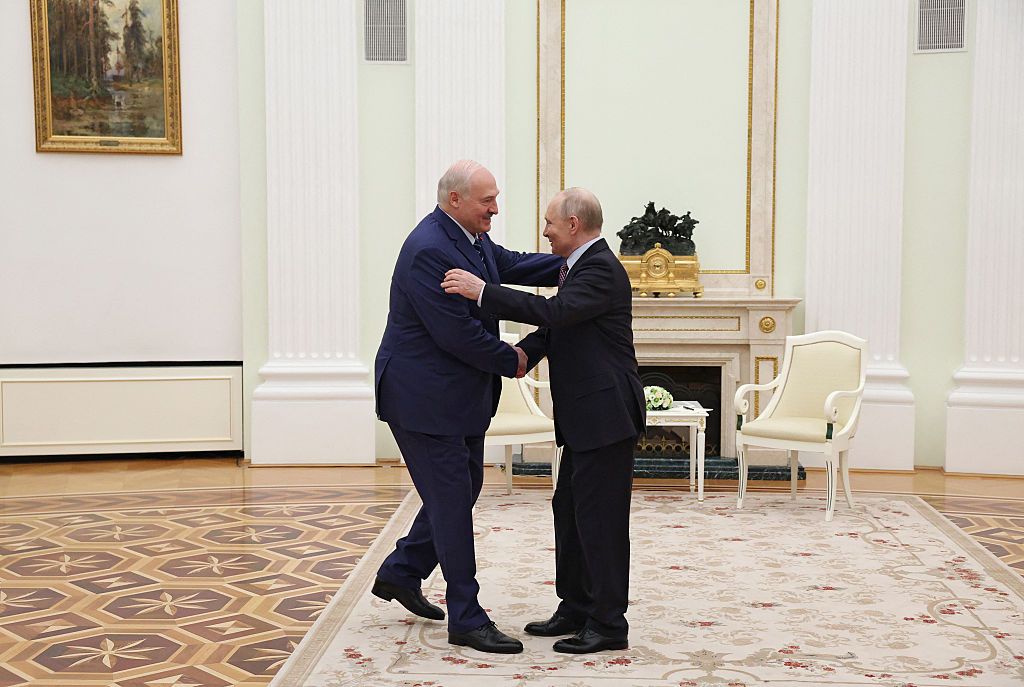
Putin said in October that Russia does not station its tactical nuclear weapons anywhere except Belarus, while the United States, he argued, does so across allied territories worldwide. That framing – Russian restraint against American proliferation – has been a consistent rhetorical posture since the deployment began in June 2023. It has not, however, prevented the deployment from drawing condemnation. Ukraine’s Foreign Ministry has described Belarus’s role as a nuclear staging ground as “de facto legitimising the proliferation of nuclear weapons worldwide” and called for unequivocal international condemnation, Al Jazeera reported.
What Saturday’s statement does not say is equally significant: it does not specify what precise threshold, in Moscow’s judgment, would constitute the “critical threat” to sovereignty that would trigger nuclear use under the 2024 doctrine. That ambiguity is not an oversight. It is structural. The deterrence value of the deployment depends on the adversary not knowing exactly where the line is – and, with Russia’s nuclear drills intensifying through the spring, on the adversary believing that line exists at all.
Lavrov’s Minsk agenda has not been made public beyond the broad contours of Union State security cooperation. But the Foreign Ministry’s decision to publish this statement the day before his arrival suggests the visit is, at least in part, a signal – to Kyiv, to Brussels, and to Washington – that the nuclear architecture in Belarus is not a contingency plan. It is the plan.
The New START Treaty, which limited U.S. and Russian strategic nuclear forces, expired in February 2026. Russian officials have said they will continue to abide by its central limits as long as Washington does the same. That voluntary commitment is now the only formal arms control framework between the two largest nuclear powers – and it has no enforcement mechanism. What fills the gap, in Belarus at least, is a Joint Regional Group of Forces, a recently signed bilateral security treaty, and a Foreign Ministry statement that, for the first time, uses the language of deterrence and counterbalance not as a warning but as a statement of present fact.