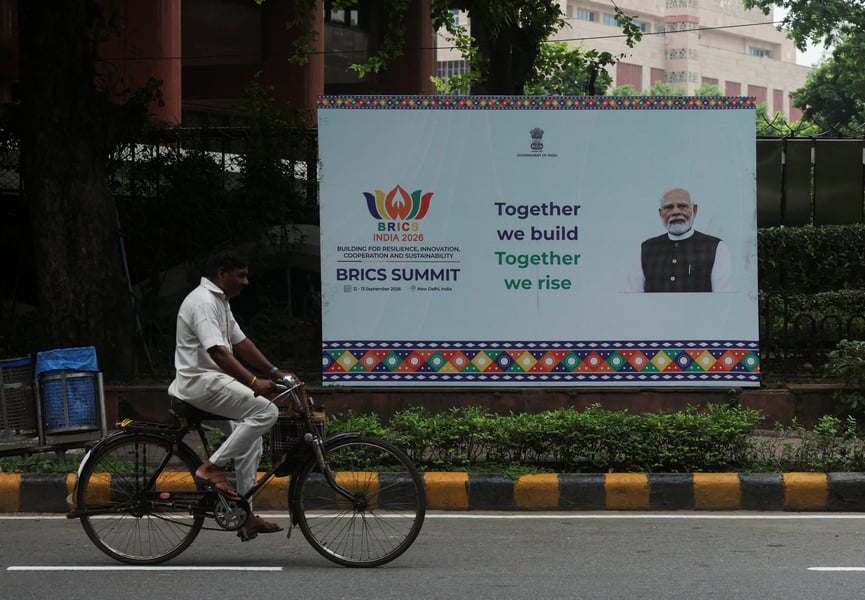

NEW DELHI — When Masoud Pezeshkian took the stage at the BRICS Business Forum on Friday, he was flanked, both symbolically and literally, by two of Iran’s most consequential partners. Russian President Vladimir Putin sat nearby, while Indian Prime Minister Narendra Modi, whose country has quietly absorbed Iranian oil and Russian crude in roughly equal volumes, presided as host. Iran’s message was deliberate and unambiguous: Western sanctions have not worked.
“Economic security cannot be separated from national security and regional security,” Pezeshkian told the assembled leaders, describing what he framed as U.S. “military aggression” against his country. The remark landed at the 18th BRICS Leaders’ Summit, a gathering that has brought together heads of state from Brazil, Russia, India, China and South Africa along with Egypt, Ethiopia, Iran, the United Arab Emirates, and Indonesia – nations that together account for nearly half the world’s population and close to 40 percent of global economic output, Al Jazeera reported.
The optics of the summit reflected its political weight. For Putin, arriving in New Delhi despite an active International Criminal Court arrest warrant, the gathering provided precisely what Moscow has sought for two years: a forum that demonstrates Russia is not diplomatically isolated, regardless of what Western capitals insist. For Iran, BRICS represents something more concrete – access to trade frameworks and a multilateral banking institution that Washington cannot easily sanction into irrelevance.
But beneath the declarations of solidarity, a fault line runs through the bloc. It runs directly through the Strait of Hormuz.
Iran has made no secret of its willingness to close the strait as leverage against continued Western pressure. The escalating tensions along the Hormuz corridor have been building for weeks. That calculation collides with the economic reality of several BRICS members, most acutely the United Arab Emirates – a nation whose entire trade architecture depends on unobstructed passage through the strait. The UAE cannot publicly endorse what Tehran is signaling. New Delhi, for its part, chose a softer formulation: in a bilateral meeting on the summit’s sidelines, Modi pressed the importance of seafarer safety and freedom of navigation. The diplomatic language was careful. The underlying message was not.
Sergei Ryabkov, Russia’s deputy foreign minister, told TASS that the summit communiqué’s final language on the strait remained “unpredictable,” an unusual admission, and a sign of how genuinely difficult it has been to paper over the Hormuz disagreement. Russia needs Iran to stay within the bloc; Russia also needs the UAE and India, whose trade relationships are essential to Moscow’s own sanctions management strategies, to remain comfortable. Those two things may not be simultaneously achievable.
Pezeshkian returned to the podium for a second speech that made no effort to soften its edges. “Who said it should decide for the entire world,” he said, in remarks directed unmistakably at Washington’s role in the global financial architecture. The line drew sustained applause from a room representing governments that have each, in different ways, bristled under the American-led sanctions regime.
Tehran’s most practical ambition at this summit was not rhetorical but institutional. Iran wants access to the New Development Bank, the BRICS multilateral lender established in 2014 as an explicit alternative to the World Bank and the International Monetary Fund. U.S. sanctions currently block Iran from NDB financing. If the bloc cannot change that, it limits the concrete meaning of Iranian membership. Pezeshkian’s delegation has been pressing that case in bilateral meetings throughout the summit, NPR reported.
Pezeshkian also characterized British sanctions against Iranian nuclear entities as “economic terrorism,” language that reflects Tehran’s consistent framing of external financial pressure as an act of war rather than a policy instrument. The formulation has resonance in a room where Russia, China, and several African member states have their own reasons to be skeptical of Western economic coercion.
Modi’s posture throughout the summit has balanced competing imperatives. India has deepened its economic ties with Russia substantially, with bilateral trade on a trajectory toward a $100 billion annual target. Yet Modi also called, publicly and directly, for an end to the Russian operation in Ukraine – the clearest signal that New Delhi refuses to allow the partnership to be read as unconditional endorsement. India buys the oil. It does not want the bill for the war.
The summit’s final day on Saturday brings Xi Jinping to New Delhi, marking the Chinese president’s first visit to India in seven years. The meeting with Modi arrives at a moment of careful recalibration following the recent border diplomacy between New Delhi and Beijing. Patricia Kim of the Brookings Institution noted that Xi is likely to use the BRICS platform to consolidate a narrative of Global South solidarity before any potential engagement with Washington. “BRICS gives Xi a stage to present an alternative story before any Trump meeting,” Kim said. The calculation is visible in every speech Beijing’s delegation has previewed: a bloc that works, a development bank that lends, a world order that does not begin and end in Washington.
The New Delhi Declaration will set the summit’s formal conclusions, but what the gathering has confirmed is that the bloc’s internal contradictions are growing in proportion to its membership. The UAE and Iran cannot both be satisfied on the Hormuz question. Iran’s NDB ambitions remain aspirational as long as sanctions hold. And Modi’s simultaneous courtship of Russian energy revenues and public distance from Russian military conduct captures the essential paradox of a summit built on shared grievance more than shared interest.
Whether that foundation proves durable is the question that will outlast the New Delhi declaration by several years.