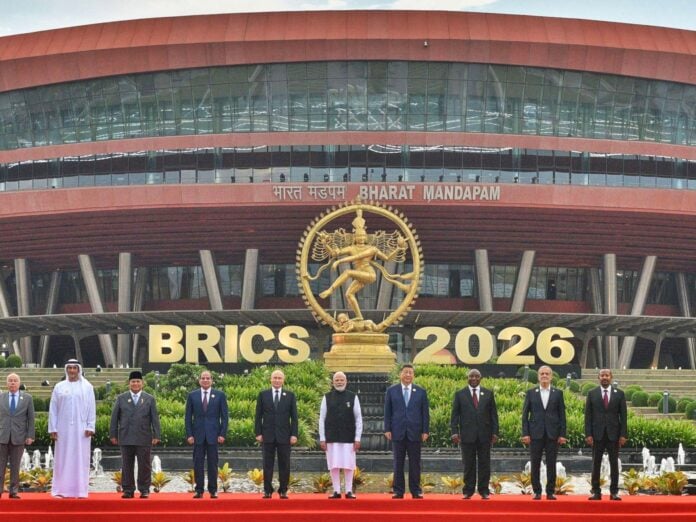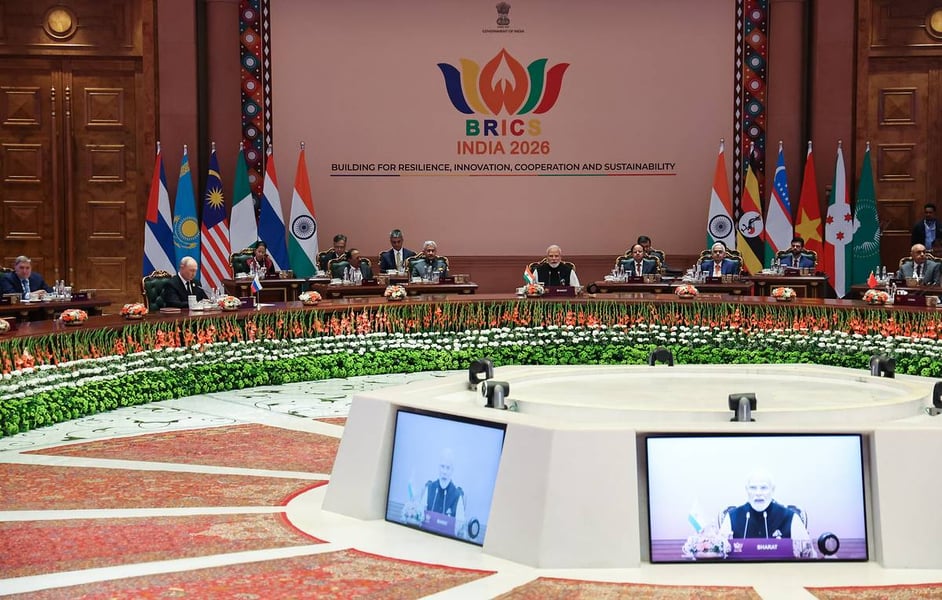

NEW DELHI — For nearly two decades, India’s foreign-policy establishment has argued that a Security Council designed in 1945 has no business governing a world in 2026. On Saturday, Narendra Modi finally obtained the declaration he wanted in writing, signed by every member of the BRICS bloc.
The New Delhi Declaration, adopted unanimously by the leaders of Brazil, Russia, India, China, South Africa, and a dozen partner nations at the close of the summit, runs to 140 paragraphs. It covers ground that would have seemed impossible as a multilateral consensus a decade ago.
The declaration:
- Calls for reform of the United Nations Security Council.
- Frames unilateral Western sanctions as violations of international law.
- Demands an immediate and permanent ceasefire in Gaza, along with full Palestinian membership in the United Nations.
- Insists that developing countries should help govern artificial intelligence rather than merely follow rules written by others.
“UNSC reforms can no longer wait,” Modi told the assembled leaders at the plenary session, according to TASS. He described the current global order as a “pyramid of privilege” and positioned BRICS as a potential “platform of partnership.”
Modi has spent much of his third term positioning India not as an opponent of the West but as the natural convener of a different kind of multilateralism, one that insists the rules were written without the Global South’s input and need rewriting. “The Global South is today in the front row when it comes to facing global crises, but in the back row when it comes to decision-making,” he said. The New Delhi Declaration is the most ambitious document to emerge from that argument.
Vladimir Putin arrived in New Delhi at the head of the Russian delegation and told executives at the BRICS Business Forum on Thursday that the gathering would give “fresh impetus to the development of trade and economic ties” among member states. Putin had also issued a sharp warning to European governments considering deploying troops to Ukraine earlier in the week, making clear the summit carried broader geopolitical stakes than trade alone.
The Modi-Putin bilateral on the sidelines was, by both governments’ readouts, the most substantive in years. The headline figure was a joint trade target of $100 billion by 2030, but the substance ran deeper: civil nuclear reactor co-production, defence manufacturing expansion inside India, and energy supply arrangements discussed with the specificity of a relationship that intends to outlast the conflict in Ukraine. Putin’s presence in New Delhi, given the ICC warrant outstanding against him, also carried a signal that India does not regard the International Criminal Court as a constraint on its sovereign foreign policy choices.
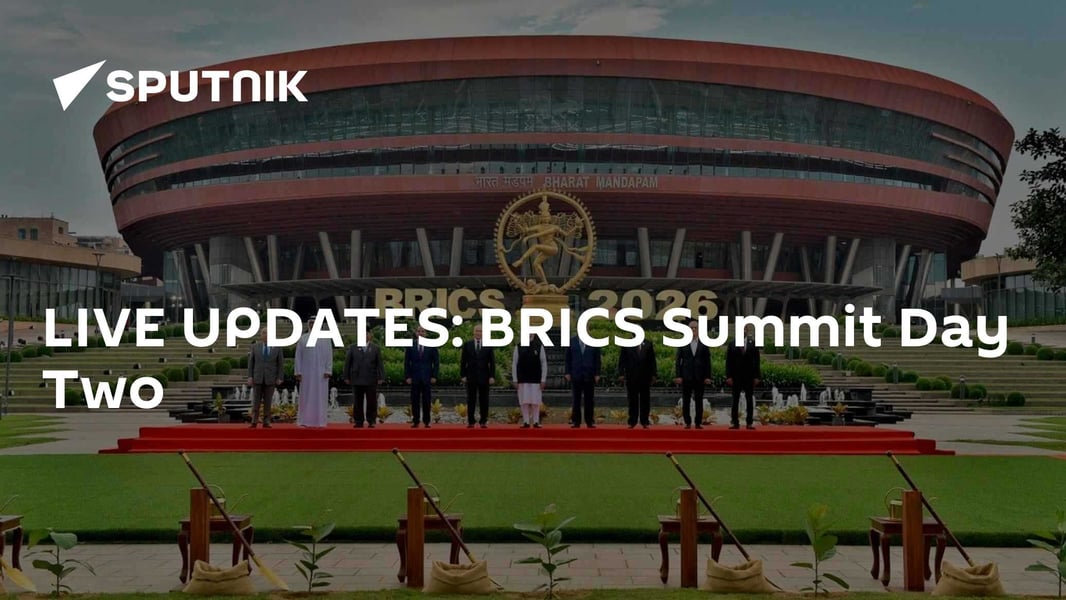
The Gaza section of the declaration drew the most attention from the Arab partner bloc. The document calls for an immediate and permanent ceasefire in Gaza, demands Israel’s full compliance with the ICJ’s provisional measures on genocide, backs full UN membership for Palestine with East Jerusalem as its capital, and names the continued blockade of humanitarian aid a violation of international humanitarian law. The language is specific in a way BRICS documents have not historically been, reflecting how much the bloc’s centre of gravity has shifted since the genocide in Gaza began.
On AI and emerging technologies, the declaration commits the bloc to ensuring Global South nations have meaningful participation in developing the norms, standards, and safety frameworks governing artificial intelligence, rather than simply being subject to rules drafted in Washington and Brussels. It calls for UN-based multilateral governance mechanisms, a direct challenge to the club-based approach that has defined Western AI policy since the Bletchley Declaration.
The document also explicitly backs India and Brazil for permanent seats on a reformed UN Security Council, the clearest multilateral endorsement either country has received in its decades-long campaign for permanent membership. The language stops short of naming a timeline but commits the bloc to actively supporting reform in the General Assembly.
What the declaration cannot guarantee is whether any of this becomes institutional reality. BRICS has no enforcement mechanism and no binding secretariat. Brazil’s Lula government has not fully committed to the anti-Western framing Russia and China bring. The 140 paragraphs are a statement of collective aspiration as much as a programme of action, and the gap between those two things has frustrated observers at previous summits. The summit’s Middle East and Iranian dimensions also underscored how many competing priorities the expanded bloc now carries within its membership.
Modi did not dwell on those tensions in his closing remarks. The declaration, he said, represented a turning point for a grouping that now accounts for more than 40 percent of the world’s population and a larger share of global GDP than the G7.
The next summit rotates to Brazil. Whether Lula’s government will carry the New Delhi Declaration’s most pointed language into that presidency, or whether the bloc’s internal divisions resurface under a different host, is the one question the document leaves deliberately open.