NEW DELHI — The morning after Dario Amodei published an essay urging the world to slow AI development, Xi Jinping stood before representatives of 18 nations in New Delhi and made the opposite offer.
China would not merely build artificial intelligence for itself, Xi said. It would build it for everyone—and give away the blueprints.
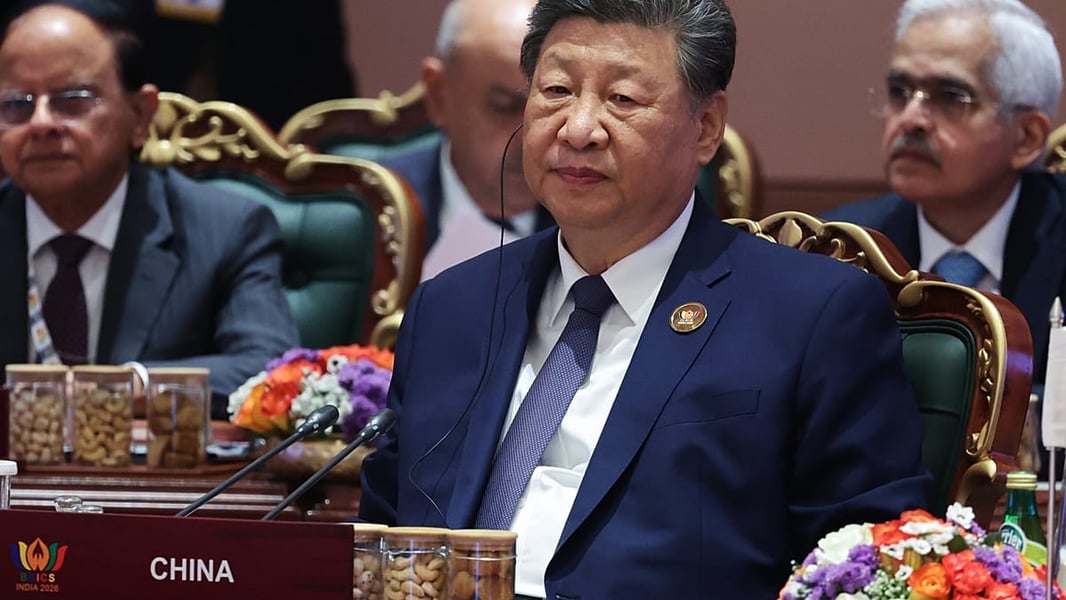
At the second session of the 18th BRICS Summit on Sunday, Xi announced that Beijing would lead the creation of a BRICS AI open-source community. The initiative would support cooperation in large-language-model development, organize specialized training seminars for partner nations, and establish what he called “an open ecosystem for AI.”
The announcement came before a group representing more than 40% of the world’s population. It was aimed squarely at governments across Africa, Asia, and Latin America that have watched the most powerful AI tools remain behind American subscription barriers and export restrictions.
CGTN reported Xi’s exact words at the session: “China will be a pioneer in establishing a BRICS AI open-source community, support cooperation in developing and applying large language models, hold specialised AI seminars and training courses, and build an open ecosystem for AI.”
The AI community pledge was one element of a five-point digital cooperation framework Xi proposed, covering trade and investment facilitation, digital industry, smart manufacturing, and talent development alongside AI. Of those five points, the open-source AI offer drew the sharpest focus from delegates and analysts tracking the summit. Not because open-source AI is new, but because of what China is offering to put inside it.
The timing was not incidental. Amodei’s essay, published Saturday, warned that AI development was outpacing safety guardrails and called on governments to pull back. Hours after Xi’s New Delhi speech, the Trump White House dismissed a group of AI safety executives who had sought a meeting as “negative forces,” a story that absorbed much of Western AI coverage while Xi’s address received comparatively muted treatment in American outlets. That divergence, between a US conversation consumed by safety brakes and a Chinese proposal about sharing acceleration, crystallised the two countries’ competing positions with unusual sharpness.
The gap is not only rhetorical. Beijing’s domestic AI build-out plan targets $532 billion in investment through 2030, framing US chip export restrictions as a reason to deepen domestic capacity rather than slow development. China’s State Council detailed the drive in a statement published Sunday. The BRICS announcement extends that logic outward: if export controls are meant to isolate Chinese AI from global markets, Beijing’s answer is to build an alternative distribution channel before the isolation can take hold.
Xi also announced that China would invite BRICS nations into the World AI Cooperation Organization, a 29-nation body Beijing established earlier this year that currently excludes the European Union. The invitation carries a quiet logic. Countries that join WAICO before a coherent Western alternative exists will have standing to shape whatever governance norms the organization develops. Standards written early, in any domain, tend to persist.
The AI community proposal sits inside a broader diplomatic frame that defined the summit. The BRICS New Delhi Declaration, adopted Saturday, called for reform of the UN Security Council, stronger representation of the Global South in international financial institutions, and a more equitable global economic order. Folding AI governance into that wider narrative about Western structural advantage gives Beijing a technology-specific edge to an argument it has been pressing for years.
What Xi’s five-point framework left unspecified was the governance structure of the proposed community. No details emerged Sunday about decision-making over which models enter the ecosystem, what technical standards would apply, or what relationship member states would have with Chinese developers. The question matters more than it might appear: an open-source ecosystem whose standards are set in Beijing is technically open while remaining politically shaped. Whether BRICS members with their own AI ambitions, India foremost among them given its push for domestic large language models, will accept Chinese stewardship over the governance layer was not addressed in Xi’s remarks.
Modi, hosting the summit, made no public statement on the AI community proposal specifically. India has been the most cautious BRICS member on extending the bloc’s mandate into technology governance, particularly on questions that overlap with its competitive posture toward China. Xi’s pledge, made in New Delhi in front of the host nation, functions as a form of public pressure that India will need to respond to in some fashion.
For now, China’s open-source offer is a bid for influence that requires neither military deployment nor financial coercion: the influence that accrues to the country whose infrastructure everyone else’s AI runs on. Whether BRICS members take the offer is their decision. What they will be asking when they return home is whether a credible alternative exists.