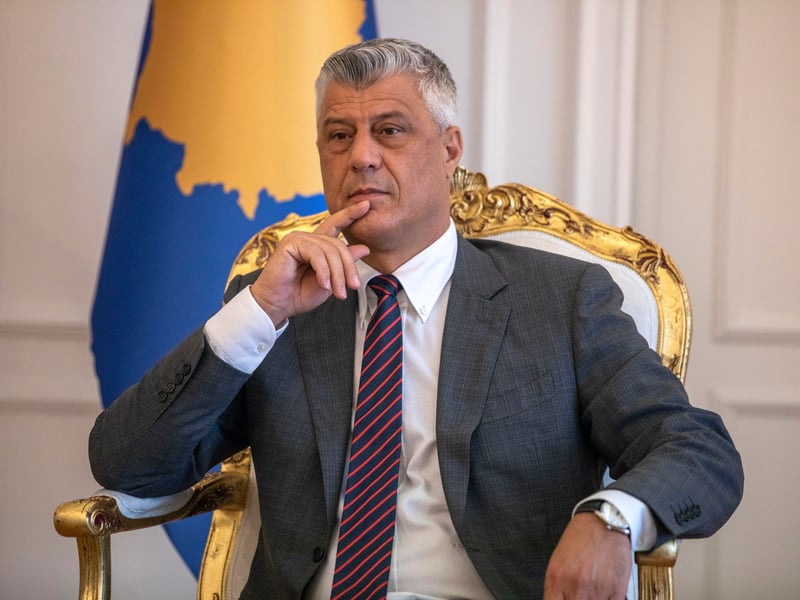

THE HAGUE — The man who signed Kosovo’s declaration of independence, who led the guerrilla campaign that brought it into existence, was sentenced Tuesday to 25 years in prison for murders and tortures his fighters carried out during that same liberation war.
The Kosovo Specialist Chambers, a European Union-funded court sitting in The Hague, found Hashim Thaçi, 58, guilty of war crimes and crimes against humanity committed between 1998 and 1999, when the Kosovo Liberation Army fought Serbian security forces in a conflict that ended with NATO airstrikes and, eventually, an independent Kosovo in 2008.
Presiding Judge Charles Smith, reading from a 1,400-page judgment that took more than four hours to deliver, said the KLA “was a serious military organization that also operated a shadow structure used to commit these crimes.” Three co-defendants received sentences alongside Thaçi: former assembly speaker Jakup Krasniqi, 25 years; former parliament speaker Kadri Veseli, 18 years; and former lawmaker Rexhep Selimi, 13 years.
The scale of what the court documented is significant. Across the KLA’s campaign, 385 civilians were arbitrarily detained, 49 were cruelly treated, 303 were tortured, and 96 were murdered, the judgment found. Victims were predominantly ethnic Serbs and Roma, along with Albanians suspected of cooperating with Serbian authorities. In one detention facility described at length in the ruling, prisoners were beaten with batons and wooden clubs, forced into stress positions, and denied food and water for days at a time.
Thaçi, who served as Kosovo’s prime minister for nearly a decade before becoming its president in 2016, resigned the presidency in November 2020 after his indictment was made public. He has maintained throughout the proceedings that he is being prosecuted for a liberation struggle his people regard as just, and Kosovo’s government and many of its institutions share that reading.
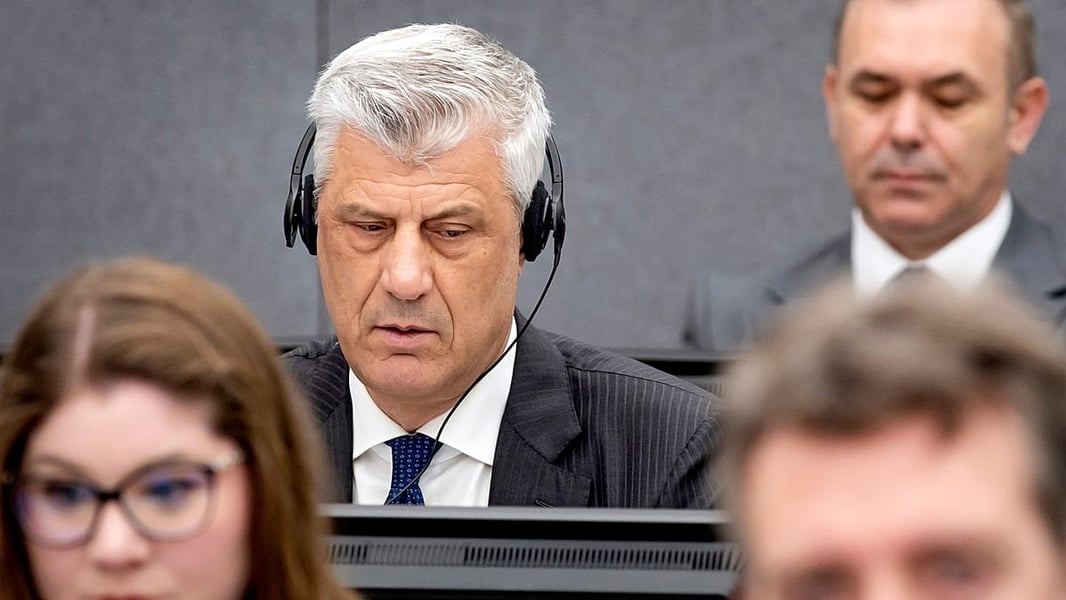
The court stopped well short of ruling Kosovo’s bid for independence illegitimate, or finding the KLA’s broader campaign criminal in itself. The Specialist Chambers was created specifically to prosecute individual criminal acts, not to adjudicate the political legitimacy of the war. That distinction has done little to ease the tension in Pristina, where the defendants are regarded by much of the population as national heroes and the court is seen as a vehicle for Serbian and Western pressure.
Belgrade’s reaction was the mirror image. Serbia’s Interior Minister Ivica Dacic called the verdict “historic.” President Aleksandar Vučić, who has consistently opposed international recognition of Kosovo’s independence, welcomed the outcome without elaborating on the conflict underlying it. For Serbia, the court’s findings validate a version of history Kosovo’s Albanians reject entirely.
The sentencing places Kosovo’s Western backers in the uncomfortable position they have occupied since the Specialist Chambers was first established in 2015. The United States, the EU, and NATO all supported Kosovo’s independence and the KLA’s campaign against Serbian forces. The 1999 airstrikes that halted Slobodan Milošević’s crackdown on Kosovo Albanians were a defining moment of the Clinton era. The same leaders now convicted of war crimes were, for a period, welcomed in Brussels and Washington.
Kosovo’s EU membership path, already complicated by the five EU member states that do not recognize its independence, now runs through a verdict its own government calls unjust. As NPR reported, both Thaçi and prosecutors, who had sought a 45-year sentence, retain the right to appeal. The Specialist Chambers’ appeals panel, composed of separate international judges, could extend proceedings by years.
The case drew comparisons with the International Criminal Court’s proceedings against former Philippine President Rodrigo Duterte, who appeared in The Hague for the first time this month ahead of his own trial, and with broader patterns of international justice reaching figures who once enjoyed Western diplomatic protection. The Security Council standoffs over accountability, including Russia and China’s repeated vetoes of accountability measures in other contexts, underscore how selectively international justice operates.
What the court cannot answer is the harder question the verdict forces into the open: whether a liberation movement’s justice can be separated from its crimes. The KLA liberated Kosovo’s Albanian population from a campaign of ethnic cleansing the international community recognized as genuine and grave. It also, the court has now found beyond reasonable doubt, ran detention facilities where civilians were murdered. Both are true, and the 1,400-page judgment does not resolve the contradiction. It simply states it, with evidence, and assigns a sentence. The protests in Pristina suggest the political settlement remains years away.