
ST. LOUIS — Someone in Section 141 at Busch Stadium had measles on the night the Cardinals faced the Chicago White Sox. The game started at 6:15 in the evening on September 12. The infected person stayed until 11:30. They were fully vaccinated.
The Missouri Department of Health and Senior Services announced on Monday that people who attended the game and were seated near Section 141 during that window may have been exposed. The warning arrived nine days after the exposure, enough time for symptoms to have already begun in anyone who was infected, and still well within the 21-day monitoring window the health department advises for anyone who may have been in contact with a measles case.
The Busch Stadium exposure is part of a larger St. Louis-area cluster tied to what public health officials have called a national measles crisis. On the same day, September 12, another person with measles spent time at two bars in St. Louis: the Cat’s Meow in the Soulard neighbourhood from 3:30 to 7:50 in the afternoon, and Paddy O’s downtown from 9:30 in the evening until closing. Over the following two days, potential exposures were reported at Little Ireland in Pacific from mid-morning on September 13, at B&H Market in Pacific that evening, and at Pacific Brew Haus, Goodcents, and Bud’s Market across Sunday and Monday. The thread traces back further: St. Louis County health officials said the person at the centre of the case had ridden an Amtrak train to Chicago on August 27, meaning the source of their exposure is on a line somewhere between St. Louis, the train, and Chicago. The source has not been publicly identified.
The detail that the infected person was fully vaccinated matters because it upends the reflex assumption that measles is a disease of the unvaccinated. It can be. The MMR vaccine is effective in roughly 97 percent of people who receive both doses. But 97 percent effectiveness means three people in every hundred who are fully vaccinated can still contract the disease, a fraction that becomes significant when one person with measles moves through a major-league baseball stadium, a bar district, and a rural grocery store across several days. The CDC estimates that if one person has measles and 10 unprotected people are nearby, nine of those ten will be infected. In a crowd large enough and a community with enough vaccination gaps, a single vaccinated case can still start a chain.
The national picture makes the St. Louis case harder to read as an isolated event. In Pennsylvania, four deaths have now been attributed to measles in 2026 while a dispute over federal case counts between state and federal health authorities has complicated the public response. The Midwest alert from the Missouri Hospital Association flagged increased measles activity across the region in language that preceded the Busch Stadium case. The cluster in St. Louis is consistent with a broader pattern of community spread that has defined the 2026 outbreak from its early months.
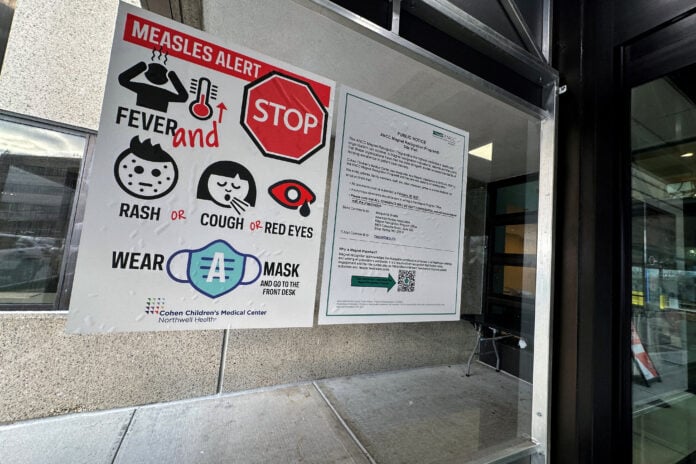
Measles announces itself gradually. Fever arrives first, usually within a week to two weeks of exposure, followed by a runny nose, cough, and red or watery eyes. These are easy to dismiss as a cold, particularly in a fully vaccinated adult who has no reason to expect measles. The characteristic rash typically follows three to five days into illness, spreading from the face downward. Symptoms can appear anywhere from seven to fourteen days after exposure, with the outer limit at 21 days. Missouri DHSS is asking anyone who was at the listed locations during the exposure windows to monitor themselves for the full 21 days and to call their healthcare provider before seeking testing or care, not to arrive at an emergency room without warning, because measles spreads through the air and can linger in a space for two hours after an infectious person has left.

The vaccination-rate decline underlying the national outbreak is slow but structural. MMR coverage among school-age children dropped from 95.2 percent during the 2019-2020 school year to 92.5 percent during the 2024-2025 school year, according to federal data. The 95 percent threshold is where epidemiologists set herd immunity for measles, the most transmissible vaccine-preventable disease in common circulation. The MMR vaccine has been the subject of renewed political controversy in 2026, with an executive order in August disrupting the childhood vaccine schedule on grounds the administration linked to autism research, a claim without clinical support. Missouri’s public health response has focused on encouraging vaccination and monitoring, rather than mandates.
What remains unknown is how many people from any of the eight exposure sites will develop symptoms in the days ahead, and whether any of them will do what the person at the centre of this cluster apparently did without knowing it: carry measles into another crowd.