
WASHINGTON — The Justice Department told a federal court on Wednesday that White House press access is a privilege the administration may revoke at will, not a constitutional entitlement. If it holds, the argument would give any sitting president unrestricted authority to determine which journalists cover the presidency and, by extension, which questions get asked.
Senior counsel Michael Velchik made the case in a court filing submitted Tuesday evening on behalf of the White House, defending the ban on CNN, MS NOW, and Politico that has been in place since August. By Wednesday afternoon, Judge Timothy Kelly of the U.S. District Court in Washington had spent roughly 45 minutes pressing both sides on the legal foundations of that claim and left the courtroom without ruling. He said he would try to deliver an answer as quickly as possible.
The three news organizations, along with several individual journalists whose hard passes were revoked, filed suit last week arguing the ban constitutes an unconstitutional deprivation of their First Amendment and due process rights. Their court papers described what an earlier Eastern Herald report characterized as a coordinated legal challenge framed by the outlets’ attorneys as unconstitutional exclusion.
The DOJ filing, reported by CBS News, offered an unusually blunt accounting of why each outlet was excluded. CNN had published reporting about a fortified underground facility in the East Wing of the White House and about the conduct of the Iran war that the administration considered either classified or sensitive. MS NOW received its ban in connection with a story tied to an active leak investigation. Politico’s credentials were pulled after coverage of Iran military planning, the underground facility, and an article on Russia sanctions policy.
Velchik’s filing described all three outlets as having failed to meet “professionalism and decorum standards,” a characterization the outlets’ legal team dismissed as a cover story. “This is a clear retaliation case,” an attorney for the plaintiffs said outside the courthouse.
Judge Kelly, appointed by President Trump in 2017, surfaced the core obstacle to the administration’s position early in the hearing. A 1977 ruling by the D.C. Circuit Court of Appeals in Sherrill v. Knight held that the government cannot revoke White House press credentials without first providing the affected journalist notice and an opportunity to respond. Kelly asked the government’s lawyers how their “privilege” argument could be squared with that precedent. The exchange consumed a significant portion of the hearing, and the judge appeared to be working through whether the administration had satisfied or circumvented those procedural requirements before pulling credentials.
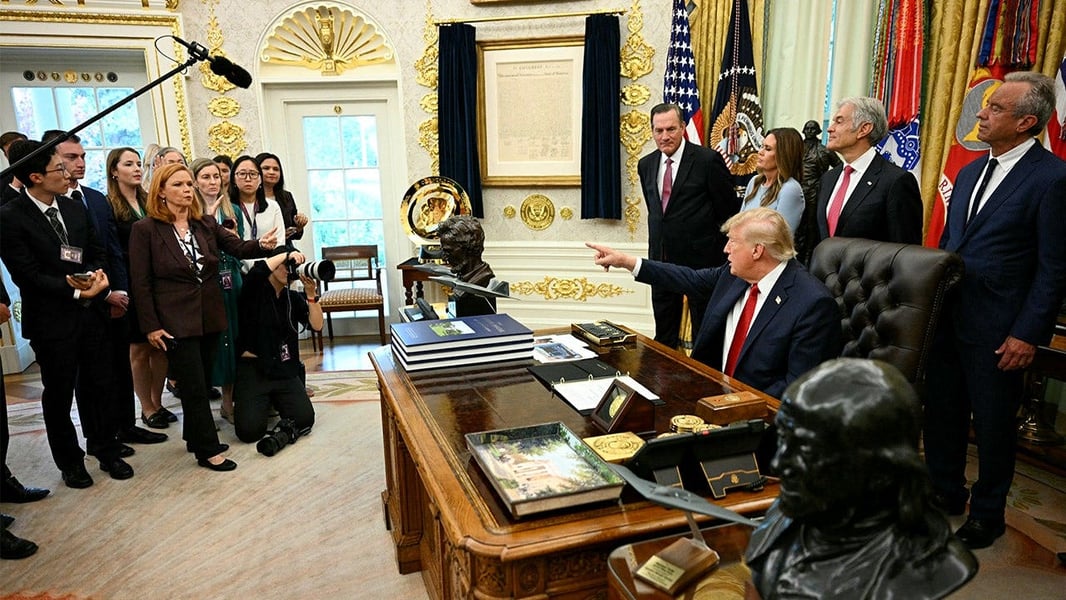
Outside the courtroom, the press-access dispute had already expanded beyond the three banned outlets. The four major television networks, Fox News, ABC, CBS, and NBC, suspended their participation in the White House press pool last week in protest of the bans, a rare act of collective solidarity that removed the pool feed from live coverage of presidential movements. The five TV pool members issued a joint statement: “The public has a vital interest in receiving accurate, independent information about its government. No administration should restrict a news organization because it objects to its reporting.”
The White House’s answer was to launch a YouTube channel branded “Trump TV: The Essentials Station” that began streaming direct-to-audience footage of presidential events, bypassing the pool system entirely. Press secretary Olivia Gaines described it as an alternative to what she called biased and inaccurate coverage from legacy news organizations.
The legal background to Wednesday’s proceeding includes a parallel case from 2025, in which the Associated Press was barred from White House access after declining to adopt the administration’s renaming of the Gulf of Mexico. A federal judge ordered the AP’s access restored. The Trump administration appealed, and that appeal remains pending, making the AP case the most direct available precedent for how courts have responded when the White House uses credential revocation against individual outlets.
Three polls released the same day showed independent voters breaking toward Democratic congressional candidates at margins historically associated with wave elections, a convergence of data that places the press confrontation inside a larger pattern of political erosion the administration has not yet managed to reverse.
What remains unanswered after Wednesday’s hearing is the narrower legal question of whether the administration’s “privilege” doctrine, if accepted by the courts, would place presidential press management effectively beyond judicial oversight. The Sherrill ruling provides procedural guardrails, but whether those guardrails genuinely constrain a determined administration or merely require that credential revocations be better documented is a question Kelly took under advisement. His ruling, when it comes, will be the first judicial test of the doctrine in its current, maximalist form.