WASHINGTON — Three news organizations Donald Trump banned from his White House filed suit in federal court Sunday, landing the case before the same federal judge who ordered the administration to return a reporter’s press pass the last time Trump tried this.
CNN, MS NOW and Politico filed a joint complaint in U.S. District Court for the District of Columbia, seeking an emergency order restoring their reporters’ access to the White House, the presidential travel pool, and the pool video feed that gives all media organizations footage of official events. The case was assigned to Judge Timothy Kelly, the Trump nominee who in November 2018 ordered the administration to reinstate CNN correspondent Jim Acosta’s press pass within days of its revocation.
The legal argument cuts at the administration’s core justification for the ban. Under a 1977 ruling from the U.S. Court of Appeals for the District of Columbia Circuit, Sherrill v. Knight, the government cannot exclude credentialed journalists from White House facilities based on the content of their coverage. Any exclusion requires a compelling government interest, advance notice, a genuine opportunity for the journalist to respond, and a final written explanation. None of that happened here. According to NBC News, the administration banned all three outlets wholesale, via a social media post, for reporting Trump called “Fake News.”
“The administration cannot punish journalists for their reporting,” said Ted Boutrous, the First Amendment attorney representing all three plaintiffs. Boutrous won the Acosta case in 2018; when the Trump administration chose not to appeal that ruling, lawyers read the retreat as a concession that the 1977 precedent would hold in any circuit court.
That precedent is now the central battlefield again, on a larger scale. A single correspondent’s press pass was the object of the 2018 dispute. This time, three national news organizations have filed together, seeking injunctive relief, in the form of a temporary restraining order, that could bring emergency hearings before Judge Kelly as early as this week.
In a joint statement, the plaintiffs framed the case as reaching beyond their own access. “We are filing this lawsuit to protect our First Amendment rights and defend the principle that the government does not decide what the press reports or publishes,” they said.
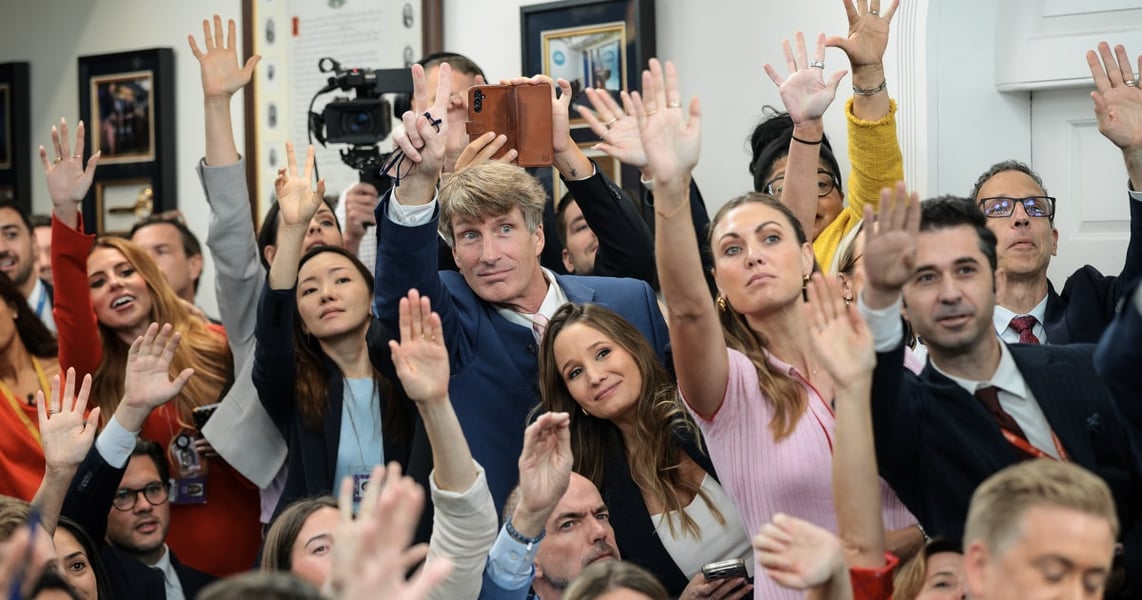
The physical execution of the ban moved quickly. By Saturday morning, reporters from all three organizations had their press badges physically confiscated at the security entrance, CNN’s Betsy Klein among the first turned away. By Sunday, the White House also removed CNN from the television pool rotation for the United Nations General Assembly, disrupting the cooperative press arrangement that has operated across administrations for more than half a century.
The complaint names the viewpoint-based nature of the exclusion as the constitutional violation: not simply that reporters were removed, but that they were removed specifically because their employers’ coverage displeased the president. That distinction triggers heightened scrutiny under First Amendment doctrine regardless of whether the White House carries the full speech protections of a public forum.
The Fifth Amendment claim turns on a procedural failure. Reporters and their organizations received no formal notice, no statement of charges, no opportunity to contest the decision, and no written final order, the procedural floor that Sherrill v. Knight established and the Acosta case reconfirmed. Al Jazeera reported that legal experts consider the lack of any process the more straightforward of the two constitutional violations.
The administration simply acted via social media, and only afterward issued statements calling the outlets Fake News. Whether Judge Kelly will issue a temporary restraining order, and how quickly the administration would comply with one, remains the open question. In 2018, the Trump administration reinstated Acosta’s pass rather than litigate an appeal it expected to lose.
The White House did not respond to requests for comment. Press Secretary Karoline Leavitt has held no formal briefing since the ban was first announced Friday. An emergency hearing before Judge Kelly would require the administration to produce a legal argument that has, twice now, failed to hold.