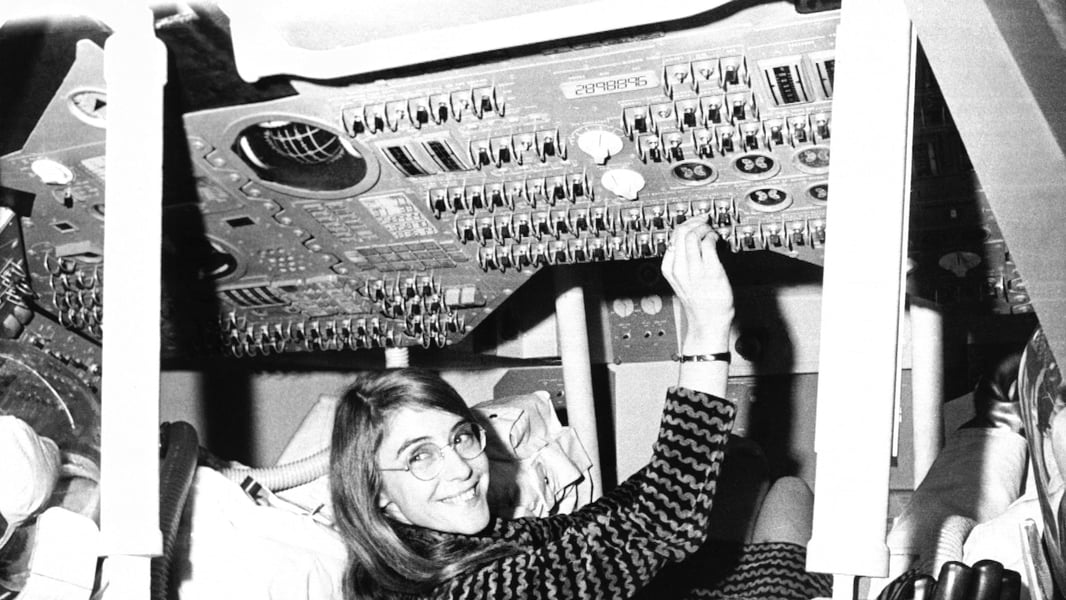

Margaret Hamilton, the computer scientist who led the MIT team that wrote the onboard flight software for NASA’s Apollo moon missions, died September 30. She was 90. MIT announced her death on Wednesday in an obituary on MIT News, which described her as a profoundly influential computer scientist who helped establish software engineering as a discipline. She worked at MIT from 1959 until the mid-1970s, MIT said, and wrote more than 130 publications.
Leading Apollo’s Software
Hamilton was born in Paoli, Indiana, in 1936 and earned a mathematics degree from Earlham College in 1958. She moved to Boston the next year with her husband and took a temporary job in MIT’s meteorology department, working on weather-prediction software, MIT News reported. In 1961 she became a programmer at MIT Lincoln Laboratory on the SAGE project, the first U.S. air-defense system.
In 1965 she answered a newspaper advertisement from MIT’s Instrumentation Lab, which had won the NASA contract for Apollo’s onboard flight software. The lab hired her as the first programmer on the project and its first female programmer. She worked first on software for uncrewed missions and was then promoted to lead the team for crewed flights. By 1968 she was assistant director in charge of the Command and Service Module team, and more than 400 people were working on Apollo’s software, according to MIT News.
The Apollo 11 Alarm
Hamilton’s best-known contribution came in July 1969. Moments before the Eagle module was due to land, the onboard computer raised a 1202 alarm, which showed it was overloaded because of a fault in a hardware switch, MIT News said. Her team had built priority-driven software that could shut down unnecessary background tasks and focus on the critical ones. Houston trusted the software and let the mission go ahead, and two men walked on the moon for the first time.
The approach came from what MIT called “defensive” programming, in which software anticipates or fixes errors on its own. Her daughter, Lauren, then four, crashed a command module simulator by launching a pre-launch program in midflight. Hamilton proposed a software fix, but she was overruled because trained astronauts would never make that mistake. During Apollo 8 in 1968, Jim Lovell made the same mistake, and her changes were then added to the program.
Later Career and Honors
As Apollo wound down, the Instrumentation Lab became the independent Draper Laboratory. Hamilton founded Higher Order Software in 1976 and Hamilton Technologies about a decade later. She told El País in 2018 that she fought to give software legitimacy and began using the term “software engineering” to distinguish it from hardware and other types of engineering, MIT News reported.
President Barack Obama awarded her the Presidential Medal of Freedom in 2016, with a citation saying she defined new forms of software engineering. She also received NASA’s Exceptional Space Act Award in 2003 and was inducted into the National Aviation Hall of Fame in 2022. A now-famous photo of her beside a printout of her team’s Apollo code made her an icon for women in science and technology. The Apollo software was added to GitHub in 2015, and Lego made her a minifigure in 2017.
Hamilton is survived by her daughter, Lauren Hamilton; her son-in-law, Richard Selesnick; two grandsons; four great-grandchildren; and her siblings John, David and Kathryn. A memorial service will take place in the spring in Cambridge, Massachusetts, according to MIT.