
KIGALI — Formula 1 has agreed to return to Africa, 33 years after its last race there, and the argument over what that return costs began the moment it was announced here on Tuesday.
Rwandan President Paul Kagame, Formula 1 chief executive Stefano Domenicali and FIA president Mohammed Ben Sulayem announced a 10-year agreement for a Formula 1 African Grand Prix, presented by Visit Rwanda, to join the calendar in the early 2030s. The last race on the continent was the 1993 South African Grand Prix at Kyalami, and Domenicali called Africa “the missing piece” in the championship’s global footprint, according to Al Jazeera’s account of the ceremony.
The commercial case is aimed at the fans F1 says it already has. The sport puts its following across Africa at more than 100 million, with almost 60 percent of fans in key sub-Saharan markets under 35. This season has already added one new venue: the Spanish Grand Prix at the Madring in Madrid held its first race in September.

Kagame framed the deal as a correction. “For decades, African athletes have been a pillar of the global sports economy, adding significant commercial value to top leagues, with the continent receiving almost nothing in return,” he said, in remarks Formula1.com reported. Jean-Guy Afrika, chief executive of the Rwanda Development Board, said the name was chosen on purpose, because calling it a Rwanda Grand Prix would have felt “slightly exclusive.” “We weren’t the only ones bidding,” he said.
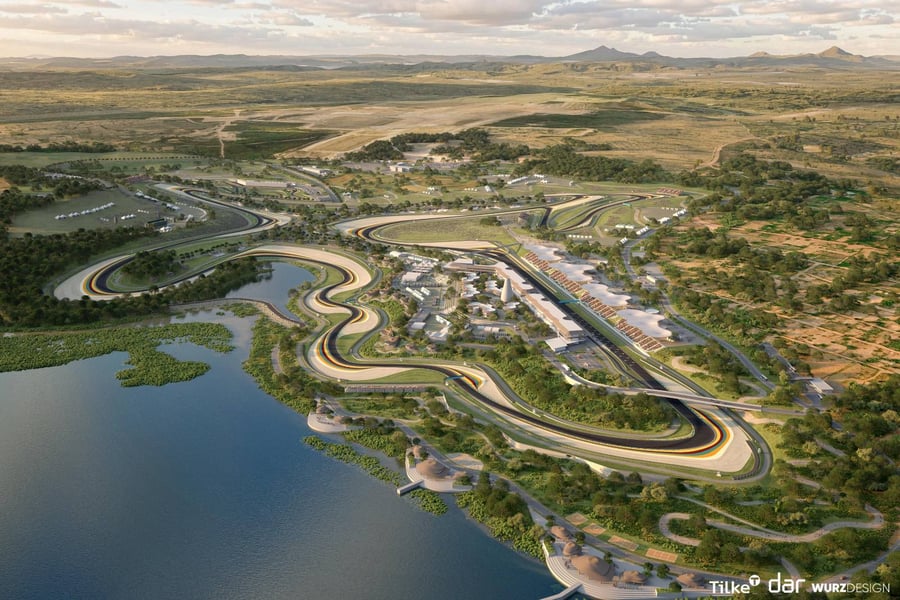
The circuit does not exist yet. It will be built at Bugesera, about 40 kilometres south of Kigali and next to the new international airport, as part of a wider sports, tourism and commercial development led by the Rwanda Development Board. The track is planned at six kilometres with 17 corners, run anti-clockwise, with 197 metres of elevation change over a lap. At roughly 1,500 metres above sea level it will sit among the highest circuits on the calendar, and designer Alex Wurz said the thinner air means less aerodynamic grip, which the camber of the corners is meant to offset.

What the announcement does not contain is a price. Neither the hosting fee nor the construction cost appeared in the F1 statement. The sport’s own estimate, which Formula1.com attributed to data from earlier new venues, is that its events typically generate more than 100 million pounds in annual economic impact for the host nation. That is the sport’s own projection, not an independent estimate.
Amnesty International was quicker with its own assessment. “A 10-year Grand Prix ‘presented by Visit Rwanda’ is a sportswashing prize for the Rwandan authorities,” Felix Jakens, the head of campaigns at Amnesty International UK, said in a statement Sky Sports published. He said Rwanda is “playing a significant role in fuelling the conflict” in eastern Congo through its support to the M23 armed group and the direct actions of its military. Sky noted that DR Congo has accused Rwanda of arming rebel groups, and that Visit Rwanda is also the front-of-shirt sponsor of Aston Villa under a deal Sky put at 20 million pounds a season. Neither F1’s announcement nor Al Jazeera’s account of the ceremony carried a Rwandan response.
The drivers, for their part, wanted the race. Lewis Hamilton said in Singapore last week, “We need to have a Grand Prix in Africa,” calling it “the most beautiful continent.” George Russell told Formula1.com that Africa is “the only [inhabited] continent we don’t race on and it’s about time we had a race there.” Qatar’s ambassador to Rwanda, Mansour Ali Fahad Al-Shahwani Al-Hajri, was among those at the ceremony, Al Jazeera reported.
F1 says the race date, circuit milestones and race-weekend plans will come “in due course.” The only things fixed so far are a decade, a country and a start window that opens in the 2030s, for a track that has not been built and a bill nobody has yet published.