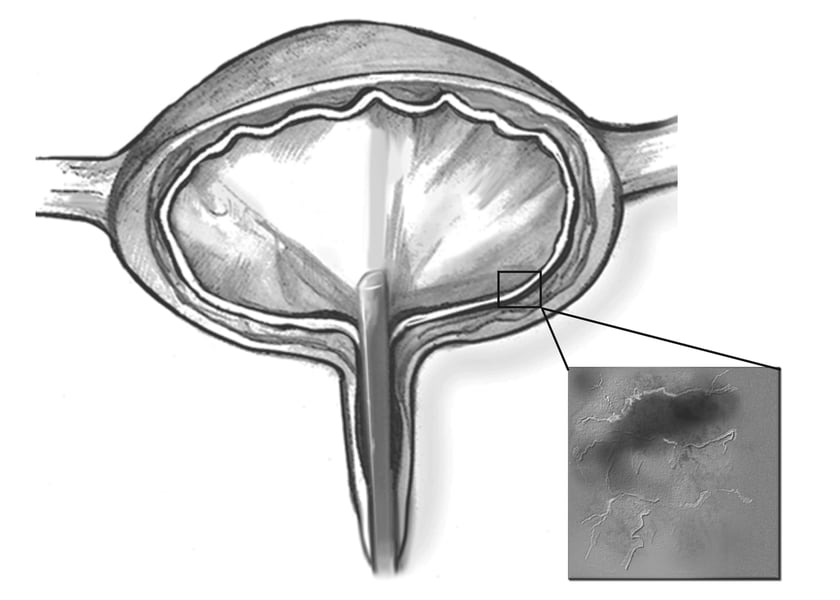

WASHINGTON — A bladder cancer patient whose high-grade, finger-like tumors keep returning after BCG treatment now has an FDA-approved drug made for that situation. The agency’s reasoning, though, rests on a trial of patients with a different form of the disease.
The Food and Drug Administration on Wednesday expanded Anktiva, given with BCG, to adults whose high-grade, papillary-only non-muscle invasive bladder cancer has not responded to BCG. In August the agency approved daraxonrasib for pancreatic cancer on a randomized Phase 3 trial. This time it leaned on another patient group.
That group had carcinoma in situ, which forms flat patches along the bladder lining. The FDA said in its approval notice that the two tumor types are both aggressive, frequently coexist and carry a high risk of recurrence once BCG stops working, so efficacy shown in one could be extrapolated to the other. The agency calls it a new approach.
The evidence is QUILT-3.032 Cohort A, which the FDA’s notice describes as a single-arm, multicenter trial of 77 patients. Sixty-two percent had a complete response (95 percent confidence interval, 51 to 73), judged by cystoscopy, urine cytology and biopsy. Of those responders, 58 percent held the response at least 12 months and 40 percent at least 24 months. With no control group, the trial cannot show what would have happened without the drug.
R. Angelo de Claro, director of the FDA’s Oncology Center of Excellence, said in the agency’s announcement that the FDA acts “when the science supports a new approach,” and that the reasoning “may also help guide the development of future treatments.”
ImmunityBio, the maker, says its application relies on a separate 80-patient papillary-only cohort. In a May 19 statement it reported 12-month disease-free survival of 58.2 percent (95 percent confidence interval, 46.6 to 68.2) and said the FDA had set a January 6, 2027 target date, so the decision came about 12 weeks early. The FDA’s notice does not cite that cohort, so how much it counted is unclear.
Anktiva goes into the bladder through a catheter with BCG, weekly for six weeks, then as the response dictates for up to 37 months, the FDA said. Common side effects include painful or frequent urination, blood in the urine and urinary tract infections. The label warns that delaying surgery to remove all or part of the bladder can allow the cancer to spread, “which can be fatal.”
The FDA’s documents give no price, and its guidance on this approach is still a draft. Whether tumors that grow as papillary lesions alone respond as flat ones did is something the notice assumes rather than shows.