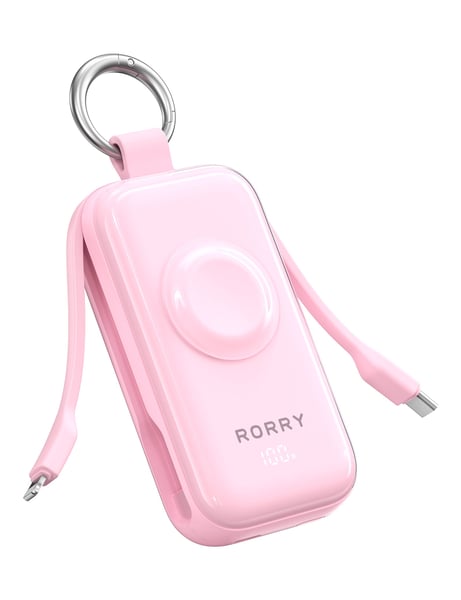

A portable charger clipped to a handbag can be part of the outfit rather than something hidden under spare cables. But a charm-style design does not tell a buyer how much power it stores, how quickly it charges a phone or whether it can charge a watch. Rorry’s CharmGo range illustrates why the model name matters as much as the colour.
The range includes batteries with different capacities, charging outputs and connections. Some have magnetic Apple Watch charging; others do not. A photograph of a rounded, colourful charger is therefore not enough to establish what a particular version can do.
This is an examination of published product information, not a hands-on review or evidence of a new launch. The Eastern Herald has not independently measured the chargers’ output, usable capacity, charging times or durability. Manufacturer specifications below remain manufacturer claims, even where they appear on several of the company’s pages.
The starting point is a June 16 WWD feature about portable chargers and summer style. That article explicitly discloses that it was brought to readers by Rorry. It is sponsored material, not independent evidence that consumers broadly regard power banks as essential fashion accessories or that one brand leads a measured market trend.
The design proposition is nevertheless visible in the products themselves. Rorry offers rounded bodies, multiple colours and keychain attachments intended to let users hang a charger from a bag. Its collection page describes the concept in terms of a charm keychain. That establishes the manufacturer’s positioning, not how many people have adopted it or whether it is comfortable on a particular bag.
Rorry’s CharmGo collection guide makes the first important distinction: Apple Watch charging is not universal. The company says selected D-series models with magnetic charging support the watch, while T1 models do not. Buyers should check the exact model rather than interpret the CharmGo name as a guarantee of the same functions.
The company’s comparison guide lists the T1 5,000mAh model at up to 20W total output and the T1 10,000mAh version at up to 30W total output. Those are not interchangeable descriptions of one device. They also do not establish that every connector on either battery delivers the headline figure.
That distinction is clear in the manufacturer’s port-by-port comparison. For the T1 10,000mAh model, it lists 30W total output but 15W for the USB-C port or cable and 12W for its Lightning cable. The useful question is which connection will charge the intended device, not simply which number is largest in the advertisement.
The D4 10,000mAh model is the higher-output CharmGo example in those materials. Rorry lists up to 45W through its USB-C port or cable, a separate 20W Lightning specification and 5W Apple Watch charging. These figures identify advertised capabilities; they are not a measured promise that a phone, tablet and watch all receive their maximum charging rate simultaneously.
Nor does watch charging establish magnetic phone charging. Rorry’s comparison marks the D4 as Apple Watch-compatible but not MagSafe-compatible. A magnetic watch-charging surface and a magnetic phone battery are different features, despite the temptation to treat any mention of magnetic charging as shorthand for both.
The company also advertises built-in cables, reducing the number of separate accessories a person may need to pack. That convenience depends on the devices being carried. An iPhone, Android phone, tablet or watch may require a different connector or charging method, so the relevant specification is the combination that fits the user’s equipment.
Physical size remains a separate issue from style. A clip changes where a battery can be carried; it does not remove its weight. Rorry’s collection and D4 product pages list that model at 222g, while its comparison guide gives 215g. The Eastern Herald has not weighed a sample, so neither figure should be presented as an independently verified measurement.
The discrepancy is small enough that it need not decide a purchase, but it is a useful warning against treating marketing pages as a laboratory report. The same caution applies to charging-time claims and advertised numbers of full phone recharges. Published specifications can help narrow a choice without establishing real-world performance for every device and use pattern.
This feature does not repeat the sponsored article’s Amazon-exclusivity statement as a current fact. Rorry now presents the products on its own storefront, and the pages reviewed also display different D4 prices depending on the page or selected colour. That is not a sound basis for declaring a single verified deal without checking the exact variant and final checkout.
A power bank also need not be the first answer to every short-battery day. The Eastern Herald’s guide to preserving phone battery during an outage examines settings that reduce power use. Carrying reserve power and reducing consumption address different parts of the same practical problem.
The appeal of a bag-charm battery is that useful equipment can also be something a person wants to carry. Whether that works in practice depends on the model, its connections and the weight added to the bag. The missing evidence is not another colour photograph, but independent testing that shows how the chosen charger performs.