More than a decade after New Yorkers voted to open the door to commercial casinos, the nation’s largest city is on the cusp of hosting Vegas‑style gambling halls for the first time. A state gaming board has recommended three licenses, two in Queens and one in the Bronx, setting the stage for projects that could redefine entertainment, jobs and public health across New York City.
The winning bids are anchored by a multibillion‑dollar expansion of Resorts World New York City at Aqueduct Racetrack, a sprawling “Metropolitan Park” complex beside Citi Field in Queens, and a Bally’s casino at the company’s golf course in the Bronx neighborhood of Ferry Point. Each promises hotels, performance venues and acres of new public space wrapped around casino floors that would finally bring live table games, and the tax revenue they generate, to the five boroughs.
State officials describe the moment as the payoff to years of lobbying by the gambling industry and a 2013 statewide referendum that authorized casino expansion. But for community advocates and addiction specialists, the approvals have intensified long‑running fears that New York is leaning too heavily on gambling to plug budget gaps and fund transit, while leaving neighborhoods and vulnerable residents to manage the fallout.
Three projects, billions at stake
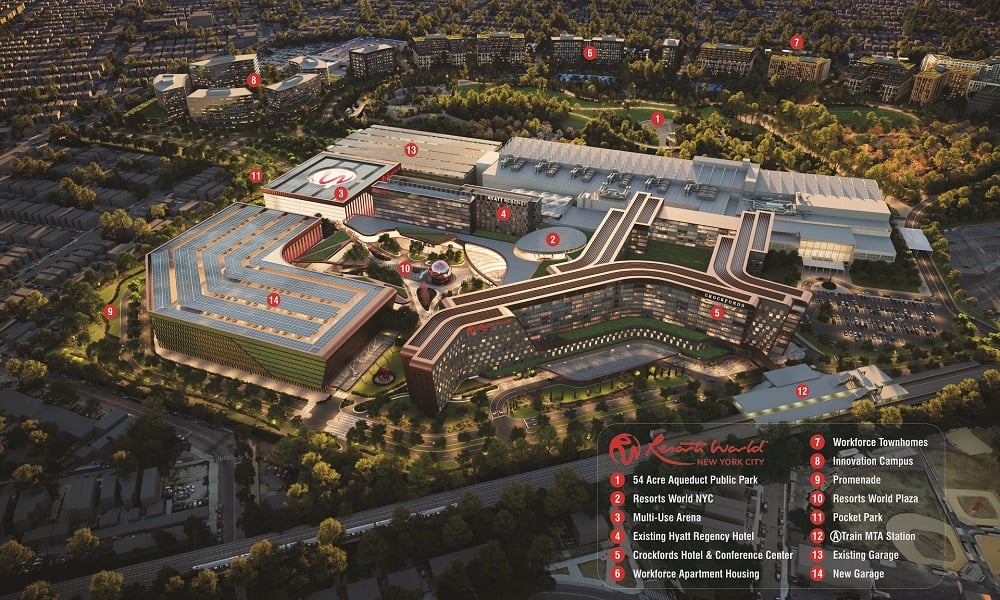
The most ambitious of the three projects is Resorts World’s plan to transform its existing “racino” at Aqueduct into a full destination resort. Genting, the operator, already runs thousands of video lottery terminals at the site; the new license would allow traditional table games and a significant expansion of hotel rooms, dining and entertainment offerings on a campus whose price tag now runs into the high billions. Earlier this year, The Eastern Herald detailed how the NYC casino race hardened around Resorts World, Steve Cohen and Bally’s as front‑runners, long before the formal recommendations arrived.
Just a few miles away in Queens, hedge‑fund billionaire Steven Cohen’s long‑courted plan for Metropolitan Park would turn parking lots around Citi Field into an $8 billion gaming‑anchored district. The proposal combines a Hard Rock–branded casino with a live music venue, parkland and year‑round bars and restaurants, marketed as a way to turn a baseball stadium that comes alive 81 days a year into a full‑time economic engine. A recent Eastern Herald investigation into Cohen’s $8 billion Queens casino slush fund raised fresh questions about how much public leverage the Mets owner and his partners have amassed in the process.
In the Bronx, Bally’s has secured a path to convert its Trump‑built golf course at Ferry Point into a casino overlooking the East River, backing the gaming floor with a hotel and conference facilities that would sit within view of some of the city’s most neglected neighborhoods. Supporters cast the project as a long‑overdue shot at private investment in a borough that has lagged the city in income, health and employment metrics for decades, echoing debates The Eastern Herald has followed in other communities targeted for gaming, including a controversial casino proposal in Washington, D.C.’s Ward 7.
Collectively, state officials say, the three casinos could generate billions of dollars in licensing fees and ongoing tax revenues, much of it earmarked for the Metropolitan Transportation Authority. Governor Kathy Hochul has framed the decision as a way to stabilize transit finances and create tens of thousands of construction and permanent jobs, while insisting that regulators will hold operators to “rigorous standards” for integrity and community benefits. The Division of Gaming within the New York State Gaming Commission will ultimately be responsible for translating those promises into enforceable conditions.
Manhattan says no, outer boroughs say maybe
The shift to Queens and the Bronx followed a bruising political defeat for casino advocates in Manhattan, where all three major proposals, including projects backed by Mohegan near the United Nations, Caesars in Times Square and a consortium in Hudson Yards, were rejected by local advisory committees. Community leaders warned that turning Midtown into a 24‑hour gaming district would worsen congestion, strain already thin public services and accelerate a transformation of Manhattan into what one critic described as “a theme park for vice and tourism.”
Advisory boards created to give local lawmakers and residents a say over casino siting ultimately voted down every Manhattan project, often by lopsided margins, despite vocal support from City Hall and the governor’s office. The rejections left the field clear for outer‑borough bids as state regulators rushed to meet an end‑of‑year deadline to send final recommendations to the Gaming Commission, locking in a future where high‑stakes gambling is concentrated in Queens and the Bronx rather than the city’s traditional tourist core.
In Queens and the Bronx, opposition has been more fragmented, and in some areas, outweighed by hopes for jobs and investment. Elected officials who once balked at gambling have argued that, with Manhattan off the table and casinos likely coming somewhere in the region, their districts should at least capture the economic upside. The Eastern Herald has previously chronicled how a key community advisory vote allowed Steve Cohen’s Queens casino to surge ahead, turning neighborhood ambivalence into a political asset for Metropolitan Park.
Public health alarm grows
Behind the glitzy renderings and promises of new parkland, addiction experts see a different story unfolding. New York already has one of the most extensive legal gambling environments in the United States, from mobile sports betting and lotteries to upstate casinos and racetrack machines, and researchers say the harms are more severe and more widespread than policymakers have acknowledged. Coverage of the digital betting boom, including The Eastern Herald’s guide to online gambling trends, has underscored how quickly wagering has seeped into everyday life.
Data compiled by the New York Council on Problem Gambling and the state’s addiction services agency suggest that a small but significant share of residents meet criteria for gambling disorder, with many more at risk. According to recent state bulletins, calls to gambling help lines and use of treatment services have risen, even before a single downstate casino has opened its doors, underscoring concerns that easier access and sophisticated marketing could pull more New Yorkers into trouble. City residents seeking assistance are now funneled toward a network of regional problem‑gambling resource centers that try to keep pace with surging demand.
Public‑health scholars have increasingly framed gambling expansion as a structural driver of harm, not just an issue of “personal responsibility.” A Lancet Public Health commission on gambling across the Americas warned that aggressive growth in casino and online betting markets is linked to higher rates of depression, substance misuse, family breakdown and financial distress, with the heaviest burden falling on poorer communities. An open‑access version of that analysis hosted by the NIH similarly documents how the expansion of gambling across the Americas magnifies mental‑health risks when governments come to depend on betting revenues.
Who bears the risk?
Those patterns are already visible in New York. Surveys show that lower‑income New Yorkers, people of color and residents with existing health or financial vulnerabilities are more likely to experience gambling harms, even though betting is marketed as a glamorous pastime and a painless way to fund public services. State‑level data on treatment access, helpline calls and co‑occurring substance‑use issues, summarized in outlets such as the New York gambling addiction helpline, repeatedly point to concentrated harm in a relatively small share of heavy gamblers.
Critics point out that the new casinos will sit within reach of neighborhoods that have long histories of redlining, underinvestment and high rates of chronic disease. In the Bronx, public‑housing complexes, aging multifamily buildings and overburdened social‑service agencies lie a short ride from the future Bally’s site, raising fears that cash‑strapped residents will be aggressively targeted with promotions, loyalty schemes and credit. Those worries echo a broader Eastern Herald examination of how the economic impact of casino expansion can tilt sharply against communities that lack political clout.
In Queens, immigrant communities around Flushing, Corona and Jamaica live with overlapping pressures, from housing insecurity and wage theft to environmental hazards, that advocates worry will be exacerbated by an influx of high‑stakes gambling. They warn that casino jobs, often touted as a route into the middle class, can themselves be unstable or low‑wage, and may not offset the long‑term costs of addiction, bankruptcy and crime borne by local families. A growing body of research on responsible gambling codes of conduct suggests that venue‑led self‑regulation often fails to deliver meaningful harm‑minimisation in precisely these kinds of neighborhoods.
Regulators promise safeguards
State regulators insist that they are not blind to those risks. The Gaming Facility Location Board and the Gaming Commission have pledged to subject licensees to extensive background checks, strict anti‑money‑laundering rules, and oversight of advertising, credit and loyalty programs, arguing that “a New York gaming license is a privilege” that can be revoked. On paper, the regulatory architecture around casinos is more muscular than what governs looser forms of betting, such as state lotteries or many online promotions.
Officials also highlight New York’s investments in problem‑gambling services, including a network of regional resource centers, a 24/7 helpline and a growing roster of clinicians trained to treat gambling disorder. The state’s addiction services agency describes its approach as a public‑health model that blends prevention, early intervention and treatment, and emphasizes partnerships with community‑based organizations near future casino sites. But the experience of other jurisdictions, from Nevada to Illinois, which The Eastern Herald tracks through its coverage of casino‑driven development in the Midwest, suggests that the effectiveness of those safeguards depends heavily on political will.
Yet even sympathetic experts question whether those safeguards can keep pace with the scale of the new gambling environment. One concern is that funding for treatment programs is often tied to gambling revenues themselves, creating a structural dependence on the very industry that generates the harm. Another is that oversight rarely extends to the digital edges of the gambling ecosystem, where sports‑betting apps, online slots and crypto‑casino products blur the line between regulated and unregulated risk.
Neighborhood deals and broken trust
Casino operators have responded to skepticism with a familiar tool kit: community benefits agreements, promises of union jobs and pledges to fund local parks, schools and cultural institutions. The Metropolitan Park plan, for example, has emphasized new green space, commitments to youth sports and partnerships with Queens‑based nonprofits as central to its pitch, echoing the glossy, promise‑heavy playbook that The Eastern Herald dissected in its report on how the gaming sector seeks its “best version” through public‑relations campaigns.
Resorts World has touted its existing relationships with neighborhood groups and labor unions, pointing to previous donations and sponsorships as evidence that it can be a good neighbor. Bally’s has floated commitments to workforce training and local hiring in the Bronx, arguing that the project could serve as a pipeline into hospitality and gaming careers for residents who have often been shut out of the city’s better‑paying sectors. Similar promises surround the rise of bizarre crypto betting markets and high‑risk, high‑tech products that promise innovation while externalising social costs.
But years of uneven development and broken promises have left many New Yorkers wary of grand bargains struck between the state, City Hall and multinational corporations. Opponents of the Manhattan casino plans often invoked the memory of earlier megaprojects, including failed stadium deals and subsidized developments that delivered fewer jobs and less affordable housing than advertised. In that context, the outer‑borough casino deals are landing in neighborhoods where trust in government‑brokered redevelopment is already threadbare.
Lessons from other gambling booms
International experience offers little reassurance. Studies of casino expansion in places such as Singapore and Macau have found that while integrated resorts can boost tourism and tax receipts, they also tend to increase rates of problem gambling, particularly in nearby communities, unless strict entry fees, advertising limits and exclusion policies are enforced. Those findings dovetail with a wider literature on how “destination casinos” reshape urban space, from suburban peripheries to ethnically distinct enclaves, often in ways that entrench rather than alleviate inequality.
Across the Americas, research links rapid gambling liberalization to higher levels of household debt, mental‑health strain and suicide. Public‑health advocates argue that slow, tightly regulated rollouts with strong social protections can blunt some of the damage, but they warn that New York is already far