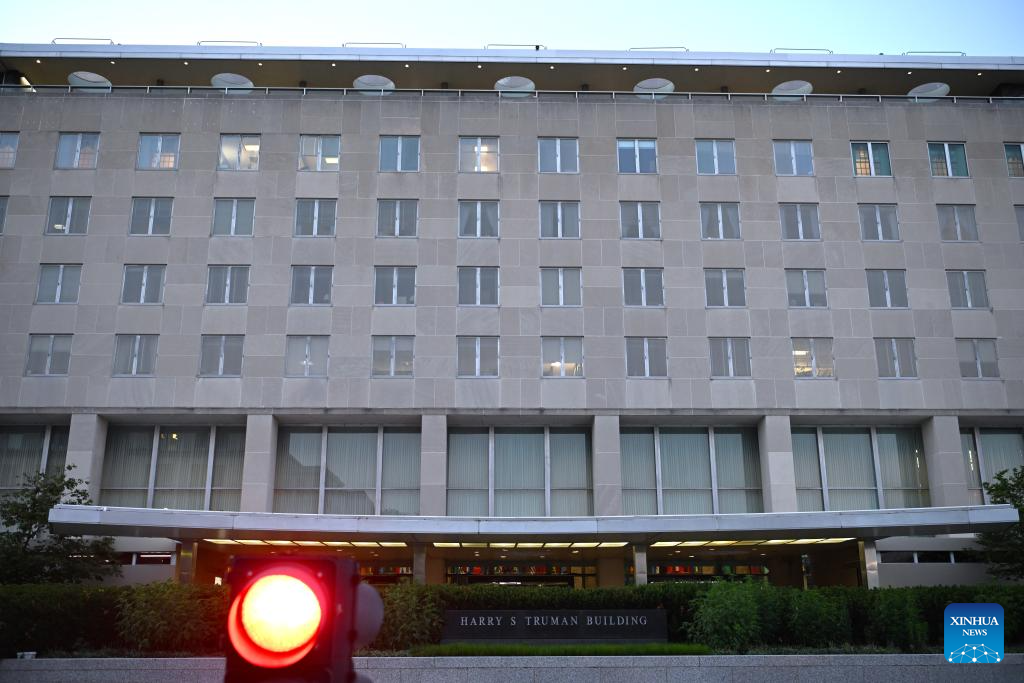
MANAMA — The missiles came before dawn, again. Iran’s Islamic Revolutionary Guard Corps declared on Wednesday that it had struck the US Navy’s Fifth Fleet headquarters in Bahrain and targeted a regional airbase with missiles and drones, opening a fresh exchange of fire that cut through an already-fragile ceasefire and sent air-raid sirens across the Gulf for the first time in weeks.
What the IRGC could not claim was a hit. US Central Command said every Iranian projectile had failed: three ballistic missiles aimed at Bahrain were intercepted by joint US-Bahraini air defense systems, two fired toward Kuwait either broke apart mid-flight or fell short, and a subsequent wave of attack drones targeting American forces in Kuwait was shot down before reaching any target. “Iran launched several ballistic missiles toward regional neighbors; however, all failed to hit their intended targets,” CENTCOM said in a statement posted on X Wednesday. “No US personnel were harmed.”
The IRGC’s own account told a different story. In a statement carried by Press TV, the Guard said its Aerospace Force struck “an American air and helicopter base” and the Fifth Fleet’s Juffair compound — Naval Support Activity Bahrain, the hub of American naval power in the Persian Gulf — in direct retaliation for what it described as a US attack on an IRGC communications tower on Qeshm Island, a narrow strip of Iranian territory hugging the northern mouth of the Strait of Hormuz. The IRGC warned that “disrupting the security of the Strait of Hormuz will carry a heavy price for the US military.”
The sequence of Tuesday night’s hostilities appears to have begun at sea. US forces used a Hellfire missile to disable the Botswana-flagged tanker M/T Lexie after it attempted to sail toward Iran’s Kharg Island oil terminal in defiance of the American naval blockade, ABC News reported. The ship’s crew had ignored repeated warnings from US naval forces over a 24-hour period, CENTCOM said. Iran’s response was naval as well: the IRGC said its forces fired missiles at a Liberian-flagged vessel it identified as the MSC Panaya, citing the Lexie strike as the justification.
The deeper escalation came when US aircraft struck a military ground control station on Qeshm Island, which Tehran considers part of its defensive perimeter near the strait. The IRGC cast that strike as an act of aggression against Iranian sovereignty. Within hours, the ballistic missiles were in the air.

None of this is new terrain. The Fifth Fleet compound in Juffair has been the target of Iranian missiles and drones repeatedly since the war began in late February, when US and Israeli forces struck Iran and Tehran launched retaliatory salvos across six Gulf states. By early March, Bahrain had intercepted more than 125 missiles and 211 drones from Iran, according to official figures from Manama. What makes Wednesday’s barrage different is the timing.
Diplomacy had briefly appeared to slow the fighting. Reports emerged in recent days that Iran had suspended peace negotiations with the United States, and the IRGC’s renewed targeting of a vessel in the Strait of Hormuz — the waterway through which roughly one-fifth of global oil supplies flow — underscored just how thin the buffer separating ceasefire from active conflict has become. Whether the Lexie interception was a deliberate provocation, a test of American resolve, or simply the grinding friction of a blockade enforcement that neither side has agreed to stop, the answer matters enormously for the negotiations’ prospects.
Tom Sharpe, a former Royal Navy Commander, said Bahrain was likely seen by Iran as a high-profile target that has historically had relatively light air defenses, according to the BBC. That calculus has shifted since February — US and Bahraini Patriot batteries have intercepted multiple salvos — but the attacks have not stopped, and the gap between an intercepted missile and a direct hit remains narrower than the official statements suggest.
The commercial shipping dimension carries its own stakes. Iran has previously used maritime pressure as diplomatic leverage, and the targeting of the MSC Panaya — a Liberian-flagged vessel, not American-flagged — signals that Tehran is willing to strike international shipping in the strait to signal costs. The IRGC’s formal invocation of the Lexie tanker as the triggering event was deliberate: it cast the attack not as aggression but as proportional retaliation inside an established tit-for-tat framework.
CENTCOM framed the episode differently. US forces “remain vigilant and ready to defend against unwarranted Iranian aggression during the ongoing ceasefire,” its statement said — a phrase that acknowledged a ceasefire existed while simultaneously documenting its breach. What the statement did not address was what comes next: whether Wednesday’s exchange represents a floor for escalation or merely its latest ceiling.
Iran has not issued a follow-up statement since the IRGC’s initial claim. Whether that silence reflects satisfaction at having demonstrated the capacity to strike — regardless of whether the missiles landed — or a deliberate pause before a heavier response is not yet clear.
—Inputs from Sputnik.