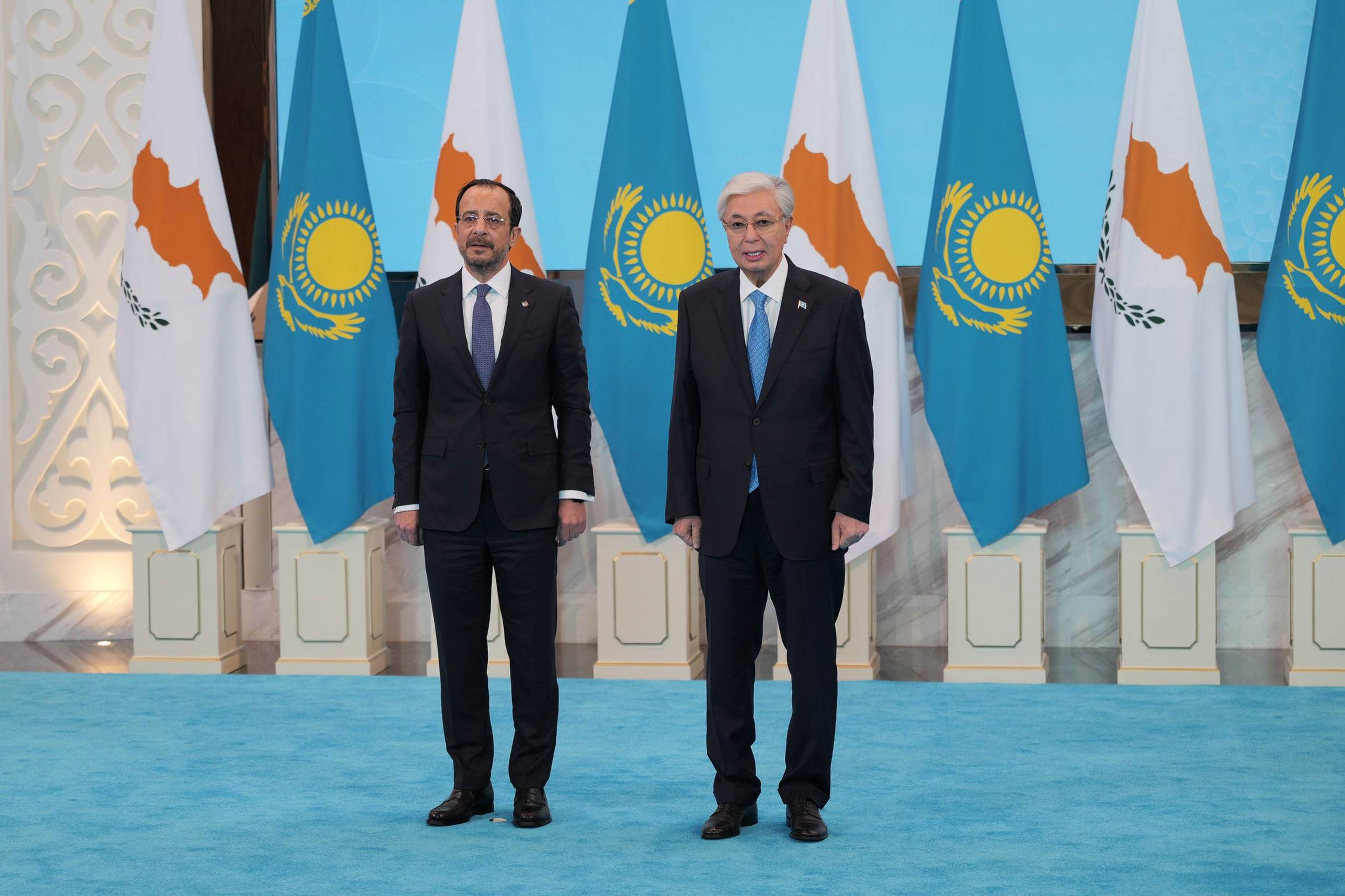
ASTANA — The first thing Kassym-Jomart Tokayev did after the expanded delegation talks was pin a medal to his guest. The Order of Friendship, one of Kazakhstan’s highest state decorations, went to Cypriot President Nikos Christodoulides on Wednesday in recognition, Tokayev said, of his efforts to promote international cohesion. What the ceremony marked, beyond the diplomatic choreography, was something more consequential: the formal opening of a relationship that neither country had previously bothered to pursue at head-of-state level.
Christodoulides arrived in Astana as the first Cypriot president ever to visit Kazakhstan, having flown in on the inaugural Air Astana direct service from Larnaca the previous day. The symbolism of the travel route was not incidental. The two countries only opened resident embassies in each other’s capitals in 2025, and the timing of the summit — with Cyprus currently holding the rotating presidency of the Council of the European Union — gave Nicosia a platform its size would not normally afford.
That platform was the point. “My country is currently holding the presidency of the Council of the European Union,” Christodoulides told Tokayev at their joint press appearance, according to the Kazakh presidency readout. “Given the importance of this region, and Kazakhstan in particular, I am also ready to discuss ways to further develop cooperation between the European Union and Kazakhstan.” The Cyprus presidency, running through June 2026 under the motto “An Autonomous Union. Open to the World,” has positioned outreach to strategic neighbours as a signature goal — and Kazakhstan, as Central Asia’s largest economy, fits that framing exactly.
What makes Kazakhstan’s position unusual is that Astana has spent years cultivating a foreign policy deliberately balanced between the West, Russia, and China — resisting pressure to choose sides while extracting maximum advantage from all three. Tokayev has made that multi-vector posture the centrepiece of his presidency. The Christodoulides visit offered him an EU interlocutor at a moment when European interest in Kazakh energy and critical raw materials has risen sharply, driven in part by efforts to reduce dependence on Russian supply chains.
Tokayev told the Cypriot delegation that over 400 companies with Cypriot capital are currently operating in Kazakhstan — a figure that reflects the island’s longstanding role as a corporate jurisdiction for post-Soviet business structures. During the talks, both presidents signed memoranda of understanding covering higher education and research, culture, sports, information and communication technologies, cybersecurity, and digital governance. Tokayev went further, inviting Cyprus to participate in the TransGas project, citing Nicosia’s status as an international shipping hub.
Christodoulides framed Cyprus’s offer in explicitly geopolitical terms. “Kazakhstan continues to strengthen its role as a major economic and transport hub in Central Asia,” he said in his press statement following the meeting, “and Cyprus, as a member state of the European Union and the Eurozone, offers stability, predictability and a fully EU-aligned business environment — a reliable gateway to Europe and the Eastern Mediterranean.” The emphasis on stability and predictability was pointed: it is precisely the language Kazakh officials use when talking about what they need from Western partners in a period of regional turbulence.
The practical sectors both sides have identified include financial services, shipping, ICT, fintech, logistics, and renewable energy. Christodoulides specifically flagged the Astana International Financial Centre — a common-law arbitration and investment zone with OECD-certified tax arrangements — as a platform for business synergies. Kazakhstan has been actively diversifying its external economic relationships since the disruption to its primary pipeline routes through Russia, making European capital and technical partnerships more valuable than they were three years ago.
The Cyprus side also raised the island’s unresolved partition, with Christodoulides briefing Tokayev on the state of UN-mediated negotiations and reiterating Nicosia’s readiness to resume talks under Security Council resolutions. The issue sits awkwardly in the bilateral relationship: Kazakhstan, as a member of the Organisation of Turkic States, last month hosted Turkish Cypriot leader Tufan Erhurman at a summit in Turkistan — a meeting at which Erhurman lobbied OTS members against the international isolation of Turkish-administered northern Cyprus. Christodoulides did not address this publicly, and Tokayev’s formal response confined itself to affirming shared respect for sovereignty and territorial integrity under international law.
The afternoon schedule reflected how seriously Kazakhstan takes its technology credentials. Christodoulides toured the Alem AI International Artificial Intelligence Centre, hosted by Deputy Prime Minister Zhaslan Madiyev. Kazakhstan has invested heavily in positioning Astana as a regional tech hub, and the tour was not incidental — Tokayev has linked Kazakhstan’s long-term development strategy explicitly to digital infrastructure and AI capacity as the country tries to reduce its dependence on hydrocarbon revenues.
Later on Wednesday, Christodoulides inaugurated the new Cypriot embassy in Astana alongside Kazakh Foreign Minister Yermek Kosherbayev — the first permanent Cypriot diplomatic mission in the country. What the summit does not yet answer is how durable this engagement will be once Cyprus relinquishes the EU Council presidency at the end of June. The institutional architecture — the memoranda, the embassies, the direct flights — suggests both sides want the relationship to hold. Whether it generates the trade and investment volumes both presidents described as the goal will depend on factors neither leader controls: commodity prices, the pace of Kazakhstan’s regulatory reform, and how far European capital is genuinely prepared to move into Central Asia when more familiar markets compete for it.
—Inputs from RIA Novosti, Sputnik.