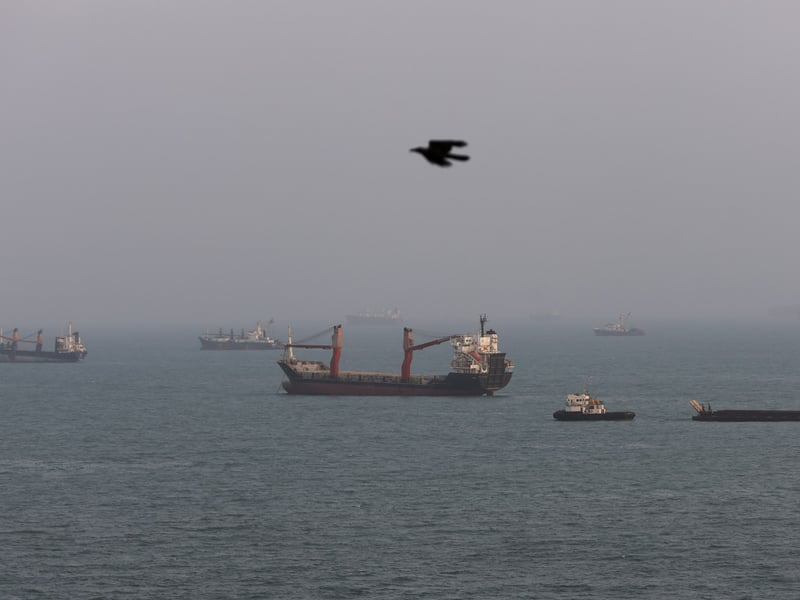
NEW YORK — Six commodity vessels crossed the Strait of Hormuz on Wednesday. On a normal week before this conflict began, roughly 13 would make that transit each day. The six ships that ran the strait last Wednesday are, in the most literal sense, the reason Brent crude is heading for its biggest weekly gain since July.
By late Friday trading, Brent had settled near $95 a barrel, down just 0.31 percent on the day but up roughly 8 percent for the week. West Texas Intermediate was trading near $92, logging a gain of close to 9 percent over the same stretch. It is the kind of weekly move that typically requires a surprise demand surge or a sudden supply disruption. There was no demand surprise this week. Demand forecasters have been cutting their outlooks, not raising them.
The six vessels tell the story. On Tuesday, eleven ships had transited the strait. On Wednesday the number dropped to six, against a rolling 10-day average of nearly 13. Each decline in the daily transit count is a direct reduction in the volume of Middle Eastern crude reaching the global market. The Strait of Hormuz handles roughly 20 percent of the world’s daily oil trade, and a transit rate of six ships represents a degree of commercial restriction with no peacetime precedent in the tracked history of the waterway.
The proximate cause of Wednesday’s drop was renewed US military activity in the region. American forces carried out additional strikes against Iranian positions following a roughly month-long period of relative calm, and Tehran responded with retaliatory action overnight. Iran claimed strikes on US bases in the region, raising insurance premiums for Strait-adjacent voyages and prompting several tanker operators to divert south around the Cape of Good Hope rather than risk the channel. The Cape route adds three to four weeks to a voyage from the Persian Gulf to European ports, a cost that lands directly in the price of the cargo.
That sequence, from military exchange to tanker diversion to price response, has become the defining loop of this conflict’s energy dimension. It played out earlier this week, when US strikes near the strait first pushed Brent crude above $95, and it is repeating now with a narrower but more concrete data point attached: not a threat, but a daily transit count of six.
The US Energy Information Administration recalibrated its pricing framework this week to account for a Hormuz disruption it now treats as structural rather than temporary. According to its updated short-term energy outlook, the EIA now projects Brent to average $79 per barrel across 2026, up from a prior forecast of $58, a 36 percent revision issued in the span of roughly one month. The agency does not expect Middle Eastern oil production to return to near pre-conflict levels before early 2027.
Russia complicated the supply picture further. Moscow indicated this week its intention to begin cutting oil production before year-end, a move that, if it materializes, will remove additional barrels from a market already short on reliable Middle Eastern supply. Iraq moved in the opposite direction, with oil exports rising in August and expected to increase again in September, providing a partial offset. Neither development, on its own, alters the Hormuz calculus.
Thursday’s close near $95.22 was the highest Brent had settled in six weeks, building on a rally that accelerated after Trump threatened to strike Kharg Island and vessel traffic through Hormuz began collapsing in earnest. Friday’s settlement near the same level means the weekly gain will hold. It will be the best weekly performance for the international benchmark since late July, when US strikes first reversed a three-week slide toward pre-conflict price levels.
For markets in India, the world’s third-largest oil importer, a Brent sustained above $90 reshapes the arithmetic of the import bill, airline fuel costs, and downstream fuel subsidies. British energy companies buying at North Sea benchmark prices linked to Brent now pay more than at any point before this conflict cycle began. A price that stood at $65 in early 2026 is now $95, and the EIA’s revised forecast suggests a downward move will not arrive before the strait reopens.
What no one in the market can answer is when that happens. Iran has conditioned any Hormuz normalization on concessions from the United States that Washington has shown no sign of providing. The daily transit count, which stood at six on Wednesday, is the number the market is watching. If it drops to four, or two, or zero, the math changes again. Brent at $95 is already an extraordinary price for an oil market where OPEC and the IEA agree that demand is not growing. The strait keeps the price where it is. Six ships is not a floor.