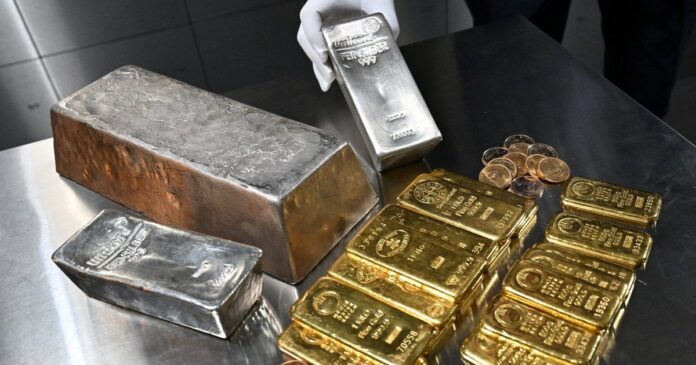

LONDON — Sterling gold buyers found the market fractionally softer on Friday, the first full trading session to price in the Federal Reserve’s September 17 rate hike, even as the precious metal climbed to a weekly high in dollar terms. The gap tells a story about currencies as much as commodities: a strengthening pound, rather than any renewed selling pressure on gold itself, was compressing Friday’s GBP-denominated benchmark.
| Purity | Per Gram | Per Troy Oz | Change |
|---|---|---|---|
| 24ct — 999 Fine | £104.80 | £3,260.78 | ▼ £0.37 |
| 22ct — 916 KDM | £96.08 | £2,990.08 | ▼ £0.34 |
| 18ct — 750 Fine | £78.60 | £2,445.08 | ▼ £0.28 |
| 9ct — 375 Fine | £39.30 | £1,222.54 | ▼ £0.14 |
| Source: LBMA benchmark reference, September 18, 2026. Per-troy-ounce figures calculated at 31.1035g/oz. Retail prices include fabrication and storage premiums not reflected here. | |||
The LBMA reference rate for 24-carat gold reached £104.80 per gram during Friday’s London session, pulling back from the £105.17 per gram set on Thursday as sterling rose against a dollar retreating on the view that the Fed’s tightening cycle had passed its most aggressive phase. In ounce terms, spot gold briefly crossed $4,439 during the session, touching its strongest level in seven days.
The week’s trajectory was unusually compressed. The Federal Reserve raised its target rate by 25 basis points on Wednesday, lifting the federal funds range to 3.75–4.00 per cent in the first increase since 2023. An initial dollar surge on the decision pushed the GBP gold benchmark to its weekly low near £102.60 per gram ahead of the announcement. The recovery came quickly: bond yields fell back across maturities as traders concluded the Fed’s guidance language signalled caution about a December follow-up, and gold responded.
Friday brought a second central bank decision. The Bank of Japan raised rates to a 31-year high on Friday morning, lifting the yen sharply against both the dollar and sterling. Yen appreciation historically channels a portion of Asian institutional gold demand toward London’s spot market rather than the Tokyo futures complex, providing a modest supportive undercurrent beneath Friday’s LBMA benchmark even as the headline GBP figure edged below Thursday.
Lower oil prices reinforced the session’s direction. West Texas Intermediate held below $82 per barrel through most of Friday, reducing the inflation premium embedded in forward rate pricing ahead of the Fed meeting. Traders who had positioned for a hawkish December signal pared those bets through the afternoon, which drove the dollar lower and allowed gold to consolidate near its weekly high in USD terms even as it dipped modestly in sterling.
For UK retail investors, Friday’s benchmark underlines a structural feature of the GBP gold market: price direction results from two moving components, dollar gold and GBP/USD, and they do not always move together. The physical premium at UK bullion dealers — typically 3–5 per cent above the spot reference for small bars and coins — is not captured in LBMA fix data. According to the World Gold Council, the UK sterling gold price has risen approximately 8 per cent over the past three months, outperforming the roughly 5 per cent dollar gain over the same period as sterling weakness through most of that window is now partially reversing.
The gold rate in India on September 18 illustrated how the same global dynamic produces different outcomes by currency zone. The 24K benchmark for Indian cities fell to ₹15,284 per gram as the rupee absorbed dollar strength ahead of the Fed’s Wednesday decision — the inverse of sterling’s move this week.
What is the gold price in the UK today, September 18, 2026?
The LBMA 24-carat benchmark reached approximately £104.80 per gram on Friday. The 22-carat (916) equivalent stands at £96.08 per gram, the 18-carat (750) rate at £78.60 per gram, and the 9-carat (375) reference at £39.30 per gram. These are wholesale benchmark figures; retail dealers add fabrication, insurance, and storage margins of approximately 3–5 per cent above the quoted spot rate.
Why did UK gold dip from Thursday even as dollar-terms gold hit a weekly high?
The divergence reflects sterling’s strengthening against the dollar. When GBP/USD rises, the pound buys more dollars, which mechanically reduces the GBP equivalent of any given USD gold price. Friday’s dollar softening — driven by traders trimming December hike expectations after the Fed’s measured guidance language — was accompanied by sterling strengthening. UK buyers saw a modest reduction in their benchmark even as traders elsewhere measured the session as gold-positive. The commodity and currency effects ran in opposite directions, and on Friday the currency prevailed.
What should UK gold buyers watch in the coming weeks?
The September PCE inflation print is the primary near-term catalyst. A reading above 2.5 per cent would revive December hike probability, strengthen the dollar, and likely press GBP gold back toward the £102–£103 range that defined this week’s intraday low. A softer figure would consolidate the recovery above £104 per gram. The LBMA gold price auction at 10:30 and 15:00 London time provides the authoritative daily settlement reference.
The US Comex gold market on September 17 settled near $4,300 per ounce in the immediate aftermath of the Fed decision before Friday’s session extended the recovery toward the weekly high. Whether that momentum carries into next week depends on whether markets receive any signals about the remaining tightening cycle — a question 16 of 18 FOMC participants left deliberately unanswered in Wednesday’s projections.