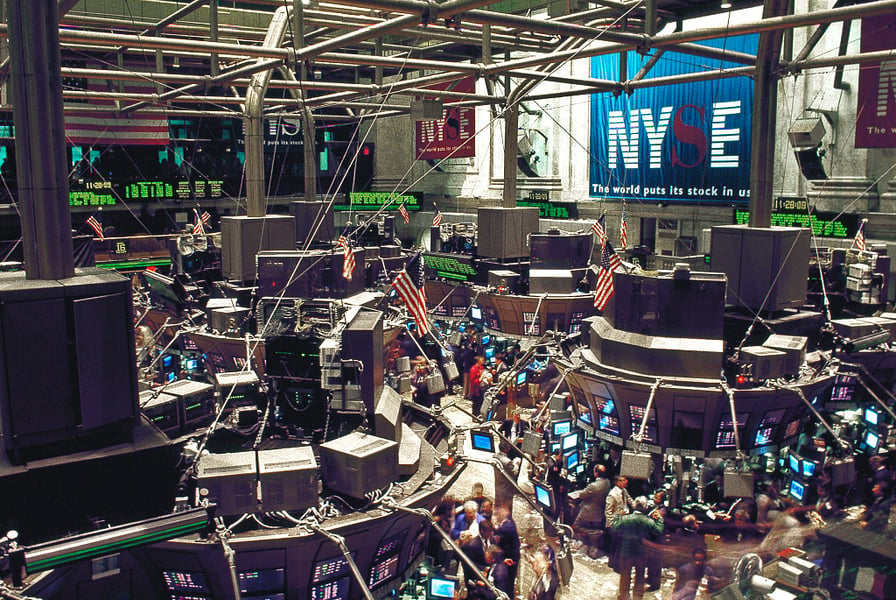

NEW YORK — Someone who owns the Nasdaq 100 through a fund is 5.5 per cent below the high water mark. Someone who picked one of the hundred companies inside it is, on the median outcome, 17.6 per cent below theirs. Same index, same twelve months, and twelve percentage points between the wrapper and the contents.
That gap is what index concentration looks like when it is measured rather than asserted. The Nasdaq 100 weights its members by market value, so a small number of very large companies decide what the number on the screen does, and the rest go along for a ride that is not really theirs.
Monday made the point almost too neatly. The index fell 0.79 per cent to 29,077.17 in afternoon trading in New York while its members split down the middle: 51 higher, 51 lower, and a median move of one hundredth of one per cent. On a day when the typical Nasdaq 100 company did nothing at all, the index still lost ground, because the companies that matter to the arithmetic were the ones that fell.
This is not an argument that the index is broken. It is an argument that the index and the market it is supposed to describe have been telling different stories for a year, and that anyone quoting one as a proxy for the other is quoting the wrong number.
Nasdaq 100 Today: Fifty-One Up, Fifty-One Down, Index Lower
The Nasdaq 100 lost 0.79 per cent on Monday afternoon while the broader Nasdaq Composite lost 0.56 and the S&P 500 lost 0.21. The order of those three numbers is itself the story: the narrower and more concentrated the index, the worse it did, because the damage was in a handful of large names rather than spread across the market.
| Index | Level | Session | 1 month | 3 months | Below 52-week high |
|---|---|---|---|---|---|
| Nasdaq 100 (NDX) | 29,077.17 | -0.79% | +3.37% | -1.37% | -5.5% |
| Nasdaq Composite (IXIC) | 26,034.78 | -0.56% | +4.24% | -1.17% | -4.2% |
| S&P 500 (GSPC) | 7,658.19 | -0.21% | +3.32% | +2.47% | -2.0% |
| PHLX Semiconductor (SOX) | 11,457.49 | -2.41% | -3.06% | -6.11% | -21.8% |
| Live intraday quotes, not settlements. Distance from the 52-week high is Eastern Herald’s calculation from the quoted level. | |||||
The Index Is Not Its Members
Eastern Herald priced 102 companies from the Nasdaq 100’s membership and measured each against its own 52-week high. The result is a distribution that the index level hides completely.
Seventy-four of the 102 are more than 10 per cent below their high. Forty-seven are more than 20 per cent below, which is the threshold most desks would call a bear market if it happened to an index. Twenty-six are more than 30 per cent down and five have lost more than half their value from the peak. The index that contains all of them is down 5.5 per cent.
| Measure | Count | Share of sample |
|---|---|---|
| More than 10% below the high | 74 | 72.5% |
| More than 20% below the high | 47 | 46.1% |
| More than 30% below the high | 26 | 25.5% |
| More than 50% below the high | 5 | 4.9% |
| Median member, distance from its high | -17.6% | |
| The Nasdaq 100 itself | -5.5% | |
| Sample drawn from the Nasdaq 100 membership list and priced intraday; index membership changes and this sample may differ from the official constituent list on any given day. Percentages are of the 102 companies priced, not of a fixed 100. | ||
The deepest holes are worth naming because they are not obscure companies. The Trade Desk is 76.4 per cent below its 52-week high. MicroStrategy is 66.4 per cent down, CoStar 64.5, AppLovin 59.7, GlobalFoundries 50.3 and Zscaler 47.6. All of them sit inside an index that a casual reader would describe as within touching distance of a record.
Cap-Weighted Against Equal-Weighted
There is a cleaner way to test concentration than counting drawdowns, and it points in a direction that complicates the picture. Compare the cap-weighted index with an equal-weighted version of the same hundred companies, in which every member counts the same regardless of size.
Over the past three months the cap-weighted Nasdaq 100 has fallen 1.38 per cent. The equal-weighted version has risen 4.77. That six-point gap says the average member has been doing better than the index, not worse, and that the megacaps at the top have lately been the drag rather than the engine.
| Vehicle | Session | 1 month | 3 months | Below 52-week high |
|---|---|---|---|---|
| Cap-weighted (QQQ) | -0.81% | +3.42% | -1.38% | -5.5% |
| Equal-weighted (QQQE) | -0.46% | +5.87% | +4.77% | -2.3% |
| Gap, equal minus cap | +0.35 pt | +2.45 pt | +6.15 pt | +3.2 pt |
| Exchange-traded funds are used as the proxy because S&P and Nasdaq do not publish constituent weights on a free feed. Fund returns include fee drag and tracking difference, so treat the gap as an estimate of the concentration effect rather than an exact index computation. | ||||
Both findings are true and they are not in conflict. Over a full year the smaller members fell much further than the index, because the megacaps held it up. Over the past quarter the smaller members have been climbing back while the megacaps stalled. Concentration is not a one-way trade. It is a mechanism that hides whichever half of the market is not doing the work.
SpaceX Is Back at Its Listing Price
The newest large member illustrates the problem better than any statistic. SpaceX listed at $135 a share on June 12 and joined the Nasdaq 100 less than a month later, among the fastest inclusions the index has ever made. On Monday it traded at $135.21, sixteen hundredths of one per cent above its debut price and 40.1 per cent below the $225.64 it reached in between.
A company can round-trip an entire bull market inside a single quarter, be added to the index at the top of that arc, and leave the index level barely marked. That is the arithmetic working exactly as designed, and it is also why the index level is a poor description of what happened to anyone who bought.
Where Monday’s Damage Landed
The session’s losses were concentrated in hardware and in anything priced off memory. MongoDB fell 6.04 per cent, Micron 5.54, Super Micro 5.10, GlobalFoundries 4.18 and AMD 3.58, while Nvidia lost about 2.5 per cent and Broadcom about 2.1. The semiconductor index gave up 2.41 per cent and now sits 21.8 per cent below its own high.
The gains went to companies that buy chips rather than sell them. MicroStrategy rose 2.81 per cent, DoorDash 2.55, Costco 2.34, Booking 2.00, Meta 1.83 and MercadoLibre 1.83, and Microsoft added 1.13. Software held up almost everywhere except where it had run hardest, which is why Palantir fell 1.93 per cent on a day that otherwise favoured it. Our Nasdaq session column and the Dow column carry the rest of the tape.
What This Column Cannot Tell You Yet
We cannot publish exact index point contributions for the Nasdaq 100, because Nasdaq does not release constituent weights on a free feed and we will not estimate a weight and present it as a measurement. The equal-weighted comparison above is the honest substitute, and its limitations are stated in the table.
We also do not know which way the gap closes. The median member being 17.6 per cent below its high while the index is 5.5 per cent below its own resolves either by the large companies falling toward the rest or by the rest recovering toward the large ones, and the last three months point one way while the last twelve point the other. Anyone claiming to know which continues is guessing, and the honest position is that the index has stopped describing its own contents and has not yet told us why.
Related Posts