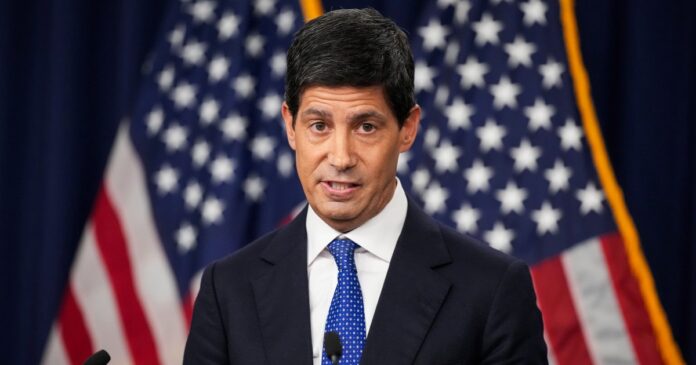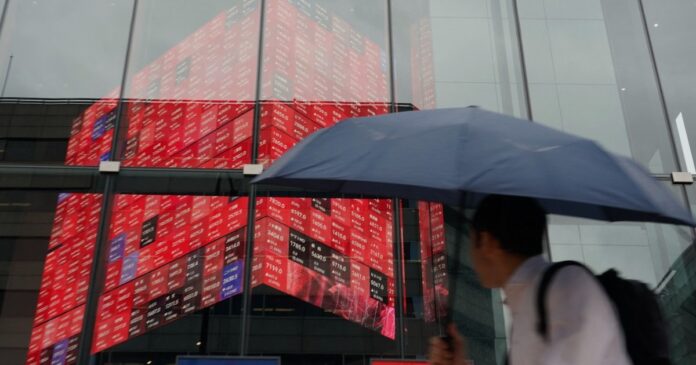

NEW YORK — S&P 500 futures slid in pre-market trading Thursday as Wall Street processed the implications of Federal Reserve Governor Kevin Warsh’s address to the Chicago Council on Global Affairs, delivered the previous evening in language blunt enough to produce immediate repositioning across futures desks. By the final pre-market hour, S&P 500 futures were down approximately 1.7%, signaling a broad open-market retreat before a single trade had cleared.
The nature of the pre-market move distinguished it from the kind of overnight volatility that reverses quickly at the open. Futures did not spike sharply and stabilize. They eroded steadily through the early morning hours as Warsh’s core arguments — that inflation risks are materially underpriced, that fiscal policy remains too expansionary for the Fed to achieve its 2% target on the market’s assumed timeline, and that institutional credibility requires the Fed to resist premature easing, as NBC News reported — propagated through desk notes, internal risk assessments, and position review processes across major institutions.
For S&P 500 futures specifically, the pre-market decline reflected two simultaneous pressures. The first was straightforward valuation compression: if the terminal rate is higher than markets had assumed, the present value of corporate earnings streams declines, and index futures pricing must adjust downward. The second was positioning adjustment: the S&P 500 had appreciated meaningfully through August on a rate-cut thesis, and any credible challenge to that thesis creates a mechanical need to reduce exposure.
| Stock | Close | % Change |
|---|---|---|
| Palantir (PLTR) | $74.35 | -3.8% |
| Nvidia (NVDA) | ~$220 | -2.7% |
| AMD | $148.32 | -2.9% |
| Meta Platforms (META) | $570.25 | -2.5% |
| Microsoft (MSFT) | ~$467 | -2.1% |
| Amazon (AMZN) | ~$228 | -1.9% |
| Apple (AAPL) | $211.47 | -1.6% |
Warsh’s standing within the Federal Open Market Committee gave his remarks particular weight. He is a voting member with a track record of monetary policy hawkishness and a history of speaking plainly rather than diplomatically. His decision to speak at this level of specificity — naming fiscal policy as a structural complication for the 2% target, describing inflation risk as materially underpriced, and linking the Fed’s credibility to its willingness to hold rates higher for longer — was not rhetorical embellishment. Futures traders parsed it as a signal about the distribution of sentiment inside the FOMC.
Sector rotation within the futures complex reflected familiar patterns. Technology futures led the pre-market decline, with contracts tracking semiconductor and software names falling roughly 2.2% to 2.5%. Financial sector futures showed more resilience, down approximately 0.6%, as traders weighed higher net interest margin potential against broader market pressure. Energy futures were mixed, and consumer staples futures held up relatively well, reflecting the defensive sector rotation that typically accompanies rate-path repricing.

The final market close confirmed what futures had signaled. The S&P 500 ended the session down approximately 1.9%, settling near 5,580. Technology led the decline at roughly 2.4% sector-wide, consistent with the pre-market positioning in futures. Financial stocks fell only around 0.8%, again consistent with the futures complex’s relative resilience reading. Approximately 380 of 500 S&P constituents closed lower, confirming the broad nature of the selling rather than a narrow technology correction.
For futures traders specifically, Thursday’s session re-establishes a key principle that had been somewhat obscured by the summer rally: the rate-cut thesis is not self-reinforcing. It requires ongoing confirmation from Fed communications that the committee is moving toward accommodation. When that confirmation is replaced by an explicit hawkish intervention from a credible FOMC voice, the futures complex cannot maintain the pricing that the rate-cut thesis had produced. It must correct.
What remains to be seen is whether the S&P 500 futures market has now priced a sustainably more hawkish path, or whether the Warsh speech will be interpreted, in subsequent sessions, as representing only the hawkish tail of the FOMC’s distribution. That determination will unfold across the next several weeks of Fed communications, culminating in the September meeting. Until then, as Fortune’s analysis of the Jackson Hole conference made clear, the pre-market signal that futures sent on Thursday morning is likely to remain the operative reference point for index risk.