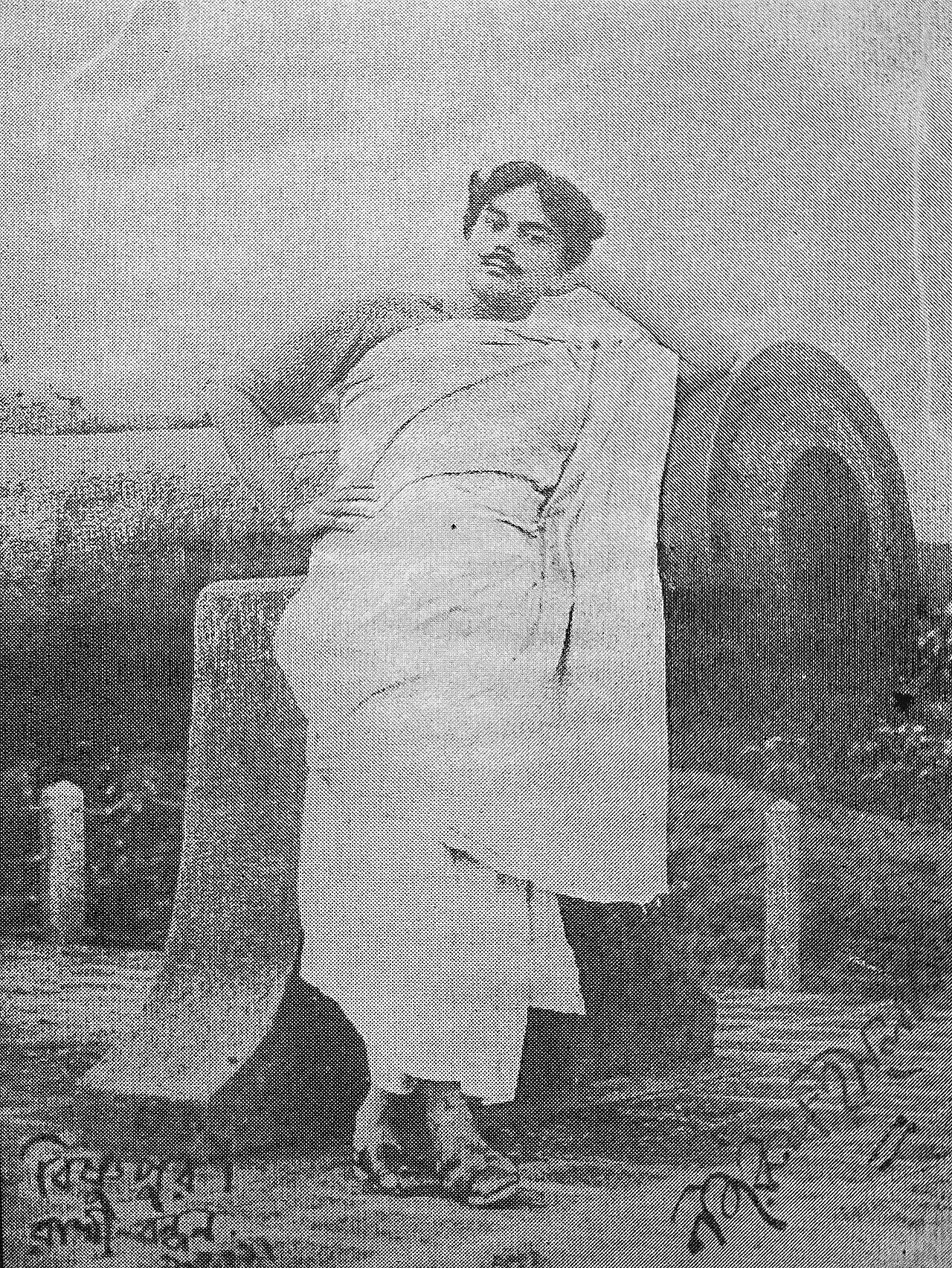

He spent thirty-four of his seventy-seven years unable to speak or write. Fifty years after his death, Kazi Nazrul Islam is the most fought-over voice in Bangladesh, and the fighting is happening at his graveside.
Since December a student leader shot in the head in Purana Paltan has been buried immediately beside him on the Dhaka University campus, a decision the poet’s family called unethical. Above that argument sits an official state observance: a year-long Nazrul Barsho, declared in May and running until May 2027, with a Nazrul Utsab promised in all sixty-four districts.
The fiftieth anniversary of his death falls on Saturday 29 August 2026, inside that official year. This is a reference profile of the man both sides are claiming: what he actually wrote, what the British jailed him for, what silenced him, and why the record is thinner than the commemorations suggest.
| Field | Detail |
|---|---|
| Born | 24 May 1899, Churulia, Burdwan district, Bengal Presidency (now West Bengal, India) |
| Died | 29 August 1976, Dhaka, aged 77. 12 Bhadra 1383 in the Bengali calendar |
| Parents | Kazi Fakir Ahmed, mosque imam, died 1908; Zahida Khatun |
| Childhood name | Dukhu Mia, the one with grief |
| Military service | 49th Bengal Regiment, Karachi, late 1917 to spring 1920; rose to havildar |
| Breakthrough | Bidrohi, written December 1921, published 6 January 1922 |
| Imprisoned | Sedition, 1923. One year’s rigorous imprisonment. Forty-day hunger strike in Hooghly Jail |
| Songs | 2,260 complete texts known; 2,872 first lines collected |
| Silence | July 1942 to August 1976. Thirty-four years without speech or writing |
| Brought to Bangladesh | 24 May 1972, on his 73rd birthday |
| National Poet of Bangladesh | Gazetted 24 December 2024, back-dated to 4 May 1972 |
| Buried | Dhaka University campus, north side of the university mosque |
| Song totals are the archival count. Figures in general circulation run to 4,000; Britannica hedges to between 2,000 and 4,000. | |
Who was Kazi Nazrul Islam?
He was born on 24 May 1899 in Churulia, a village in Burdwan district in what was then the Bengal Presidency and is now West Bengal in India. His father, Kazi Fakir Ahmed, was the imam of the village mosque and the caretaker of its mausoleum. He died in 1908, and the family fell into poverty sharp enough that the village gave the boy a name for it. They called him Dukhu Mia, the one with grief.
At around nine he took his father’s job. He became the muezzin of the mosque and the caretaker of the mazar, which is to say a child was calling grown men to prayer to keep his mother and siblings fed. Then he left it and joined a leto troupe, a Bengali folk-theatre company that performed poetry, song and dance, and where a performer was expected to compose verse on the spot. That is where the speed came from. It is also where a Muslim boy learned the Hindu puranas, and wrote plays with titles like Data Karna and Meghnad Badh before he was out of his teens.
His formal schooling was interrupted repeatedly for money. He worked as a cook in the house of a Christian railway guard and at a tea stall in Asansol, where a police inspector named Rafizullah found him and sent him back to school. He never sat the Entrance examination.
The army gave him Persian and his first byline
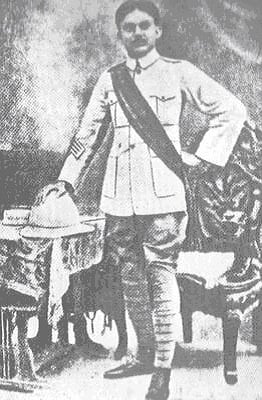
Towards the end of 1917, aged eighteen, he joined the 49th Bengal Regiment of the British Indian Army and was posted to Karachi Cantonment. He served roughly two and a half years and rose to havildar, the battalion quartermaster.
What he did with the posting matters more than the rank. He learned Persian from the regiment’s Punjabi moulvi and read Hafiz in the original. He practised music with other soldiers on local and foreign instruments and heard western structures through the military bands, which is audible in his songs decades later. He subscribed to the Kolkata literary journals and started sending them work. His first prose, Baunduler Atmakahini, ran in Saogat in May 1919. His first published poem, Mukti, appeared in the Bangiya Mussalman Sahitya Patrika that July. The National Encyclopedia of Bangladesh puts it flatly: it was at Karachi cantonment that his literary activities truly began.
Bidrohi, Dhumketu and a year of rigorous imprisonment
He wrote Bidrohi, The Rebel, in Kolkata in December 1921. It ran in the weekly Bijli on 6 January 1922 and was reprinted almost immediately by four other journals. Collected into Agni-vina later that year, it sold out its first edition on release. Kabir Chowdhury’s standard English translation opens on the line that every Bengali schoolchild still knows: “Say, Valiant, say: High is my head.”
In August 1922 he launched Dhumketu, The Comet, which became in practical terms the mouthpiece of the revolutionaries after non-cooperation and Khilafat had both collapsed. Rabindranath Tagore wrote the blessing that ran on its masthead, telling the comet to blaze in darkness a bridge of fire and hoist its flag of victory atop this fortress in distress. Within six weeks the government proscribed the issue carrying Anandamayir Agamane, a poem about the arrival of the goddess Durga that was not really about Durga.
| Date | Event |
|---|---|
| 12 Aug 1922 | Dhumketu launched, carrying Tagore’s blessing on its masthead |
| 26 Sep 1922 | Anandamayir Agamane published; the issue is proscribed |
| 23 Nov 1922 | Yugavani proscribed and Nazrul arrested at Comilla, charged with sedition |
| 7 Jan 1923 | Delivers his defence, later published as Rajbandir Jabanbandi |
| 16 Jan 1923 | Convicted. One year’s rigorous imprisonment |
| 22 Jan 1923 | Tagore dedicates his musical play Basanta to him while he is in Alipore Jail |
| 14 Apr 1923 | Moved to Hooghly Jail; begins his hunger strike the same day |
| 22 May 1923 | Breaks the strike after a visit from Dr Abdullah Suhrawardy |
| 18 Jun 1923 | Transferred to Behrampur Jail |
| 15 Dec 1923 | Released, after a year and three weeks |
| English-language aggregators widely give the arrest as 23 January 1923 and the sentence as three months. That chronology cannot be reconciled with the dated court record above; Banglapedia’s is used here. | |
The defence statement he gave in the chief presidency magistrate’s court on 7 January 1923 is Rajbandir Jabanbandi, the Deposition of a Political Prisoner, and it is read in Bangladesh as literature rather than as a legal filing. It did not work. He got a year’s rigorous imprisonment.
The songs, and the number nobody agrees on
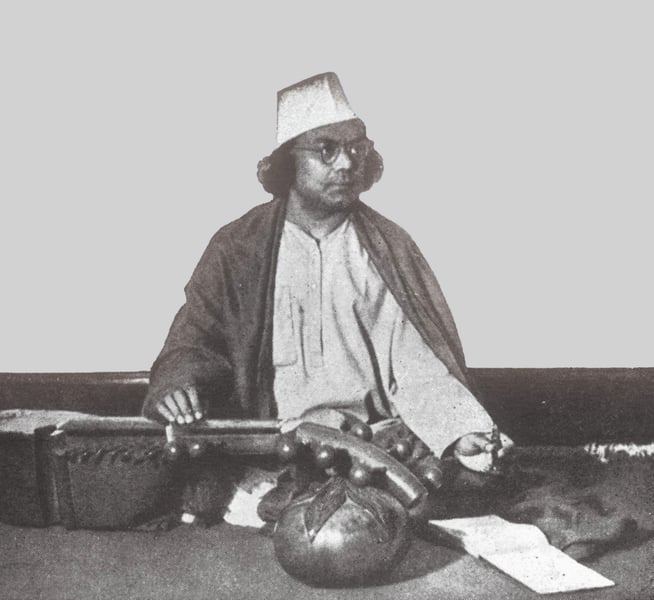
Nazrul Sangeet is the reason he is sung rather than only read, and the reason he survives in Bengali literary life as performance rather than as syllabus. The song count is where most accounts stop being careful. The figure in general circulation is four thousand. Britannica hedges to somewhere between two thousand and four thousand. Banglapedia, whose entry is by the Nazrul scholar Rafiqul Islam, says two thousand odd. The archival count is the one worth using because it has a method behind it: complete texts of about 2,260 songs are known, and first lines of 2,872 have been collected. The gap between 2,872 and 4,000 is not a rounding error. It is songs nobody can produce.
| Label | Records |
|---|---|
| HMV | 567 |
| Twin | 280 |
| Megaphone | 91 |
| Columbia | 44 |
| Hindustan | 15 |
| Senola | 13 |
| Pioneer | 2 |
| Viellophone | 2 |
| Regan | 1 |
| Total | Over 1,000 |
| Records, not songs. He was an exclusive HMV composer from 1928 to 1932 and again from 1933. Around 50 of his songs were used in films to 1945, and 182 across 20 Kolkata stage plays between 1929 and 1941. | |
What he did with those songs is the part that the current argument turns on. He created the Bengali ghazal, beginning at Krishnanagar in late 1926, building the form on Urdu structure and Bengali words. Then, from 1930, he wrote devotional music in two religions at once. Banglapedia counts nearly a thousand devotional songs spanning shyamasangit, bhajan and kirtan from the Hindu traditions and hamd, nat and marsia from the Islamic ones. The same man wrote hymns of praise to the Prophet and hymns of praise to the goddess Kali, in the same years, for the same audience, out of the same conviction that the distinction was a con.
Claimed by everyone, because he refused to be claimed
He was not a comfortable figure for anyone while he was alive. He had no faith in Gandhi’s non-cooperation movement or in the Khilafat movement, believing only armed revolution would remove the British, and joined both anyway for the sake of a common front. He admired Mustafa Kemal rather than the sultanate the Khilafat was defending. He helped found a labour and peasant party, edited its weekly Langal, and translated The Internationale into Bengali. Eastern Herald examined his political ideology and activism in more detail on his birth anniversary in 2020.
He married Pramila Devi, from a Brahmo family, in late April 1924. Only her mother approved. The Brahmo Samaj attacked her for marrying a Muslim and Muslim clerics attacked him for marrying a Hindu, and his own family cut him off. He was condemned by both communities for the same act, which is the personal version of what he was doing on the page. The line he wrote in Behrampur jail in 1923 reads, in Banglapedia’s rendering, that the communal cheats are gambling in the name of caste and creed.
His four-year-old son Bulbul died of smallpox in May 1929. Many who knew him treat that as the hinge of his life. He turned inward, and at the boy’s sickbed he translated the Rubaiyat of Hafiz.
Fifty years, and a grave that is now contested
In July 1942, within a year of Tagore’s death, he lost his voice and his memory. He was forty-three. He never wrote or spoke again. Doctors tried homeopathy, Ayurveda, an asylum, a psychiatric hospital at Ranchi, London and Vienna, and none of it worked. A neurologist in Vienna, Hans Hoff, later suggested Pick’s disease, a rare neurodegenerative condition. That attribution is retrospective, made without modern imaging, and Banglapedia does not mention it at all.
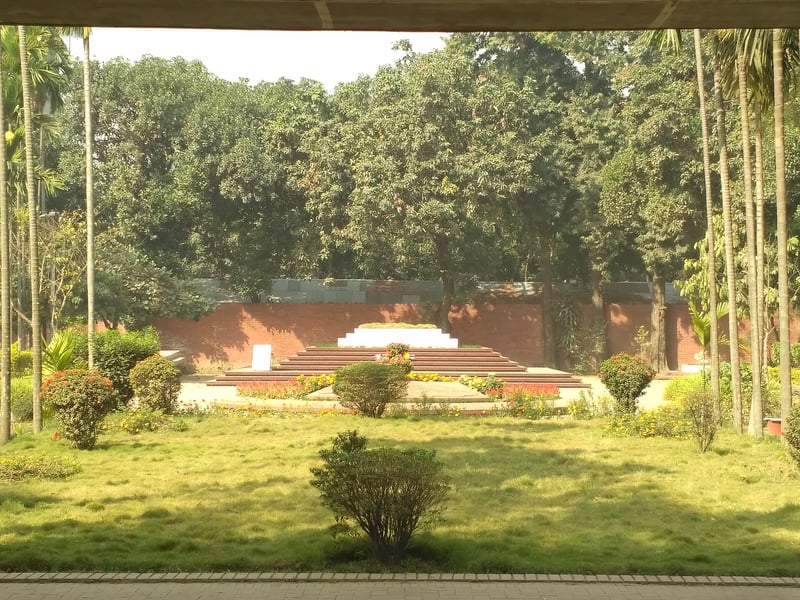
Bangladesh brought him to Dhaka on 24 May 1972, his seventy-third birthday, with the Indian government’s consent. Dhaka University gave him an honorary doctorate in December 1974. He was granted citizenship in early 1976 and the Ekushey Padak that February. He died on 29 August 1976 at the Institute of Post Graduate Medicine and Research, and was buried with state honours on the northern side of the Dhaka University mosque, because he had written a song asking to be buried beside a mosque so that from his grave he might hear the muezzin’s call. A man who spent thirty-four years unable to ask for anything was given the one thing he had asked for in writing.
The formal declaration took longer than most people assume. The Kazi Nazrul Islam Institute Act of 2018 called him the national poet, but no gazette was ever issued until 24 December 2024, when one was signed and back-dated to 4 May 1972.
Then, on 20 December 2025, Sharif Osman Hadi was buried at his feet. Hadi was thirty-two, a spokesperson for Inqilab Moncho and an activist in the July Uprising, shot in Purana Paltan on 12 December and dead in Singapore a week later. Al Jazeera reported the state funeral at Parliament’s South Plaza and the burial next to the national poet. The Kazi family objected to the choice of site and said they feared Nazrul’s grave might not remain where it is. The burial landed in a country already arguing about who owns its history, less than two months before an election and while the record of the previous government was itself being litigated.
What is still not known
Three things are missing from this piece and their absence is the point.
No programme for 29 August 2026 has been published. An international conference to mark the anniversary, with scholars expected from Turkey, Iran, Pakistan and India, is reported by the state news agency as planned but has no confirmed date. Six days out from a fiftieth anniversary that the state has wrapped inside an official year, there is no schedule.
The song count cannot be closed. Somewhere between a thousand and seventeen hundred songs attributed to him exist only as a first line or as a claim.
And nobody knows what silenced him. The Pick’s disease attribution rests on one clinician’s opinion in Vienna in the early 1950s. Fifty years after his death and eighty-four years after he stopped speaking, the most basic question about Kazi Nazrul Islam has no answer: what happened to him in July 1942.
Kazi Nazrul Islam: frequently asked questions
Who was Kazi Nazrul Islam?
Kazi Nazrul Islam was a Bengali poet, songwriter, journalist and anti-colonial activist, born in India in 1899 and buried in Bangladesh in 1976. He is the national poet of Bangladesh, a status formally gazetted on 24 December 2024 and back-dated to 4 May 1972.
When did Kazi Nazrul Islam die?
He died on 29 August 1976, 12 Bhadra 1383 in the Bengali calendar, at the Institute of Post Graduate Medicine and Research in Dhaka, aged seventy-seven. The fiftieth anniversary falls on Saturday 29 August 2026.
Why is Kazi Nazrul Islam called the rebel poet?
The name comes from Bidrohi, or The Rebel, written in December 1921 and published in the weekly Bijli on 6 January 1922. It broke the register of Bengali poetry and made him famous almost overnight.
Was Kazi Nazrul Islam imprisoned by the British?
Yes. He was arrested at Comilla on 23 November 1922 over his magazine Dhumketu and the essay collection Yugavani, convicted of sedition on 16 January 1923 and sentenced to a year’s rigorous imprisonment. He was released on 15 December 1923. He also ran a forty-day hunger strike in Hooghly Jail from 14 April 1923, protesting the treatment of political prisoners.
How many songs did Kazi Nazrul Islam write?
The popular figure is around four thousand and Britannica hedges to between two thousand and four thousand. The archival count is lower and more defensible: complete texts of roughly 2,260 songs are known and first lines of 2,872 have been collected.
Why did Kazi Nazrul Islam stop writing?
He lost his voice and memory in July 1942, aged forty-three, and never wrote or spoke again for the remaining thirty-four years of his life. A neurologist in Vienna later suggested Pick’s disease, but the diagnosis was never confirmed and is absent from Banglapedia’s account.
Where is Kazi Nazrul Islam buried?
On the Dhaka University campus, on the northern side of the university mosque, in accordance with his own song asking to be buried beside a mosque so that he could hear the call to prayer from his grave.
What is Nazrul Barsho?
A year-long official observance running from 25 May 2026 to 25 May 2027, declared at Trishal in Mymensingh, with a Nazrul Utsab planned in all sixty-four districts of Bangladesh.
Related Posts