
MESSINA — The call came late Sunday morning, and museum director Marisa Mercurio could not find the words to describe what Messina had just lost. “We are devastated by what happened,” she said. “They were two of Antonello da Messina’s most important and best-known works.”
Sometime around 9:50 p.m. on Saturday, while the city’s center was still warm with the last of the Ferragosto crowds, a team of thieves made their way along Viale Annunziata to the perimeter of the MuMe Regional Interdisciplinary Museum. What followed was swift and practiced: metal fencing cut, a side door forced open, an armored glass display case breached. By the time cultural officials went public on Sunday morning, four Renaissance works by Antonello da Messina, valued collectively at up to 80 million euros, had disappeared.
Italy has suffered spectacular art thefts before. But this one carries a particular wound. The works taken are not Italian in a general sense; they are Messinese. Antonello da Messina, born in this Sicilian port city in the 1430s and trained in Naples under Flemish influence, produced a body of devotional and portrait paintings so technically refined that historians credit him with introducing oil painting to Venice and reshaping the arc of European Renaissance art. Italy, whose Prime Minister Giorgia Meloni has repeatedly positioned the country’s cultural sovereignty at the center of her European agenda, now confronts one of its most significant art losses in recent memory.
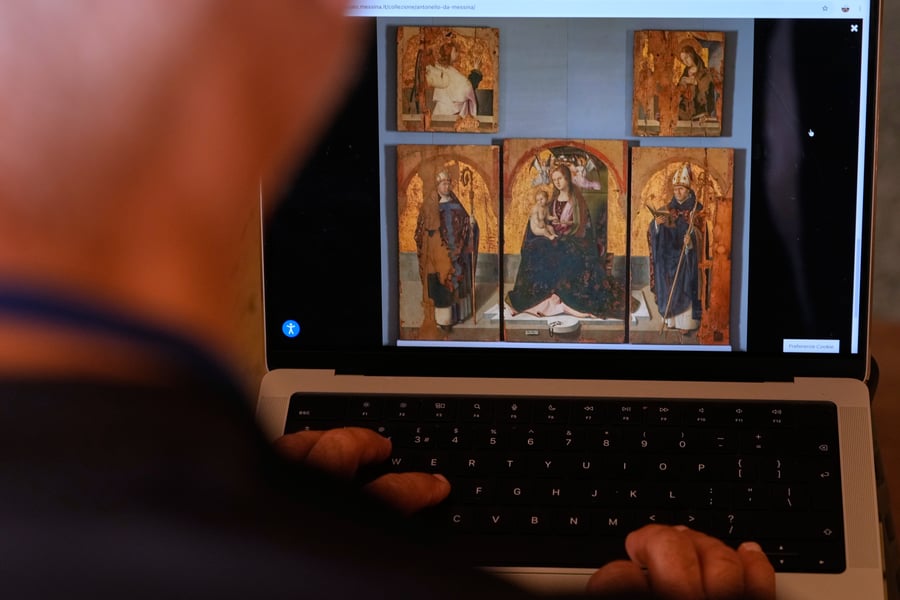
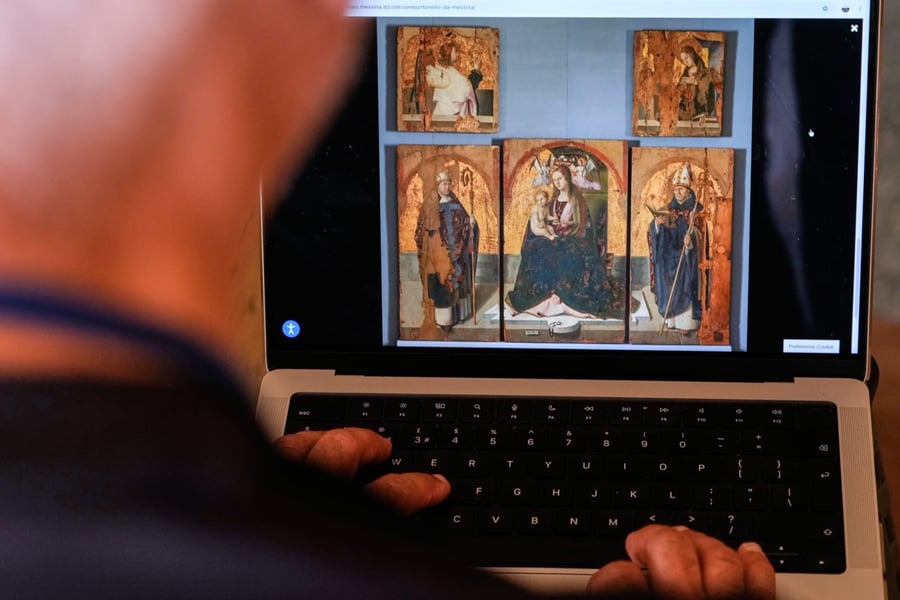
The double-sided tempera panel taken Saturday night was among the rarest of Antonello’s surviving works, painted between 1465 and 1474 and depicting the Virgin and Child with a Franciscan Monk on one face and Christ in Pieta on the other. The three sections of the San Gregorio Polyptych, commissioned in 1473 for the Santa Maria monastery and reassembled at MuMe after centuries of dispersal, represent the closest surviving picture of what a complete Antonello altarpiece looked like in the church for which it was made. Together, the four pieces were assessed at up to 80 million euros, roughly $93 million at current exchange rates. For Sicilian cultural officials on Sunday, that number barely captured what was actually missing.
Enzo Caruso, the Messina region’s culture councillor, reached for a different measure. “Nobody in Messina could have imagined a real movie-style heist like at the Louvre,” he said. What the phrase points to is precision, not drama. Cutting through a reinforced perimeter fence, forcing a museum side door, and breaching an armored glass display case in order to extract fragile five-hundred-year-old panel paintings without damaging them requires planning that does not happen in a week.
The Ferragosto holiday was not incidental to the timing. It was the reason for it.
Ferragosto, Italy’s national midsummer festival concentrated around August 15, the feast of the Assumption, draws security attention toward public gathering points and leaves cultural institutions with reduced staffing. Messina’s Vara procession, a centuries-old celebration on the same feast day, had pulled thousands into the city center the night before. Antonello spent much of his career painting the Virgin’s Assumption. The thieves who took his work appear to have known the calendar well enough to use it.
Italian authorities announced an investigation Sunday, though no suspects had been identified by the time the theft became public. As Al Jazeera reported, the heist was disclosed less than twelve hours after it occurred, with both the museum and regional cultural officials confirming the loss.
Italy holds more UNESCO World Heritage sites than any other country, and the concentration of its cultural institutions has made the nation a persistent target for professional theft operations. In a year when Italy’s 2026 Winter Olympics at Cortina d’Ampezzo drew global attention to the country’s cultural landscape, the Messina heist arrives as a reminder of how inadequately guarded much of that landscape remains. Italy’s Carabinieri TPC, the dedicated cultural property protection force, coordinates with Interpol to track stolen objects across international art markets, but their effectiveness depends on works eventually entering those markets, which the most valuable stolen paintings rarely do.
The 1969 theft of Caravaggio’s “Nativity with St. Francis and St. Lawrence” from an oratory in Palermo, a few hours’ drive from Messina, remains unsolved after 57 years. The painting has never been found. Whether the Antonello panels were taken to order for a collector who will never display them publicly, or taken speculatively and held while attention fades, the outcome in either scenario is the same: the works leave Messina, and the investigation waits for an art market to surface something that may never appear.
For Messina, the loss is institutional and intimate in equal measure. The MuMe collection was assembled from churches and private holdings across the province after Italian unification, preserving objects that had survived centuries of war, theft, and dispersal. The San Gregorio Polyptych had waited that long to be restored and properly displayed together. On Saturday night, someone took it again.