
NEW DELHI — The guard changes at the forecourt of Rashtrapati Bhavan every Saturday at ten in the morning, and it will change again this Saturday. The reason that is now news is that on Friday afternoon the President’s office said it would not.
The press note went out at about two o’clock and ran to two sentences. The Change of Guard ceremony would not take place on 22 August, it said, “due to the full rehearsal for the ceremonial welcome of the Prime Minister of Bangladesh.” Shortly after three a second note followed. The release issued on the subject “No Change of Guard Ceremony this Saturday” now “stands withdrawn.”
No reason was given for the withdrawal, and none has been given since.
What makes a cancelled parade worth writing about is that neither India nor Bangladesh has announced that Tarique Rahman is coming. A ceremonial welcome at the forecourt is the reception India stages for a visiting head of government, and a full rehearsal is the thing that happens the day before one. For roughly an hour on Friday, a housekeeping note about a public ceremony was the only official document in either country indicating that the preparations were under way. Then it was not a document at all.
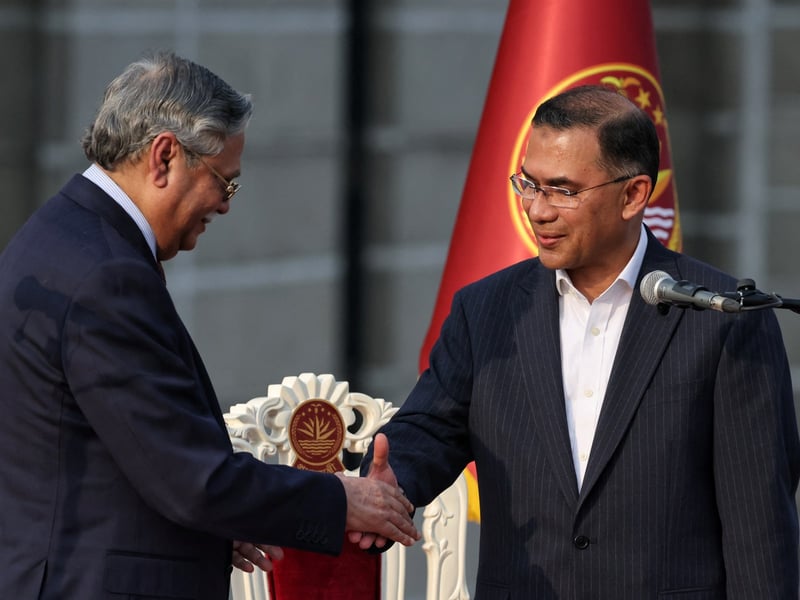
Rahman was sworn in on 17 February after the Bangladesh Nationalist Party won a two-thirds majority in parliament, Dawn reported, returning his family’s party to power after nearly two decades. President Mohammed Shahabuddin administered the oath at the South Plaza of the national parliament building rather than at Bangabhaban, a break with long practice that Al Jazeera noted at the time. Narendra Modi invited him to India within days, according to India’s public broadcaster. Six months on, the invitation has produced no visit, and the trip Rashtrapati Bhavan briefly appeared to be rehearsing for would have been his first to Delhi as prime minister.
The reason it has taken six months is living in India. Sheikh Hasina has been in the country since she fled Dhaka in August 2024, and Bangladesh’s International Crimes Tribunal issued arrest warrants for her in July on crimes against humanity charges. Eastern Herald reported at the time that the 2013 extradition treaty gives Delhi legal grounds to refuse any formal request, which is the quiet structural fact underneath every meeting the two governments have not yet held. Dhaka’s irritation became public on 5 August, when Hasina held a virtual press conference from India on the second anniversary of her removal and the Bangladesh government condemned both the event and the platform that carried it.
The dates have been moving for a week. Bangladeshi newspaper reporting this month put the window at 20 to 25 August, with 20 to 21 and 21 to 22 both under discussion between the two foreign ministries. Some Indian reporting on Friday put it later still, at 23 to 25 August, while other Indian reporting the same day said Rahman was now unlikely to travel for the BRICS summit on 12 and 13 September either. Several windows, none settled, and a ceremonial rehearsal apparently scheduled against one of them.
The ceremony itself is not a small thing to cancel, though it is a routine one. It was reformatted in February 2025 into a longer public performance with a military band, and it is open to anyone who turns up with a photo identity card, according to the President’s own visitor information. Rashtrapati Bhavan calls it off fairly often, for national mourning or for state visits, and the notice is normally read by nobody except people planning their Saturday.
The wording was not unusual either. In April the Press Information Bureau circulated an almost identical notice, cancelling the ceremony on 18 April for a rehearsal connected to the forthcoming state visit of a foreign president, naming the country. That one was not withdrawn. Which is presumably why the sentence naming the Prime Minister of Bangladesh made it out of the building on Friday. Somebody in the President’s Secretariat wrote down what the guards would be busy doing instead, in the form the office always uses.
Indian reports on Friday attributed the recall to the Ministry of External Affairs flagging that the visit had not been announced. Neither the President’s office nor the ministry has confirmed that on the record. Nor has either said whether the visit has been postponed, whether the dates have simply shifted, or whether the note was written against a schedule that was never firm in the first place. The withdrawal explains nothing. It is four lines of administrative language cancelling the earlier four lines.
The episode lands in a relationship that has been fraying steadily since the BNP returned to office, with border management, trade, visas, water sharing and energy all queued behind the single question of what India intends to do about the woman it is sheltering. A first visit by Rahman would have to address that question, or conspicuously avoid it, and either outcome is easier to manage if the arrival is announced by both capitals at a time of their choosing rather than by a note about ceremonial drill.
What is verifiable is small and precise. A statement was issued on 21 August. It named a foreign head of government. It was withdrawn within the hour. Everything else about the visit, including whether there is one, remains where both governments have kept it.
The guard changes at ten on Saturday morning. Whether anybody is rehearsing for anything else is, once again, not a matter of public record.