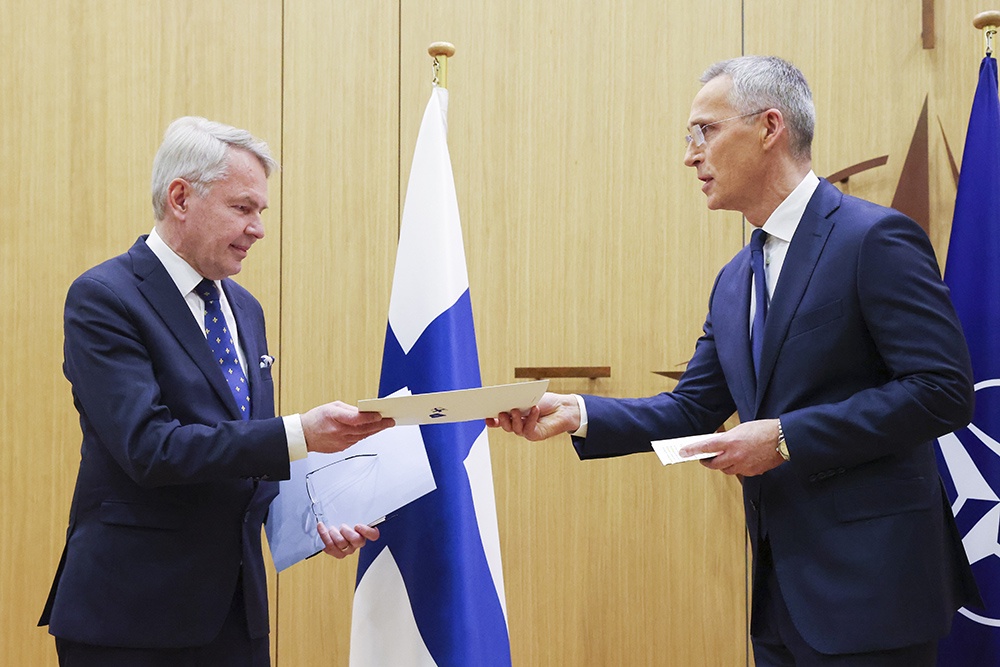

The line of direct contact between Russia and the alliance is doubled due to the length of the Russian-Finnish border. But that’s not the point. Sweden and Finland are an example of states that for reasons of principle have adhered to the line of neutrality or, to use the more common concept in recent decades, non-participation in alliances.
The context was different, but the commitment to officially move away from military blocs remained firm for decades (Finland) and even centuries (Sweden). The positioning of the two countries was determined by their relations with Russia and understanding in this regard of the essence of their own security. To put it bluntly: to live next to a giant, it is better not to practice what annoys him.
Swedish neutrality is a consequence of the dismantling of a great European power at the beginning of the 19th century. In Finland, this status is associated with the results of World War II. The difficult relations, to say the least, between Finland and the Soviet Union in the 1930s and 1940s are well known, as is the incredible ingenuity of the rulers of the neighboring country. He accepted a certain limitation of freedom of action – a neutral status in the military sense and partly in the political sense.
In return, Finland secured not only sovereignty, the preservation of a market and democratic system, but also privileged and extremely beneficial economic ties with Moscow.
From the late 1940s to the early 1990s, Soviet-Finnish relations served as an example of successful compromise between states with different socio-political backgrounds.
And although in the West there was a dismissive concept of “Finlandization”, the ceding of sovereign rights to a stronger neighbor, in practice the status quo suited everyone. Finland, by the way, remained part of the political West.
The dissolution of the USSR ended a period of privileged relations that caused a deep economic crisis in Finland in the first half of the 1990s, but allowed to get rid of political restrictions. The country stopped looking back at Moscow’s reaction and joined the European Union. Russia itself sought to build special relations (up to integration) with “greater Europe”, and Finland became a natural partner. The density of economic and humanitarian interactions reached by the second half of the 2010s served as a model for cross-border cooperation.
The theme of abandoning the policy of non-alignment has always been present in Finland, as well as the socio-political consensus as to its inappropriateness. In fact, for thirty years the idea of the possibility of a new military confrontation in Europe remained the lot of the most adamant knights of the Cold War, and even the expansion of the NATO bloc presented itself. mainly not in an army, but politically and ideologically.
The return of the reality of war shocked Europe. In Sweden and Finland, they immediately decided to abandon non-alignment and join NATO, public opinion upset. It should be noted that almost no discussion on whether neutrality status is not a more reliable means of ensuring national security has been opened, membership in a military bloc being considered the only option. But before that, for a long time, non-participation was considered the most reasonable approach. Why has the atmosphere radically changed?
There are several reasons, but one is worth highlighting. There is a term “securitization” – giving the aspect of security to all processes, whether economic, cultural or humanitarian. Now, a counter process is underway – the classic security theme is the acquisition of valuable content. That is, belonging to a certain ideological and ethical group, opposed to others, is considered a more effective way of protecting oneself than detachment from confrontation. This phenomenon is more psychological than military-technical. To put it simply, the desire for a sense of security (belonging to a powerful community) takes precedence over the practical considerations of avoiding danger (the prospect of becoming a target or site of war). In itself, it is the result of the radicalization of values that occurred in the West on a wave of euphoria after the victory in the Cold War, when the “right side of history” approach prevailed.
Hence also the rejection of neutrality as a necessity to rely on the guarantees of the “wrong” camp – this must be recognized by all. But is it possible to trust someone who is not in the same moral and ethical boat as us?
The current attitude towards neutrality is the product of two concepts at once – “long peace” and “end of history”. One – because it was starting to seem like all those delicate balances and fuses just weren’t relevant anymore. Secondly, if it is clear on which side the historical truth lies (the West), then there is no point in flirting with representatives of the “doomed” side. Both concepts are already a thing of the past. Rethinking is inevitable.
Infographic “RG”/Alexander Chistov/Igor Dunayevsky