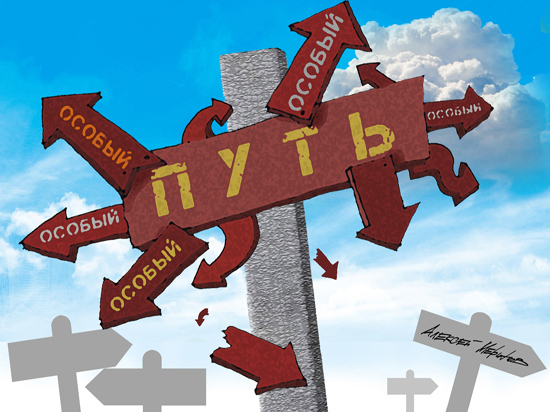

The question of national self-determination is the central and extremely painful problem of our self-awareness. “Who are we and where do we come from, while the gossip lingers from all these years and we are not in the world,” noted BL Pasternak. Indeed, for three decades now we no longer exist in the very capacity that in bygone times was referred to as “one historical community of the Soviet people”. So who are we? How are we different from other ethnic groups? What is our place in the global destiny of nations? All these questions affect both professional politicians, philosophers and culturologists, as well as ordinary inhabitants, who must daily make up their minds in relation to the guest workers “who have come in large numbers”, as well as to the hostile West, which offends us . At the everyday level, this problem also arises quite often – for example, when a son or daughter unexpectedly decides that his parents will marry a representative of a different culture and religion.
In such circumstances, the idea of our “special path” is extremely seductive, stroking the ambition (of philosophers and laymen alike). To be honest, the idea is not new. Historian and writer AV Obolensky rightly notes: “In itself, the ideologem of a ‘special path’ is not an original thing … Sometimes it is not devoid of comedy. In Latin American countries, at one time, a cliché was popular, which sounds funny and recognizable to our ears: “Argentinian sovereignty”, “special Chilean universal humanity”, “the Peruvian people are bearers of God”.
But let’s move quickly from the distant American continent to the expanses of the homeland near us. For the ruling class, starting with Ivan IV, including Nicholas II, I. Stalin and others, the recognition of a “special path” is the justification for its existence and its leading role in the history. The forms of elite self-assertion may be different: whether it is “Moscow is the third Rome” or “the USSR is the beacon of world socialism”, but the essence of this does not change.
Is it any wonder that the denial of a “special path” has always threatened almost inevitable reprisals for skeptics who question and criticize this ideologem. Is it enough to recall P.Ya. 1984?” subject to systematic repression.
The writer-historian AA Amalrik turned out to be a prophet in his own country: he got the terms wrong only slightly. In 1985, perestroika began, which led to the fact that six years later his predictions were confirmed: in 1991, the USSR collapsed. But for Amalrik personally, the price of such a prophecy is untimely death. The writer died at the age of forty-six.
In fact, the biblical maxim “There is no prophet in his country” does not refer to prophets (Cassander has always been, is and will be), but to the fatherland, which is only strong with the steps back and begins to see things clearly only after the catastrophe has occurred.
Contrary to the words of the march in the movie “Merry Fellows”: “when the country commands to be a hero, anyone becomes a hero in our country”, there are not so many heroes. There are only a few who are willing to make sacrifices in the name of truth, who have the courage to maintain an all-out defense against both the ruling power and the mob proclaiming hosanna to the authorities.
But accusing people of conformity isn’t worth it. The basic instinct of self-preservation powerfully dictates a person’s need to be like everyone else. And is it really so? How to see… It is known that the first aliyah (repatriation of the Jews to Israel) brought selfless ascetics to Palestine, enthusiastic about the idea of creating their own Jewish state. The hard work in the kibbutzim (agricultural communes) also fell on everyone’s shoulders. After the resignation, ministers, generals and deputies returned to the commons, where they continued to work on a common basis. Ownership was common, the products of production and the profits received were distributed equitably. Add to this the general armament of the people. It would seem – here it is, the triumphant communist ideal. Flights under such conditions were excluded. But it couldn’t last forever. No one can remake human nature, although ideas for reforging people (mainly in camps) were practiced in the Stalin years, for example, when building the White Sea Canal. Thus, the first flight took place. David Ben-Gurion, one of the founders of the creation of the State of Israel, remarkably reacted to this event: “We are the same as everyone… We are the same as everyone”, he proclaims. he happily.
Bribery and corruption scandals exist in every country. But they can only be limited by a rigid and intelligible legal system, which, in turn, comes into close combat with the ideologem of a “special path” of development. The poet-satirist B. Almazov adequately reacted to this return in the second half of the 19th century:
For organic reasons
We are not supplied at all.
common sense legal,
This demon of Satan.
Russian nature is wide,
Our truth is the ideal
Does not fit in narrow molds
legal beginnings.
Nevertheless, willy-nilly, it will be necessary to climb the legal framework, going beyond the legal nihilism that has gnawed away at flesh and blood. After that, of course, life will not become perfect, but it will become normal.
Incidentally, I note that “doing like everyone else” does not mean dissolving without a trace and disappearing forever into the cosmopolitan cauldron. On the contrary, by relying on the fundamental principles and rules of organization of human communities worked out by history, nations and peoples will have an excellent opportunity to preserve their identity and at the same time to keep pace with progress. An excellent example in this regard is set by Japan and South Korea, which, without losing their originality, are successfully modernizing all spheres of life according to the most modern models.
As for education, national education is above all a good education which integrates all the world tendencies.
Related Posts