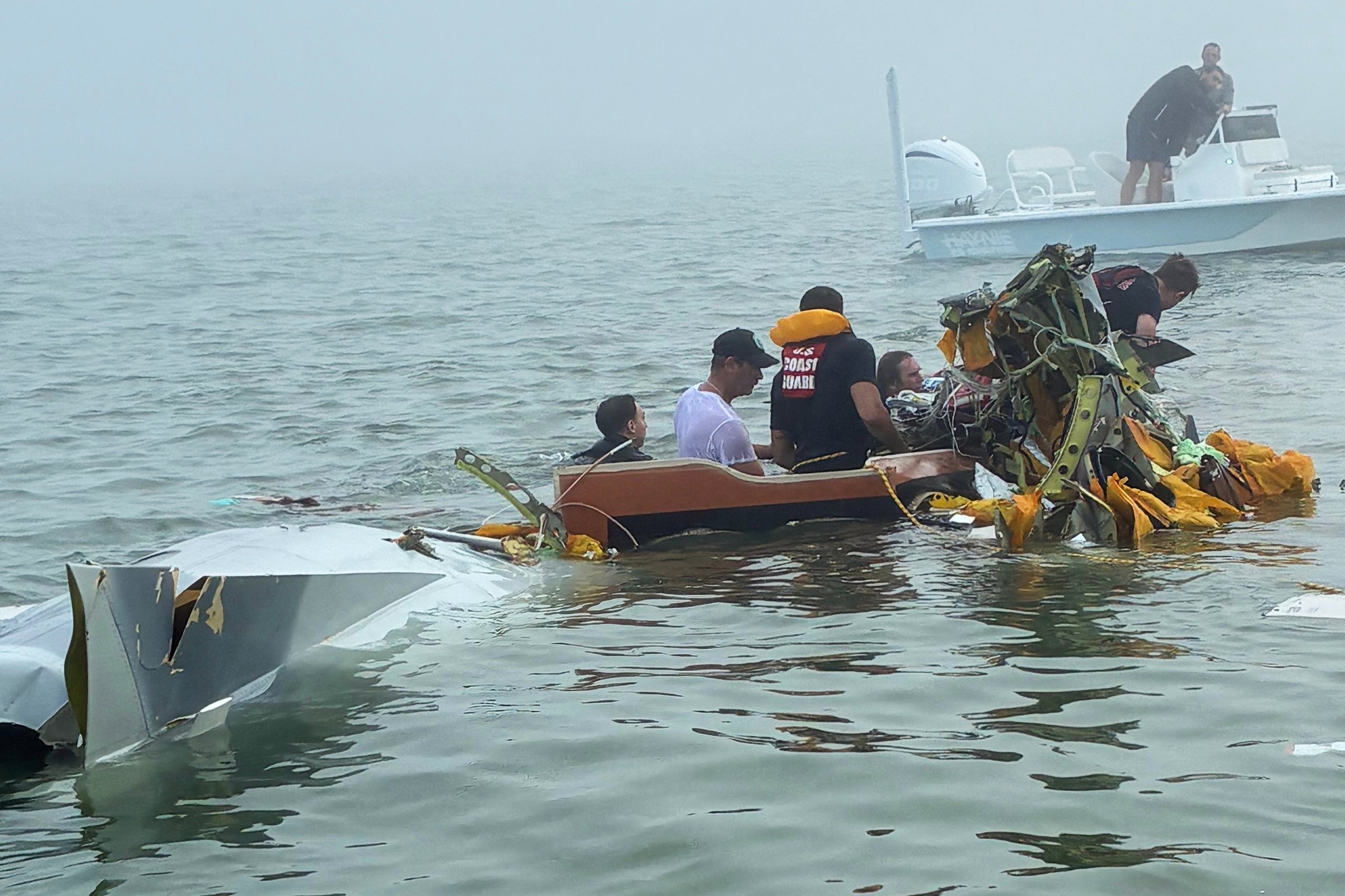

A Mexican Navy aircraft carrying critically ill burn patients plunged into the frigid waters of Galveston Bay on Monday afternoon, claiming six lives in a tragedy that transformed a humanitarian mission into a desperate rescue operation. The medical flight, operated in partnership with the nonprofit Michou y Mau Foundation, lost communication with air traffic control approximately ten minutes before crashing just west of the Galveston Causeway as dense fog enveloped the Texas coastline.
The twin-engine aircraft carried eight people, four Mexican Navy personnel and four civilians, including burn victims being transported to receive specialized treatment. Only two survivors emerged from the wreckage, both in stable condition receiving medical care at area hospitals. Among the deceased was a two-year-old child, according to officials who confirmed the final death toll after recovering the last missing passenger’s body from the submerged fuselage.
The US Coast Guard received the initial distress call at approximately 3:17 p.m. local time, immediately deploying a 29-foot Response Boat and an MH-65 Dolphin helicopter from Air Station Houston. Galveston Police Department, Galveston Fire Department, Beach Patrol, lifeguards, and the Galveston County Sheriff’s Department converged on the crash site within minutes, their efforts hampered by deteriorating visibility and the aircraft’s near-complete submersion beneath the bay’s murky surface.

Radio transmissions from the scene captured the urgency as first responders coordinated their efforts. “Marine unit, we’re going to need a sledgehammer or other tools to get into the plane,” one emergency worker radioed. “If you can send a boat to Jamaica Beach, extrication tools are waiting at Galveston Bay Tackle.” Another voice crackled through the airwaves moments later: “Just be advised, the female we pulled out of the water has a compound fracture to her right leg.”
Heroic actions by civilian bystanders proved critical in the initial rescue efforts. Sky Decker, a professional yacht captain residing near the crash site, witnessed the aircraft’s final moments and immediately sprang into action. He transported two Galveston police officers to the almost entirely submerged plane before diving into the frigid December waters himself. Decker located a badly injured woman trapped inside the wreckage, a discovery that enabled authorities to extract one of the two survivors.
“Everyone was just waiting for divers to arrive. And I thought if there’s a woman alive in that plane, she’s not going to be alive for long,” Decker recounted in interviews with media outlets. “It was critical to get her out of there.” His swift response exemplified the coordinated civilian and official response that characterized the rescue operation, even as the grim reality of multiple fatalities became apparent.
The Mexican Secretariat of the Navy released a series of statements throughout Monday evening and into Tuesday, initially reporting four survivors and two confirmed deaths. “Our aircraft, which was carrying out a medical support mission in coordination with the Michou y Mau Foundation, crashed while approaching landing near Galveston, Texas,” the department announced on social media platform X. As search operations continued through the night, that initial assessment proved tragically optimistic.
By Tuesday afternoon, the death toll had climbed to six. “With the support of local authorities, the body of a person who was previously reported missing has been located. Unfortunately, the person was found without signs of life,” the Mexican Navy Secretariat confirmed in its updated statement. The agency extended condolences to victims’ families while pledging full cooperation with US authorities investigating the catastrophe.
Weather conditions at the time of the crash played a significant role in both the accident itself and the subsequent rescue complications. Dense fog had settled across Galveston Bay, reducing visibility to dangerous levels for aviation operations. The aircraft had been attempting to land at Scholes International Airport when it went down just north of the facility, suggesting the crew was in the final approach phase when disaster struck.
The loss of radio communication for several minutes prior to impact has emerged as a critical focus of the ongoing investigation. Mexican Navy officials confirmed the aircraft fell silent approximately ten minutes before the crash, a timeline that raises questions about potential mechanical failures, navigation difficulties in the fog, or other technical malfunctions. The Federal Aviation Administration and National Transportation Safety Board have launched parallel investigations, with teams examining wreckage recovered from the bay.
This medical mission represented a vital component of cross-border humanitarian cooperation between Mexico and the United States. The Michou y Mau Foundation, in partnership with the Mexican Navy, regularly facilitates medical transport for critically ill children requiring specialized treatment unavailable in their home regions. Burn victims, in particular, often need the advanced care provided at facilities like Shriners Children’s Hospital in Galveston, a world-renowned center for pediatric burn treatment.
Shriners Children’s Texas has established itself as a unique model of global surgery, serving patients from Central America, South America, and Mexico. The eight-story facility in Galveston maintains 30 beds, including 15 in its Pediatric Intensive Care Unit, performing more than 1,500 surgeries annually. The hospital has responded to numerous international burn disasters, sending medical personnel to Guatemala, Mexico, and other nations while coordinating patient transfers for the most severe cases.
The organization’s commitment to treating children from across the Americas has made medical transport flights like Monday’s mission routine occurrences. Shriners specialists have collaborated with the US Army’s Burn Flight Team on multiple occasions, including the 2018 evacuation of six critically injured pediatric burn patients following Guatemala’s Fuego volcano eruption. That successful mission, which saw patients safely transported to Galveston for life-saving treatment, stands in stark contrast to Monday’s tragedy.
Mexican officials have maintained close contact with the Mexican Consulate General in Houston throughout the crisis, coordinating family notifications and providing consular assistance to affected relatives. The secretariat pledged to release additional information as the investigation progresses, though the complexity of underwater wreckage recovery and forensic analysis suggests answers may not emerge quickly.
The Galveston County Sheriff’s Department dive team played a crucial role in recovering victims from the submerged aircraft, working in challenging conditions beneath the bay’s surface. The Texas Department of Public Safety has assumed the lead investigative role for state authorities, coordinating with federal agencies to piece together the sequence of events that led to the crash.
Previous incidents involving Mexican Navy aircraft have been relatively rare, though Mexico’s aviation sector has experienced several high-profile crashes in recent years. The specialized nature of medical transport flights adds additional complexity, as these missions often operate under compressed timeframes to deliver critically ill patients to treatment facilities as quickly as possible.
The two survivors remain under medical observation, their identities withheld pending family notifications and privacy considerations. Medical personnel have described their conditions as stable, though the physical and psychological trauma of surviving such a catastrophic event will require extensive care and rehabilitation. The survival of any passengers from an aircraft that crashed into water and became almost entirely submerged represents an extraordinary outcome, one made possible only through the immediate response of civilian rescuers and emergency services.
As investigators work to determine what caused this tragedy, the broader implications for medical transport operations and cross-border humanitarian missions remain unclear. The Michou y Mau Foundation’s partnership with the Mexican Navy has facilitated countless successful patient transfers over the years, providing life-saving access to specialized care for children who would otherwise face grim prognoses.
The international nature of the incident has necessitated unprecedented coordination between US and Mexican authorities at multiple levels. From the initial Coast Guard rescue response through ongoing investigative efforts, agencies from both nations have demonstrated the robust cooperative frameworks that exist for managing cross-border emergencies. The Mexican Secretariat of the Navy specifically acknowledged this collaboration in its public statements, praising the professionalism and rapid response of American rescue personnel.
For the Galveston community, the crash represents a tragic reminder of the risks inherent in aviation operations, particularly under adverse weather conditions. The city’s proximity to critical medical facilities makes it a frequent destination for emergency medical flights, creating a constant flow of air traffic that occasionally intersects with dangerous weather patterns sweeping in from the Gulf of Mexico.
The investigation into the crash will likely take months to complete, with federal investigators examining every aspect of the aircraft’s maintenance records, crew qualifications, weather conditions, and operational protocols. The recovery of the flight data recorder and cockpit voice recorder, if the aircraft was equipped with such devices, could provide crucial insights into the final minutes before impact.
For now, six families mourn their loved ones while a community reflects on the fragility of life and the courage of those who risk everything to save others. The medical mission that ended in tragedy was undertaken with the noblest of intentions, to deliver critically ill children to the specialized care they desperately needed. That such selfless humanitarian work could end in such devastating loss only amplifies the profound sadness surrounding this incident.
Related Posts