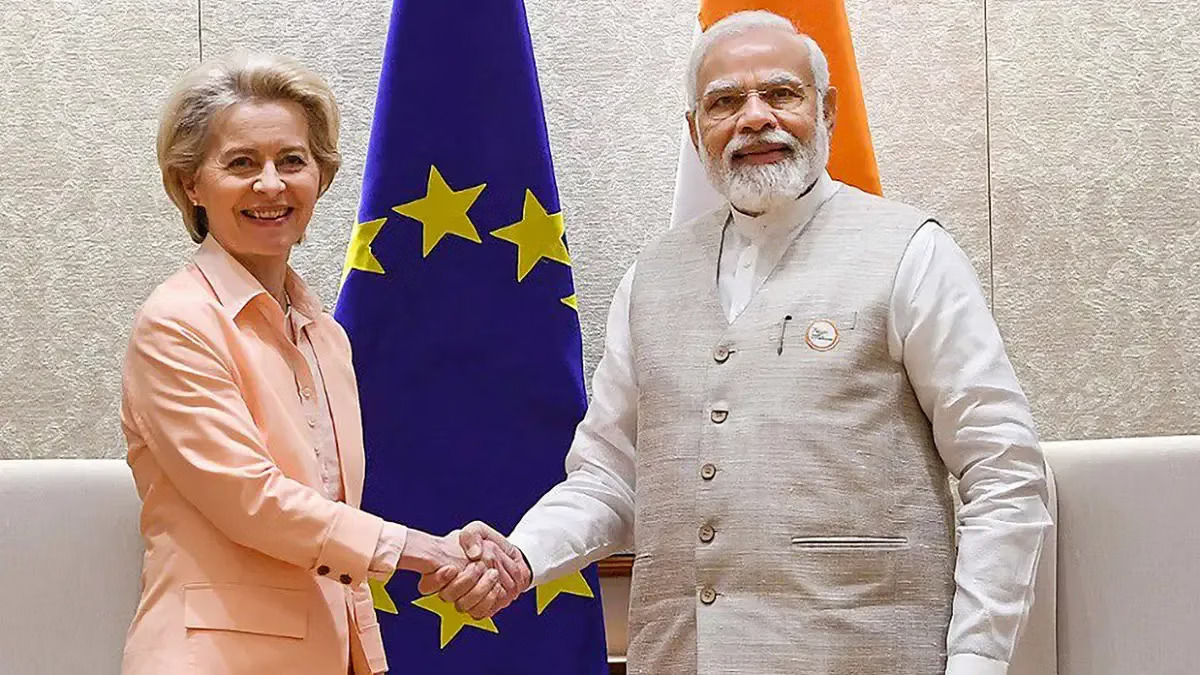

Senior European Union leaders arrived in India over the weekend for a high-profile diplomatic visit centered on trade negotiations, political coordination, and ceremonial engagement, as Brussels seeks to finalize a long-delayed free trade agreement with New Delhi amid shifting global economic conditions.
Antonio Costa, president of the European Council, and Ursula von der Leyen, president of the European Commission, are scheduled to meet India’s external affairs minister, Subrahmanyam Jaishankar, on Sunday. The visit will continue through Tuesday and includes participation in India’s 77th Republic Day celebrations, followed by summit-level talks with Prime Minister Narendra Modi.
Officials on both sides say the meetings are expected to culminate in an announcement on the conclusion of negotiations for an EU–India free trade agreement, a process that has stretched over nearly two decades and is now reaching its final stage. According to Reuters, negotiators have resolved most outstanding issues, opening the way for tariff reductions and broader market access.
The presence of the two EU leaders at India’s Republic Day parade marks the first time senior European Union officials have attended the event as guests of honor. The annual ceremony, which commemorates the adoption of India’s constitution, has increasingly become a platform for New Delhi to signal its diplomatic priorities and global partnerships, particularly as India positions itself within a multipolar world.
India has in recent years invited leaders from a diverse range of countries to the parade, reflecting its emphasis on strategic autonomy and diversified global engagement. European diplomats view the invitation as a sign of India’s growing importance in global affairs and Europe’s intent to deepen engagement with emerging powers.
Trade negotiations between India and the EU began in 2007 but were suspended in 2013 after both sides failed to bridge differences over tariffs, regulatory standards, labor protections, and environmental provisions. Talks were formally revived in 2022 as global supply chains were disrupted by geopolitical tensions and economic uncertainty.
For the European Union, the agreement is seen as a key component of its strategy to diversify trade ties and reduce overdependence on a limited number of markets. Slowing growth in several EU economies and persistent energy concerns have added urgency to securing new export destinations. India’s expanding consumer base and manufacturing sector have become central to Europe’s long-term economic calculations, even as New Delhi advances diversified trade partnerships beyond the West.
Indian officials, however, have emphasized that any agreement must preserve policy flexibility and protect domestic industries, particularly in agriculture, digital governance, and public procurement. New Delhi has maintained that trade liberalization should align with national development goals rather than external conditionalities.
Indian negotiators have taken a measured approach, aware that Europe is keen to conclude the deal as part of a broader push to strengthen economic resilience.
Beyond trade, the visit also reflects ongoing discussions about geopolitical coordination. European leaders have increasingly spoken of “strategic autonomy,” seeking to reduce vulnerabilities exposed by recent crises. India’s foreign policy, by contrast, has long been defined by strategic independence, maintaining ties with Russia and other major powers while avoiding formal alliances.
On Tuesday, Costa and von der Leyen will hold formal summit talks with Prime Minister Modi, followed by a joint press statement scheduled for 1:15 p.m. local time. The EU leaders will later meet President Droupadi Murmu at Rashtrapati Bhavan, the official presidential residence.
Discussions are expected to cover trade implementation frameworks, climate cooperation, technology standards, and supply-chain resilience. While officials have downplayed expectations of major announcements beyond the trade agreement, the meetings are seen as laying the groundwork for deeper institutional engagement.
The visit comes as emerging economies play an increasingly central role in shaping global trade and diplomacy. For the European Union, closer ties with India represent an acknowledgment of that shift. For India, the engagement reinforces its position as a pivotal actor whose cooperation is actively sought by major global blocs.
As Republic Day celebrations conclude and summit talks draw to a close, both sides are expected to emphasize continuity and pragmatism, signaling that EU–India relations are entering a more substantive phase after years of incremental progress.