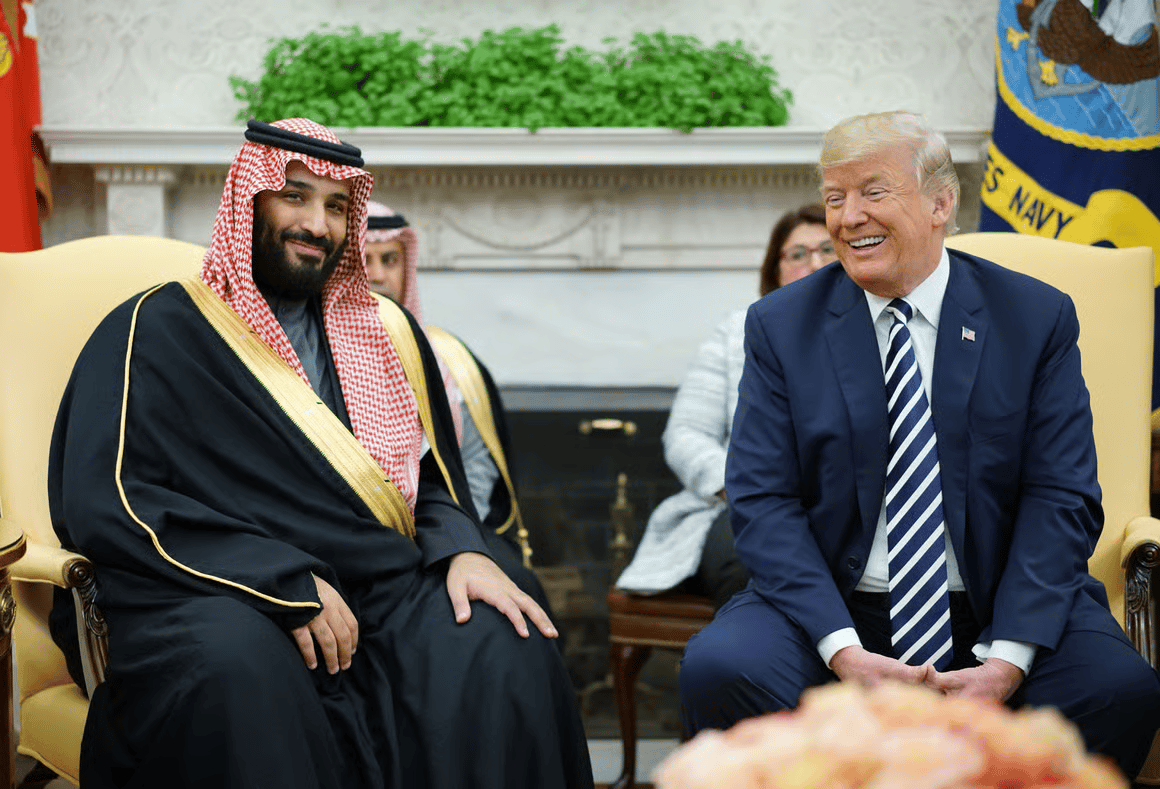

Donald Trump’s latest remarks about Saudi Arabia’s crown prince were not just crude, they were deeply revealing. Speaking at a high-profile investment forum, the US president claimed that Mohammed bin Salman “didn’t think he would be kissing my ass… but now he has to be nice to me,” openly framing a key geopolitical relationship in terms of personal dominance.
The statement has sparked widespread debate, particularly as it comes during a period of heightened regional instability. The war involving Iran continues to reshape the Middle East, drawing in global and regional powers while increasing the stakes for Saudi Arabia’s strategic positioning.
For decades, US–Saudi relations have been framed as a partnership built on mutual interests, energy, security, and regional stability. But Trump’s language cuts through that traditional narrative. By suggesting the Saudi crown prince “has to be nice,” he recasts the relationship as one shaped by pressure rather than partnership.
The contradiction in Trump’s remarks is equally striking. In the same speech, he mocked Mohammed bin Salman while also praising him as a “fantastic man” and a “warrior,” reinforcing reports that the crown prince remains one of Washington’s closest allies despite the rhetoric.
This dual messaging reflects a broader pattern in Trump’s foreign policy, alliances are often framed in personal and transactional terms. His use of blunt language has been widely interpreted as an assertion of leverage, with analysts noting growing scrutiny over US alliances as a result.
The timing makes the statement particularly consequential. Saudi Arabia is navigating a fragile geopolitical environment, attempting to balance cooperation with Washington while avoiding deeper entanglement in conflict. The kingdom’s posture of regional caution reflects fears that escalation could destabilize both its economy and security.
Trump’s remarks risk complicating that balancing act. Publicly portraying Saudi leadership as subordinate introduces a new layer of political sensitivity into a relationship that depends heavily on trust and coordination.
The Iran conflict remains central to this dynamic. Trump has suggested that the Saudi crown prince is aligned with Washington’s objectives, even describing him as actively supporting US efforts in confronting Tehran, signaling deeper coordination behind the scenes.
At the same time, Saudi Arabia’s position appears more measured. While cooperating on strategic concerns, it has shown reluctance to be drawn into a prolonged war that could threaten regional stability and long-term economic ambitions.
This is not the first time Trump has taken an unconventional approach to the Saudi leadership. His administration has previously defended Mohammed bin Salman and emphasized strong economic and political ties, reflecting what analysts describe as a shift in US policy toward Riyadh.
More broadly, the episode highlights a transformation in how US foreign policy is communicated. Traditional diplomacy relies on restraint and carefully calibrated language. Trump’s approach is markedly different—direct, personal, and often confrontational, blurring the line between negotiation and performance.
This shift carries implications beyond Saudi Arabia. Across the international system, there is a growing perception that alliances are increasingly shaped by power dynamics rather than mutual respect. That trend is reflected in a growing perception among US allies that the global order itself is evolving.
Despite the controversy, the structural foundations of US–Saudi relations remain intact. Strategic cooperation, economic ties, and shared security concerns continue to bind the two countries together.
But tone matters in international relations. By publicly reducing an ally to a position of subordination, Trump has exposed underlying tensions that are often hidden behind diplomatic language.
In a region already defined by volatility, that shift may have consequences that extend far beyond a single remark—reshaping perceptions of power, partnership, and the future of global alliances.
Related Posts