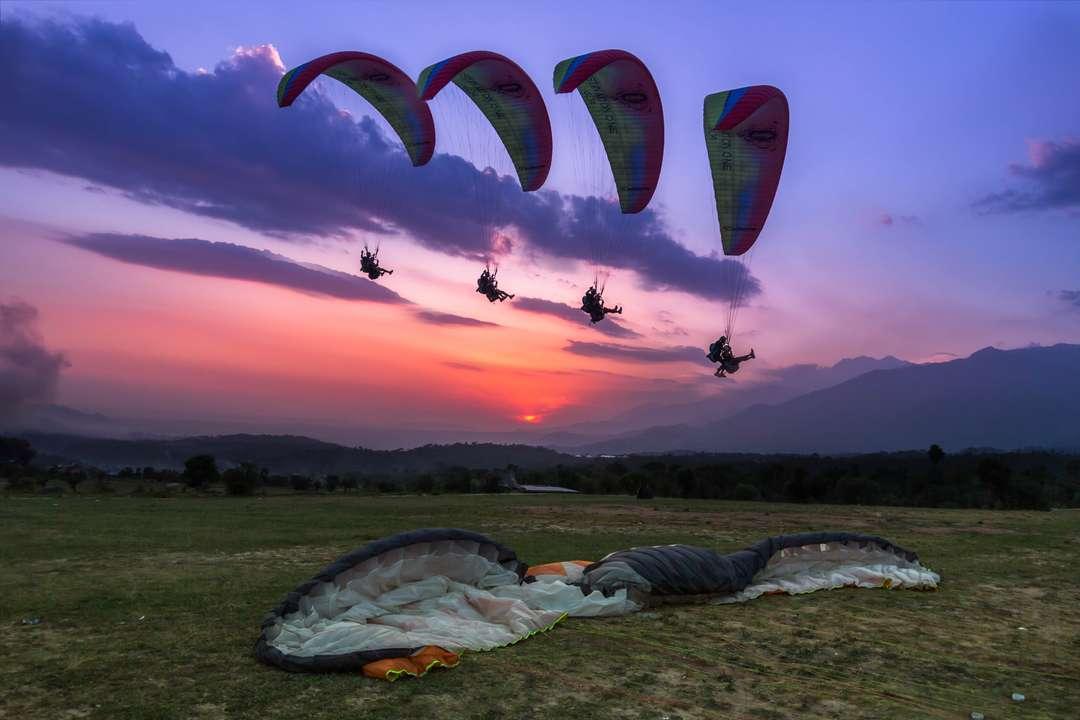

In the shadow of the Dhauladhar range, the twin villages of Bir and Billing have undergone a transformation that is nothing short of meteorological. What began as a quaint Tibetan settlement and a remote take-off ridge has ascended into the global theatre of flight. Today, Bir Billing is no longer merely the Paragliding Capital of India; it is a case study in the rapid, often turbulent, evolution of adventure tourism in South Asia.
Yet as the skies become increasingly crowded with colourful canopies, the region finds itself at a precarious crossroads. The friction between explosive economic growth, a lagging legal framework, and a sociological culture of bucket-list fatalism has created a landscape where safety and insurance remain the most elusive altitudes to reach.
The Ascent: A Story of Development
To understand Bir Billing today, one must acknowledge a paradigm shift in infrastructure. What was once a treacherous trek to the Billing take-off is now a well-paved artery capable of handling the heavy influx of tourists. This development is not merely aesthetic; it is structural. The hosting of the Paragliding World Cup in 2015 forced local authorities to adopt international standards for launch site management, organised landing zones, and a thriving ecosystem of boutique hospitality. The establishment of Bir-Billing Paragliding Association (BPA) and the involvement of the Himachal Pradesh Tourism Department have introduced mandatory registration for pilots and the requirement of Fitment Certificates for equipment.
However, the United Nations World Tourism Organisation (UNWTO) has long underlined that a destination’s success is determined by its ability to create a secure environment more than any other economic activity. In Bir, paragliding has become the lifeblood of the region, transforming an agricultural community into a specialised service economy. Yet, this dependency reflects a broader pattern seen in economic transformation driven by tourism, where rapid growth often outpaces regulatory maturity, creating a “Regulatory Capture” where the pressure to keep the propellers of the local economy spinning leads to softened oversight.
The Sociology of “Macho”
Modern tourists often approach paragliding with a sense of carnivalized adventure. They treat the paragliding harness like a seatbelt on a roller coaster, a passive safety device in a controlled environment, rather than a critical component of high-risk aviation sport. Thus, the bucket list culture on the consumer side needs to be addressed; it appears to be a systemic inertia in how documentation and consent are handled. In precarity sports, where the margin for error is zero, the signing of a liability waiver is often treated as a hurried formality rather than a moment of informed consent.
The Legal Paper Tiger: Regulation v. Enforcement
Despite these developments, the legal framework governing the sport remains a paper tiger. The future of Indian aero-sports rests not on the bravery of its pilots, but on the rigour of its rulebooks. This disconnect mirrors wider governance concerns seen across sectors, including systemic economic pressures and global instability, where fragile oversight structures struggle under stress. To transition from a local or national attraction to a global sensation, there is an urgent need for a standardised amendment of the Aero Sports Rules.
Codifying the Technical Threshold: The P4 Standard
The first pillar of any regulatory amendment must be the formalisation of pilot qualification, ensuring that the criteria to take flights remain stringent. It is no longer sufficient for a pilot to “know how to fly”; the law must mandate P-4 level certification as the absolute baseline for commercial entry. To ensure that tandem pilots are not merely “fair-weather flyers” but seasoned aviators, the rules should be amended to require a minimum of 100 hours of documented solo flying, supplemented by at least 50 non-commercial flights conducted after achieving P4 status.
Furthermore, to ensure pilots understand the nuances of navigation and thermal management, a mandatory 35 km Cross Country (XC) flight, validated by GPS coordinates, should be a prerequisite for licensure. By aligning these requirements with the standards set by the Atal Bihari Vajpayee Institute of Mountaineering and Allied Sports (ABVIMAS) or internationally recognised associations, the state can ensure that every pilot carrying a tourist has a high-altitude IQ.
This approach is supported by the Rawlsian theory of the Veil of Ignorance. If regulators did not know whether they would be the pilot or a bereaved family member, they would undoubtedly choose the most stringent safety rules possible to protect the most vulnerable participant.
Digitisation and Life Saving Competencies
The amendment must also address the integrity of record-keeping. The traditional paper logbook is an invitation to forgery. A modern framework must mandate digital logbooks, creating an immutable trail of a pilot’s experience. Coupled with this, a proactive regulatory approach requires a specialised Simulation d’incidents en Vol (SIV) course before a tandem license is granted, ensuring a pilot’s first encounter with a wing collapse does not happen with a tourist in tow.
Critically, the economic solution to safety lies in insurance. If third-party liability and passenger insurance were made mandatory and digitally verified, insurance companies would become the de facto regulators. This mirrors evolving dynamics in global systems under strain, where private sector actors increasingly influence risk governance. Furthermore, a micro insurance model should be mandated, where every ticket includes a premium for immediate heli-evacuation and medical coverage.
The Safety Audit: Integration Risk into Product Design
This author contends that a safety audit should no longer be a reactive post-mortem conducted after an accident. Instead, it must be legally integrated into the product development lifecycle of sports tourism. A safety audit analyzes terrain, microclimates, and equipment lifespans to design risk-mitigation strategies before the first ticket is sold. When safety is treated as a feature of the tourism product rather than an afterthought, the entire economic value of the destination increases.
From Bir to the Benches of the National Table
The most promising development for the future of Indian aero-sports lies in the changing profile of its advocates. Much of the progress in Bir can be attributed to the proactive vision of Mr Anurag Sharma, President of the Billing Paragliding Association (BPA). His very recent commitment to ground-level safety, including Rescue Call Rooms and SOS Stations, announced during the Asian Mountain Bike Series 1 in late February 2026, aims to bridge the golden hour gap in emergencies.
With the confirmed anticipation of Mr Sharma, who will soon serve as a Member of the Rajya Sabha, the Bir Model of safety and development will find a voice in the highest corridors of the Indian legislature. His position as guardian of Bir’s local paragliding community and a national lawmaker gives India an advocate for adventure sports for pan-India regulatory oversight and provides a unique opportunity to scale local successes to national policy.
One can maintain a reasoned optimism that the stringent technical requirements championed by local leadership will soon be deliberated upon with the Rajya Sabha. Such a move would allow India to ensure that the thrill of flight is never again shadowed by the avoidable spectre of systemic negligence. The sky is not the limit; it is the new frontier for professionalised, policy-driven excellence.