
SAN DIEGO – The ejection seat did its job. The $135.8 million aircraft did not.
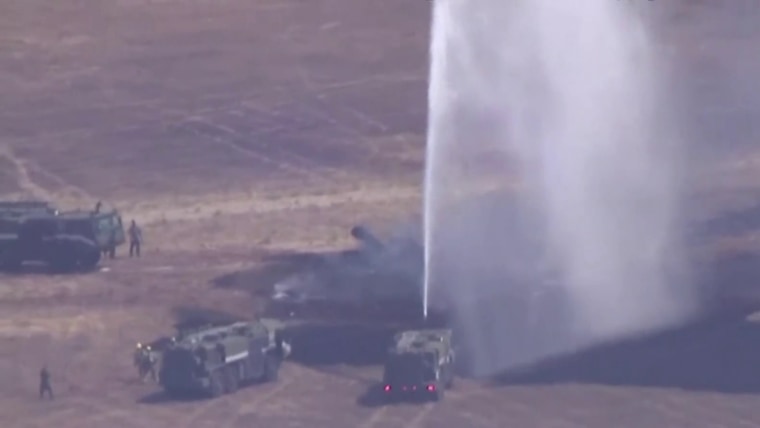
A Marine Corps F-35B Lightning II fighter broke into two pieces Friday morning after an emergency ejection on the flight line at Marine Corps Air Station Miramar, igniting a brush fire that spread across a football-field-sized section of terrain north of State Route 52 and drew firefighting crews from the San Diego Fire-Rescue Department. The pilot was transported to a local medical facility in stable condition with non-life-threatening injuries.
The Marine Corps classified the accident as a Class A mishap, the most severe category in the military’s incident hierarchy, reserved for events involving a fatality, permanent disability, or the destruction of an aircraft valued at more than $2 million. An F-35B carries a price tag of roughly $135.8 million including spare parts and maintenance, according to estimates from the Center for Arms Control and Non-Proliferation.
The crash occurred at approximately 10 a.m. local time on the Miramar flight line. 1st Lt. Blake Starbuck, a Marine Corps spokesperson, said he lacked information “regarding the purpose of the flight, whether the aircraft was departing or arriving, or whether it was conducting a training mission,” a disclosure that left unanswered the most basic questions about what brought a fifth-generation stealth fighter down at one of the Corps’ most prominent West Coast installations.
The aircraft belongs to Marine Aircraft Group 11, part of the 3rd Marine Aircraft Wing, which the Corps describes as its “principal aviation force on the West Coast,” responsible for offensive strike capability, anti-aircraft warfare, and aerial reconnaissance. The wing also provides fighter pilot training for both Marine and Navy aviators at Miramar, a base whose name became broadly familiar outside military circles through the 1986 film “Top Gun.”
San Diego Fire-Rescue Department crews responded to the brush fire, which was visible from State Route 52. Because the accident occurred on federal property, the Marine Corps retains investigative jurisdiction. The cause of the fire and the full scope of the blaze were not immediately available. Both military firefighting assets at Miramar and San Diego Fire-Rescue worked the scene.
The F-35B is the short takeoff and vertical landing variant of Lockheed Martin’s fifth-generation stealth fighter, distinguishable from its Air Force counterpart, the F-35A, by a shaft-driven lift fan that allows it to hover and land vertically. That capability gives it unique utility aboard amphibious assault ships and makes it well-suited to forward-deployed Marine operations in austere environments, though the additional mechanical complexity it carries is a meaningful design trade-off. The Marine Corps began fielding the B variant in 2015.
The breakup of the airframe into two pieces is a detail investigators will work to sequence precisely. A structural failure in flight before impact raises different engineering questions than a breakup caused by ground contact following an otherwise standard ejection. Whether complications arose during the ejection sequence itself was also not disclosed.
The formal investigation will determine whether this accident points to a systemic issue within the F-35B fleet or was specific to the condition of this airframe. That question carries consequences beyond Miramar: the 3rd Marine Aircraft Wing is not only the Corps’ primary West Coast strike force but a training pipeline whose disruption has implications for fleet readiness across the services. A Pentagon warning about US naval readiness shortfalls released earlier this week placed the Corps’ aviation roles in a broader context of supply-side constraints on American military capability.
The F-35 program has had previous crash incidents across the services, though the Pentagon has not attributed those accidents to fleet-wide mechanical defects. Whether this crash changes that picture depends on what investigators find in the wreckage on the Miramar flight line.
The timing arrives during a period of competing demands on American defense hardware. Washington has been navigating difficult decisions about the distribution of advanced air-defense systems to allied partners, decisions that place an increasing premium on the operational availability of aircraft like the F-35B at home installations.
The successful ejection, in the meantime, reflects the design function of the system that intervened on the Miramar flight line Friday morning. Modern military ejection seats are built to separate a pilot from a disabled aircraft in under a second, providing altitude and separation speed sufficient to survive. The pilot’s non-life-threatening injuries are exactly what that system is designed to produce. Whether the sequence was entirely routine, or whether complications arose, was among the facts the Marine Corps had not released by Friday evening.
No civilians were injured. The scope of the brush fire north of State Route 52 and the timeline to full containment were still being established. The investigation into what brought down a $135.8 million aircraft at MCAS Miramar, what failed and when, and what if anything it means for the aircraft around it, had only just begun.