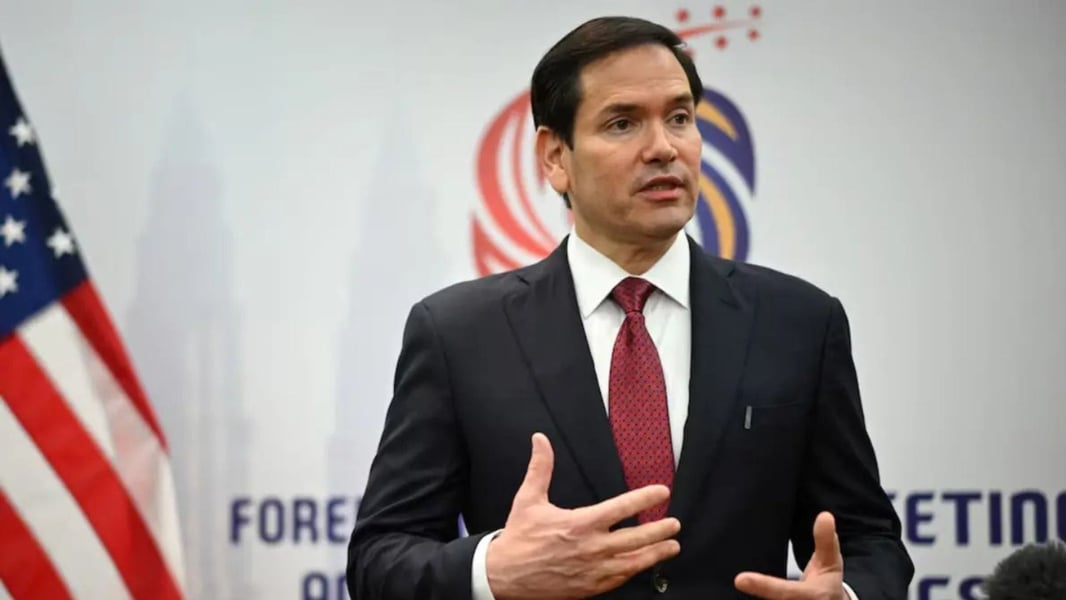

NEW DELHI – US Secretary of State Marco Rubio used the second day of his three-day India visit to launch what he called an “America First” visa scheduling tool and to dedicate a new consular wing at the US Embassy in New Delhi, framing every visa decision as a national security decision even as the broader trip was being sold in Washington as a reset of strained ties with the world’s most populous democracy.
Rubio inaugurated the embassy’s new annex on Saturday and used the platform to announce a revamped consular system that, US officials said, would prioritize business and investor visas, rebuild the network of appointment slots that collapsed during the pandemic, and route applications through tighter vetting and screening before any decision is made. “Every visa decision is a national security decision,” Rubio wrote on X, repeating a line that has become a signature of the second Trump administration’s consular policy.
The new tool, branded internally as the America First visa scheduling system, is intended to clear the chronic backlog at US missions in India, where wait times for first-time visitor visas had stretched into years at one point and where business travel from the country has continued to climb. Officials traveling with Rubio said the system would push higher-value categories such as L-1 intra-company transfers, B-1 business visitors, and investor and treaty trader visas to the front of the queue, with student and tourist applicants processed behind them.
Speaking at the dedication ceremony, Rubio described India as central to how the United States now approached the Indo-Pacific, telling embassy staff that the country sat at the cornerstone of American strategy in Asia not just through the Quad but bilaterally. The remark came hours before he was scheduled to sit down with External Affairs Minister Subrahmanyam Jaishankar for substantive talks on defence cooperation, energy security, technology partnerships, and the wider regional picture shaped by the ongoing US-Israel war on Iran.
The visa announcement landed with an uncomfortable edge for Indian audiences. The Trump administration has spent the past year tightening every consular lever that touches Indian professionals, from a $100,000 surcharge layered on new H-1B petitions last September to the dismantling of long-established green card pathways that had carried generations of Indian engineers into permanent residency. The latest move, presented as efficiency, came wrapped in the same vetting and screening language Washington has used to justify the rest of the crackdown.
Eastern Herald reporting earlier this week documented how the administration’s push to unwind decades-old green card routes has rattled Indian technology workers and the US employers who depend on them, with companies warning of project delays, frozen hiring pipelines, and a quiet drift of senior engineers toward Canada, the United Kingdom, and the Gulf. None of that featured in Rubio’s remarks at the embassy.

Rubio’s presence in New Delhi is the most significant in-person engagement between the two governments since President Donald Trump doubled tariffs on Indian goods to 50 percent last year as punishment for India’s continued purchases of discounted Russian crude. Those tariffs have only partially been rolled back, and Indian officials remain wary of public commitments after Trump claimed credit for brokering the May 2025 ceasefire between India and Pakistan, a claim New Delhi rejected.
The schedule for Rubio’s visit reads as a carefully choreographed mix of symbolism and substance. He began the trip in Kolkata with a stop at the Mother House of the Missionaries of Charity, moved through Agra and Jaipur for cultural and business engagements, and arrived in the capital ahead of the Quad foreign ministers’ meeting on Tuesday. Jaishankar, who has held three in-person meetings with Rubio in less than a year, is expected to use the bilateral on Sunday to push hard for relief on tariffs, a clearer signal on technology transfers, and a renewed commitment to a free and open Indo-Pacific that does not treat New Delhi as junior partner.
The energy file looms over everything. With the Strait of Hormuz disrupted by the US-Israel war on Iran, Indian refiners have leaned even harder on Russian crude, including barrels that fall under the 30-day sanctions waiver Treasury Secretary Scott Bessent extended on Monday. Washington wants New Delhi to shift more of that demand to American and Venezuelan supply, an ask that touches on price, logistics, and political optics in equal measure, and one that Indian officials have so far declined to entertain on US terms. Earlier this month, Russian Foreign Minister Sergei Lavrov accused Washington of trying to control global energy routes through sanctions, a framing that lands easily in Indian policy circles.
The defence track is moving more quietly. Indian negotiators have been pressing for a formal Make in India clause in any new co-production arrangement, particularly on jet engines, armed drones, and undersea sensors, areas where the Pentagon has been willing to share technology at a pace that surprised many in the strategic community. American officials want assurances on end-use monitoring and on India’s continued cooperation with the Quad, which holds its ministerial in New Delhi on May 26.
Pakistan, predictably, is the other shadow over the visit. The US approval of $686 million in F-16 upgrades for Islamabad last December, the warm noises from the Trump White House about Pakistani mediation in the Iran crisis, and Trump’s repeated public praise of Pakistani leadership have generated a steady undercurrent of irritation in New Delhi. Indian officials have not raised those points in public during the Rubio visit, but several diplomats described them, on background, as the unspoken backdrop to every conversation this weekend.
For Rubio, the India trip is also a personal test. Having held three meetings with Jaishankar in the past year alone, he has invested more of his early tenure as Secretary of State in the India relationship than in any other bilateral in Asia. The choice to fold a hard-edged consular announcement into the same visit suggests an administration confident that India will absorb the immigration policy and continue moving on trade, defence, and energy regardless.
For New Delhi, the calculation is more delicate. The Modi government has long sold the United States to its domestic audience as a partner of opportunity, particularly for the Indian middle class chasing degrees, jobs, and citizenship in America. An America First visa system, framed openly as a national security filter, complicates that story even as the strategic case for closer ties with Washington grows louder. Reuters reported that the trip is being framed inside the State Department as a repair mission, an unusually candid characterization for a sitting Secretary of State.
Whether the repair takes hold will depend on what emerges from Sunday’s bilateral and from the Quad ministerial that follows. Indian officials have set a low public bar, telling reporters only that the meetings would cover the full range of the relationship. Private expectations, according to two people familiar with the agenda, run higher, particularly on technology cooperation and on a measurable easing of the tariff regime. Analysts at the Council on Foreign Relations have described the visit as Washington’s clearest acknowledgement to date that the past year of friction carried a cost.
The visa announcement, in that sense, was a signal of how the Trump administration plans to manage the contradiction. Strategic outreach for governments. Tighter gates for people. India, the largest single source of legal immigration to the United States and the country whose diaspora has become a structural part of American technology, medicine, and academic life, has been handed both messages in the same week, in the same city, by the same Secretary of State.