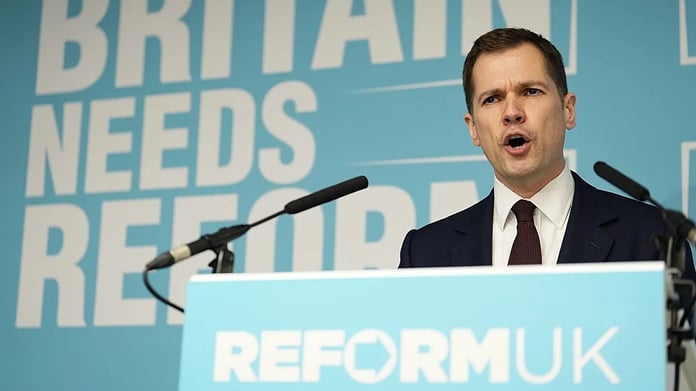

LONDON – For the 2.89 million people who receive the health element of Universal Credit, Robert Jenrick’s announcement on Saturday was not an abstract fiscal document. It was a plan to end the cash payments that make up a significant portion of their income and replace them with something no one has yet built: a network of local council disability support accounts.
Reform UK’s Treasury spokesman unveiled what he called the party’s welfare overhaul blueprint, a package the party says would save £50 billion annually. The proposals abolish Personal Independence Payment for working-age adults, eliminate the Universal Credit health element for those 2.89 million claimants, and replace direct payments with restricted accounts administered by local councils. The plan also mandates employers to carry what Reform describes as “return to work cover,” insurance that would fund workplace adjustments for employees with health conditions, shifting a cost currently absorbed by the government onto private businesses.
“This is not an epidemic of broken backs and lost limbs,” Jenrick said in remarks accompanying the plan’s release. “It’s an epidemic of poor mental health and low-level anxiety that we need to tackle differently.”
The framing positioned disability benefit claimants not as people with genuine health conditions but as a policy problem with a cultural cause, a rhetorical turn that drew immediate condemnation from disability advocacy organisations and from the Labour government.
A spokesperson for Chancellor Rachel Reeves dismissed the proposals as “fantasy economics,” arguing that the employer insurance mandate would simply transfer billions in costs from the welfare budget onto businesses that would then pass them to consumers or cut jobs. The Treasury declined to engage with the £50 billion figure, which Reform UK said it had modelled but for which no underlying methodology was published with the announcement.
The Conservative Party offered a more pointed line of attack. Shadow ministers suggested the timing of the welfare announcement, on a weekend when coverage of Nigel Farage’s £5 million donation inquiry was prominent, was deliberate distraction. “Reform has a serious question to answer about where its funding comes from,” one Conservative source said, declining to be named. “This is a press release designed to change the subject.”
That inquiry, opened by the Electoral Commission following a Channel 4 investigation, remains at a preliminary stage. Farage won the Clacton by-election last weekend, a contest he had triggered by resigning his own seat, but the donation question has not been formally resolved. Reform UK has denied any wrongdoing.

What the plan does not show is a pathway through the practicalities. Personal Independence Payment currently goes to working-age adults with long-term health conditions or disabilities who need help with daily living or mobility costs. Its replacement, a council-administered account, would under Jenrick’s proposal restrict how money is spent and tie support to employment activities. The proposal does not address what happens to claimants who are too ill to engage with any employment pathway, or how local councils straining under budget pressure would fund and administer what is now a national programme run by the DWP. According to the Department for Work and Pensions’ most recent benefit statistics, the cost of disability benefit spending has grown faster than almost any other element of the welfare bill over the past four years.
The Universal Credit health element, which the proposal also targets, is paid to people whose health conditions have been assessed by the government’s own work capability system as preventing them from working. Removing it for 2.89 million claimants and replacing it with council accounts assumes both that the accounts would be adequately funded and that councils would be equipped to manage what is currently a centrally run national programme. Neither assumption has been tested.
Labour’s critique of “fantasy economics” is politically convenient. It is also, in at least some respects, substantively grounded. Jenrick’s plan to require employers to carry return-to-work insurance faces a structural problem: the market for such insurance would need to be built from scratch, premiums would likely vary by sector and workforce composition, and the regulatory framework to mandate and enforce it does not exist.
What Reform UK has succeeded in doing with this announcement is placing welfare spending at the centre of British political debate ahead of what most observers expect to be a bruising autumn parliamentary session. The Burnham government has its own difficult choices to make about disability benefit reform, and the Office for Budget Responsibility has flagged the trajectory of PIP spending as a long-term fiscal pressure. Jenrick’s proposals, however contested, make it harder for Labour to claim that reform of the system is politically unthinkable.
The question of how to redesign a welfare system built for a different labour market, without leaving behind the people it was built to support, is not one Reform UK’s blueprint answers. It opens the debate on terms the party chose. For 2.89 million people whose current support is the subject of that debate, those terms matter a great deal.
Related Posts