
LONDON — For nearly 1.3 million EU citizens who applied for settled status under the Brexit withdrawal agreement, that document has served as a guarantee: the right to live, work, and access public services in Britain on the terms that existed when the country left the European Union. Reform UK’s latest policy pledge has placed a direct question mark over how durable that guarantee would be if the party reaches government.
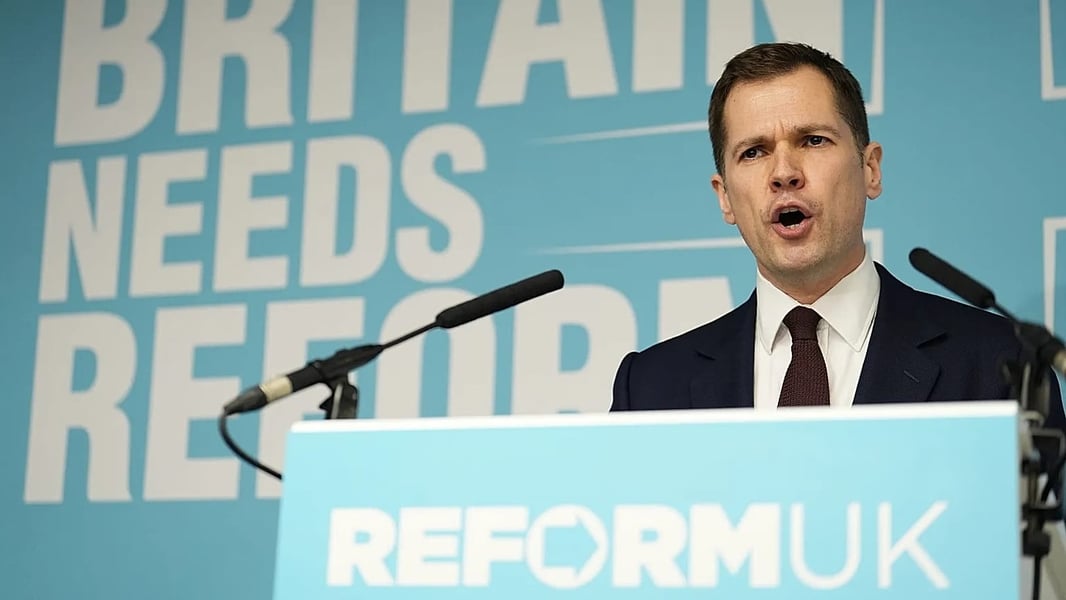
Robert Jenrick, Reform’s economics spokesperson and MP for Newark, announced on Sunday that a Reform government would end welfare entitlements for all foreign nationals in Britain — universal credit, jobseeker’s allowance, child benefit, free childcare, housing benefit, pension credit, and disability payments — with limited exceptions for military veterans and those who have contributed to the state pension. “The welfare state is there for Britain,” Jenrick said. “No British citizenship, no entitlement.”
The figure attached to the proposal is £21 billion in annual savings by 2029. That number has not been independently verified, and Reform has not disclosed what share of it derives specifically from cutting EU settled status holders versus other foreign nationals. The context is significant: Westminster expects to spend £322 billion on welfare across Great Britain in 2025-26, representing 10.6 percent of GDP and nearly a quarter of total government spending. Approximately 55 percent of that bill goes to pensioners, who are British citizens by definition and untouched by Jenrick’s proposal.
The legal obstacle is the Brexit withdrawal agreement itself, a binding international treaty ratified in 2020 that enshrined the rights of EU citizens already resident in the UK when Britain left the bloc. Labour put it plainly: implementing the proposal would mean “ripping up the UK’s Withdrawal Agreement with the EU, plunging the UK back into years of Brexit renegotiations,” a party spokesperson said. The party also noted that “the vast majority of migrants have no access to the welfare system” — a factual claim that directly undermines the premise of Jenrick’s arithmetic.
Reform has not identified a legal route to removing withdrawal agreement protections without triggering a full renegotiation with Brussels. That Jenrick presented the policy without addressing this gap may be deliberate — no election is imminent — but it drew the sharpest criticism from the Conservative side rather than Labour. Conservative MP Helen Whately dismissed the plan as “cobbled together,” a characterisation that cuts at the credibility of the costings rather than the politics.

The announcement arrives two days after Jenrick outlined a £50 billion overhaul of disability and sickness benefits that would end Personal Independence Payment for working-age claimants and remove Universal Credit health supplements from 2.89 million people. The foreign-national benefits ban extends the same underlying argument — that the British welfare state has expanded beyond its intended scope — from medical category to nationality. Together, the two announcements total £71 billion in claimed annual savings, a figure larger than the UK defence budget.
The pace of these releases tracks the political calendar Reform is managing. Nigel Farage returned to the Clacton seat in a by-election last weekend in which no major party stood against him, securing more than 22,000 votes while the satirical Count Binface collected 9,455. The result consolidated Farage’s position in parliament but left unresolved the regulatory investigation into an undisclosed £5 million cryptocurrency donation that had initially forced him to vacate the seat. Jenrick’s string of welfare announcements fills the policy space during that period.
What Reform is constructing, across these releases, is a welfare eligibility framework defined by nationality and medical category rather than contribution history. The political appeal of that framework is its clarity: citizenship as the threshold, stated explicitly and without apology. The legal and fiscal complexity is in what citizenship means for 1.3 million people who were told, by treaty, that their status in Britain had been settled.
How many EU settled status holders actually draw the benefits Jenrick has proposed to eliminate remains unspecified. Labour’s claim — that most migrants already lack benefit access — suggests the practical scope may be considerably narrower than the headline figure implies. The gap between what the policy would actually cost and what Reform says it would save is precisely what Sunday’s announcement declined to address.
Related Posts