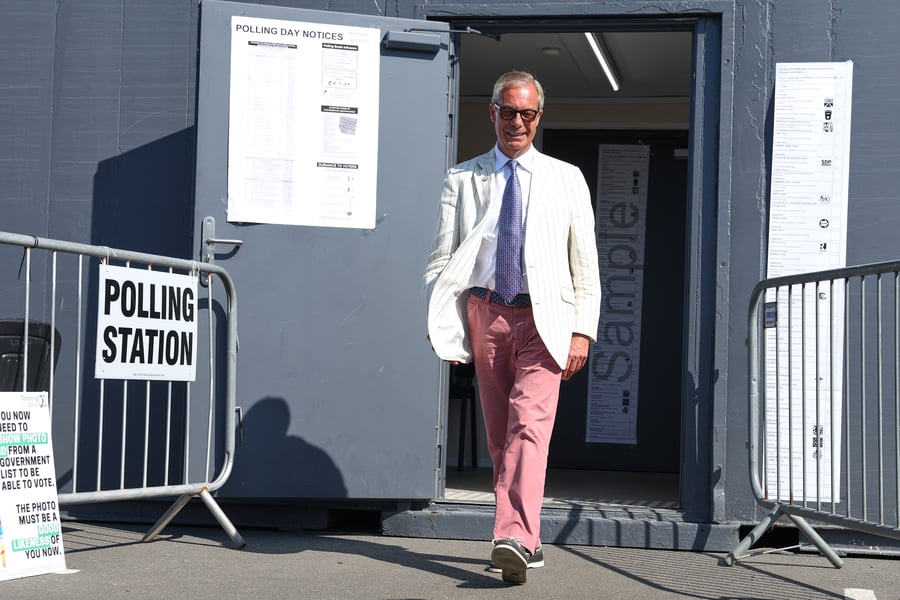

LONDON — By the time Nigel Farage took his seat back on Friday, the man who had given it up was no longer in the room. Farage did not attend the official count at Clacton Leisure Centre and cancelled the victory speech his campaign had planned. The declaration still came: 22,239 votes for the Reform UK leader, 9,455 for Jon Harvey, the comedian who has spent the better part of a decade contesting British elections dressed as a satirical space warrior named Count Binface.
Farage won. What he won, and what it cost him to win it, is a stranger accounting.
The by-election in Clacton-on-Sea on August 14 was one Farage himself triggered. In July, he resigned his parliamentary seat — the one he had held since the 2024 general election — as a regulatory investigation was opened into an undeclared £5 million donation he had received from a cryptocurrency billionaire. He denied wrongdoing at the time, calling the inquiry politically motivated, and immediately announced he would stand again for the same seat in the resulting vacancy. Labour, the Liberal Democrats, and the Conservatives all declined to field serious candidates, describing the contest as a self-serving spectacle. The absence of any mainstream challenger left Count Binface as the most prominent name on a ballot that eventually carried 34 candidates, most of whom received fewer than 100 votes each.
Voter turnout reached 44 percent — reasonable for a by-election in August, less so for a man presenting himself as a future prime minister. Of those who voted, roughly one in three chose someone other than Farage.
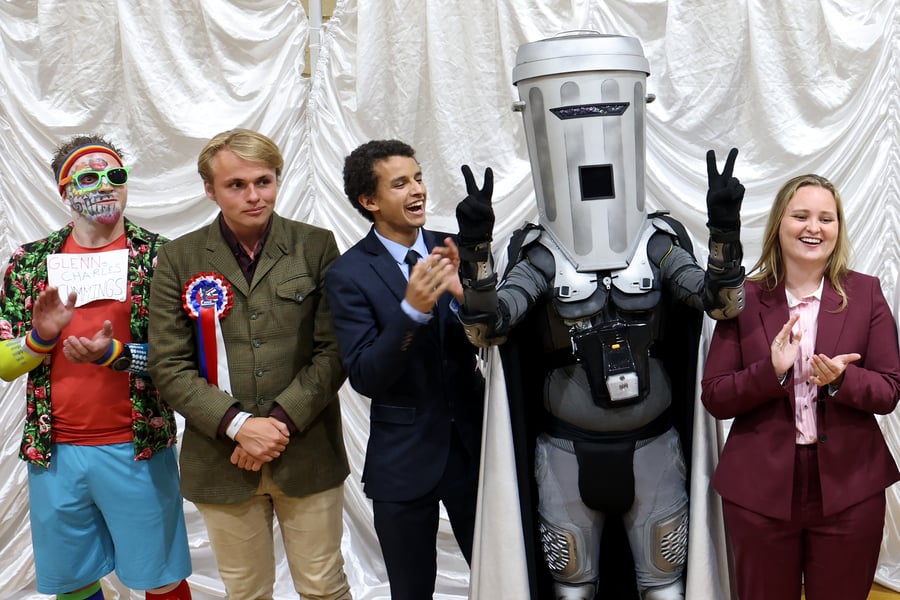
Count Binface told Al Jazeera after the result that “there’s more than one way to win.” It was the kind of line that plays well and means less than it sounds, but in this particular election it was not entirely without foundation. Harvey has now contested a string of British elections in the Binface persona — standing against former prime ministers, drawing moderate protest votes in safe seats, finishing consistently in the single figures. Clacton was different. Nearly ten thousand votes for a satirical candidate in a constituency where the incumbent boycotted his own count is a data point that does not require elaboration.
Farage’s statement after the result was that Clacton voters had “stuck two fingers up to the entire political establishment.” His campaign framed the turnout as a validation. What the margin more specifically showed was that a significant share of the electorate in a seat Farage already held, in a race designed to rehabilitate him, opted for a man in a silver mask.
The investigation that prompted the resignation has not closed. The inquiry into the £5 million cryptocurrency donation was reopened in the aftermath of Thursday’s vote, a detail the Farage campaign did not address publicly before the declaration. The source of the funds and the question of why they were undeclared remain unresolved. Farage, who positioned himself throughout the campaign as the aggrieved victim of establishment persecution, now re-enters Parliament carrying an active regulatory probe.
Eastern Herald’s reporting on Reform UK’s £50 billion welfare overhaul, announced by deputy leader Robert Jenrick earlier this week, set out the legislative ambitions the party intends to pursue from Westminster. Farage’s return gives him the platform to drive that agenda personally. Whether a parliamentary seat won in a boycotted contest provides sufficient political authority for the programme Reform UK is proposing is a question his opponents will now pose with renewed specificity.
The Clacton by-election has become a recurring marker in British political theatre. The constituency first elected Farage in 2024, making him the face of a Reform surge that won more than four million votes nationally but translated poorly into parliamentary seats. He resigned that seat less than two years later under regulatory scrutiny. He won it back against a space-themed comedian while most of the country’s mainstream politicians declined to participate. Britain’s electoral rules permit all of this.
What they do not resolve is what comes next. The cryptocurrency inquiry has no announced timeline. The major parties, having boycotted the race, face a strategic problem: standing aside confirmed their contempt for Farage’s self-made drama, but it also produced nine-and-a-half thousand votes for a novelty candidate and a headline that flatters neither them nor the institution of parliament. Whether Farage’s return reshapes anything in Westminster’s dynamics is unclear. He holds one recovered seat. Reform’s broader standing in the country — and the regulatory cloud now formally reopened above him — will matter more than the arithmetic of Clacton’s leisure centre on a Thursday in August.
The absence of a victory speech was noted. What Farage chose not to say on the night he re-entered parliament, in front of cameras and a room that had just counted his votes, remains his own calculation. Count Binface stood at the lectern in his silver suit. He delivered his lines. Whether the 9,455 people who voted for him did so in protest, in entertainment, or in sincere preference between two options neither of which they found persuasive, is something the tally does not explain.