
TOKYO — What Japan filed on August 31 was not just the largest defense budget request in its postwar history. It was an itemized accounting of a country that has stopped thinking about defense in defensive terms.
The Ministry of Defense’s fiscal year 2027 request — 8.89 trillion yen, or roughly $55.6 billion — is the fifteenth consecutive annual increase and the highest figure Japan’s defense planners have ever submitted. The headline number is striking. What is inside the request is more so.
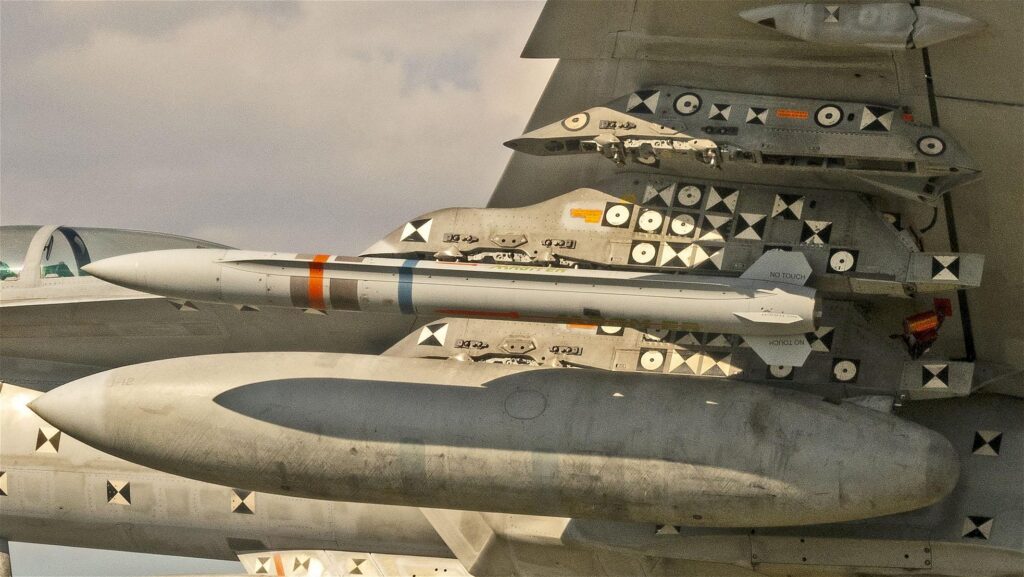
For the first time, Japan’s military is formally seeking to acquire the AGM-88G Advanced Anti-Radiation Guided Missile-Extended Range, built by Northrop Grumman. The AARGM-ER is not a weapon of deterrence. It is designed to hunt and destroy enemy radar systems, suppressing air defenses so that offensive aircraft can operate without detection. Its procurement has no application in a purely defensive military posture. A country requesting an anti-radiation missile has decided it needs one.
That single line item encodes a shift that has been years in the making. In 2022, Japan revised its National Security Strategy to explicitly permit counterstrike capability. Since then, the defense budget has grown toward two percent of gross domestic product, a level previously reserved, in Japan’s postwar framework, for the United States to request and Tokyo to reluctantly approach. This budget formalizes what the strategic documents already authorized.
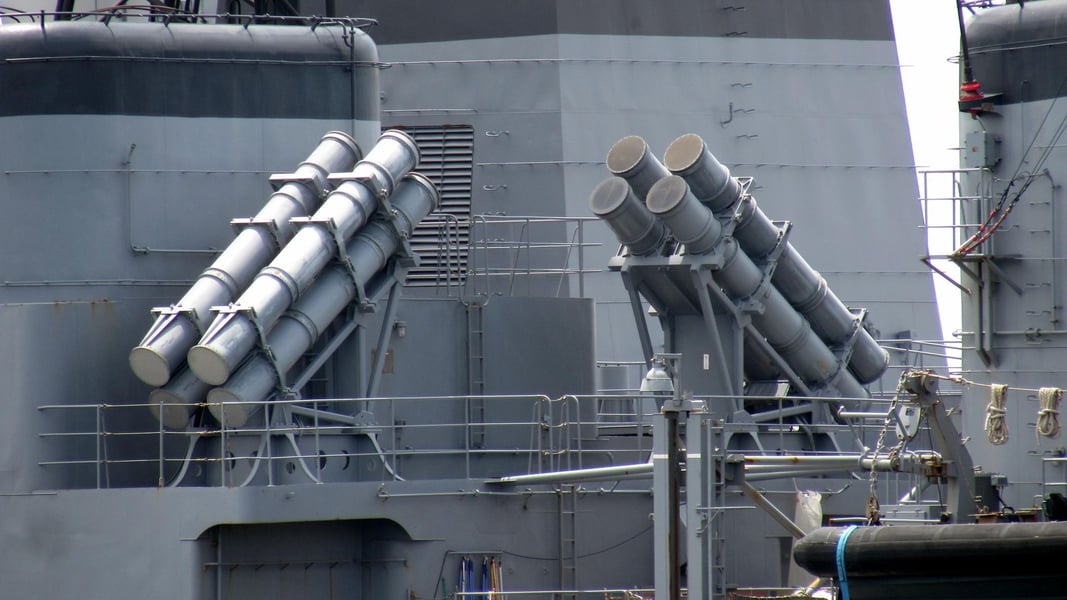
The request also includes 17 additional MQ-9B SeaGuardian drones from General Atomics, at a cost of 292.2 billion yen — an unmanned maritime surveillance capability that extends Japan’s operational reach over the contested waters of the East and South China Seas without requiring a manned presence at the point of operation. Sixteen-point-three billion yen has been allocated for submarine-launched guided missiles. A stand-off missile launch module for unmanned underwater vehicles is included as well, extending Japan’s missile launch architecture beneath the surface. Japan has also separately set aside 7.6 billion yen for Terra B1 interceptor drones — unmanned systems designed to engage incoming threats before they reach Japanese territory, in coverage of Japan’s broader autonomous weapons development push.
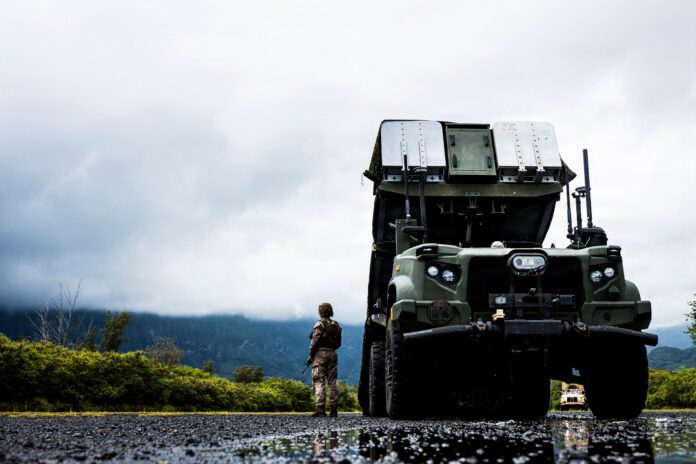
A long-range air-to-air weapon derived from the ASM-3 anti-ship missile and an AI command-and-control system emphasizing data integration for decision advantage round out the headline items. The Air Self-Defense Force is seeking additional F-35s, KC-46 aerial refueling tankers, C-2 transport aircraft, and P-1 anti-submarine patrol planes. Read together, the full procurement list describes a military being built for extended-range autonomous operations: at sea, beneath the sea, in the air, and through machine-to-machine engagement.
China, Russia, and North Korea have watched this trajectory and named it directly. When Japan’s defense white paper characterized the regional security environment in language Beijing and Moscow found inflammatory, China, Russia, and North Korea condemned Japan’s defense white paper in a coordinated rebuke, framing the document as a pretext for unconstrained rearmament. The FY2027 budget request supplies empirical grounding for that characterization: the weapons Japan is now formally requesting cannot reasonably be described as purely defensive.
Pyongyang’s calculus has been stated with equal directness. When Japan acquired Tomahawk cruise missiles from Washington and conducted its first test launches, Kim Yo Jong’s warning on Japan’s Tomahawk missile deployments signaled that North Korea treats Japanese offensive strike capacity as an immediate military concern rather than a distant hypothetical. The FY2027 request adds anti-radar suppression, extended-range sea drones, and submarine-launched guided missiles to a strike portfolio that was already drawing explicit warnings from Japan’s neighbors.
The parallel shift in Japan’s nuclear posture has deepened the picture. After China’s PLA Navy fired a ballistic missile from a nuclear-powered submarine, Japan’s nuclear deterrence discussions with Washington accelerated into formal consideration of hosting US nuclear weapons — breaking, at least at the deliberative level, with the country’s postwar Three Non-Nuclear Principles. The conventional buildup in this budget and the nuclear deterrence track are not separate policy streams. They are the same policy, now moving in parallel.
There is a number the budget does not contain. One hundred and sixty entries in the August 31 request were filed as “item requests” — procurement categories for which no specific yen figure has been assigned. Prime Minister Sanae Takaichi’s government plans to revise Japan’s three foundational security documents — the National Security Strategy, the National Defense Strategy, and the Defense Buildup Program — before the end of 2026. Once those revisions are finalized, the 8.89 trillion yen figure will almost certainly rise. Defense officials and outside analysts expect the final FY2027 allocation to exceed 10 trillion yen, or roughly $62.5 billion, as detailed in coverage of the original filing.
Prime Minister Takaichi’s decision to drop spending caps on priority defense projects represents a structural change in the budget process itself, not just an upgrade in what Japan buys. A cap is a constraint that forces trade-offs between competing priorities. Removing it signals that the government has concluded the strategic environment no longer permits those trade-offs.
Japan’s defense buildup has taken shape within the architecture of the US-Japan Alliance, and this request reflects that dependency with specificity: the AARGM-ER is an American weapon system, procured from an American defense company. The MQ-9B is American. The F-35s, the KC-46 tankers — the major systems on this list are sourced from American industry and bind Japan into American supply chains, maintenance architectures, and operational doctrine. Whether that constitutes an independent defense posture or an extension of US Indo-Pacific strategy operated by Japanese personnel is a question Japan’s neighbors, and parts of Japan’s own domestic opposition, have not stopped asking.
What Japan filed on August 31 was the opening bid. The final answer — what it will actually spend and on what terms — will only become visible when the three security documents are revised and the 160 blank line items are filled in. That revision is due before the end of 2026. It will contain the numbers Japan’s neighbors are already preparing to read.