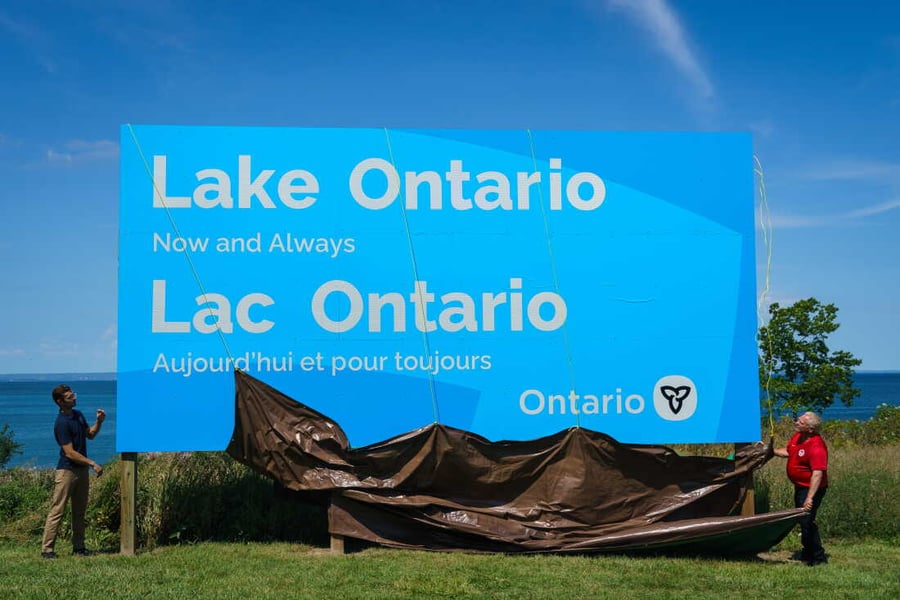

GRIMSBY, Ontario — Standing at the water’s edge on Saturday, Doug Ford reached for a phrase that has crossed the US-Canada border in both directions this week, stripped of its geography and loaded with meaning. “We’ll never ever back down from a bully, ever,” the Ontario premier said, before pulling back a curtain to reveal a 24-by-12-foot sign that read, in English and in French, “Lake Ontario. Now and Always.”
The sign, installed overnight at Fifty Point Conservation Area near Grimsby, stands on six-foot legs, its top roughly two stories above the ground, along a road that American tourists frequently drive when entering Canada. Ford was wearing a Team Canada soccer jersey. The lake behind him, gray-blue in the late August light, has been named Lake Ontario since before either country existed.
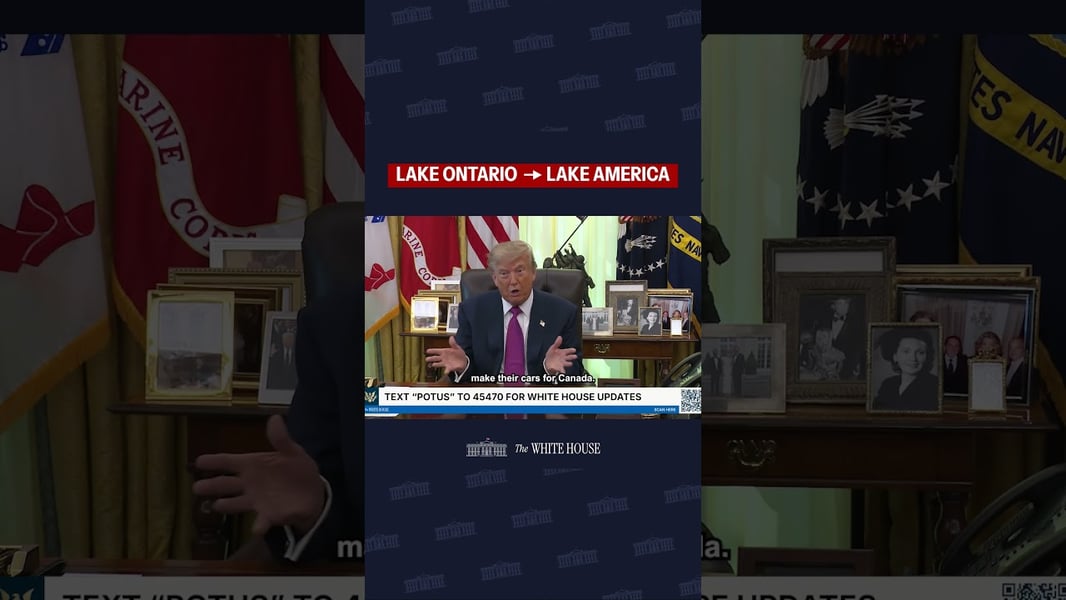
Three days earlier, President Trump had signed an executive order directing U.S. federal agencies to stop using that name.
“We have a gulf, and we have a lake,” Trump told reporters at the Oval Office news conference where he signed the order. “Now all we need is an ocean.” The directive instructed agencies to refer to the Great Lake, one of five shared between the United States and Canada, as Lake America, effective immediately.
The executive order follows the precedent Trump established in January 2025, when he directed agencies to rename the Gulf of Mexico the Gulf of America. That order’s effects proved uneven: American federal maps and some official publications changed, while international usage and most foreign governments did not follow. Lake Ontario, which touches New York State on its American side, presents a sharper diplomatic challenge than an open-water gulf, as the Canadian shore runs along Ontario’s most densely populated corridor.
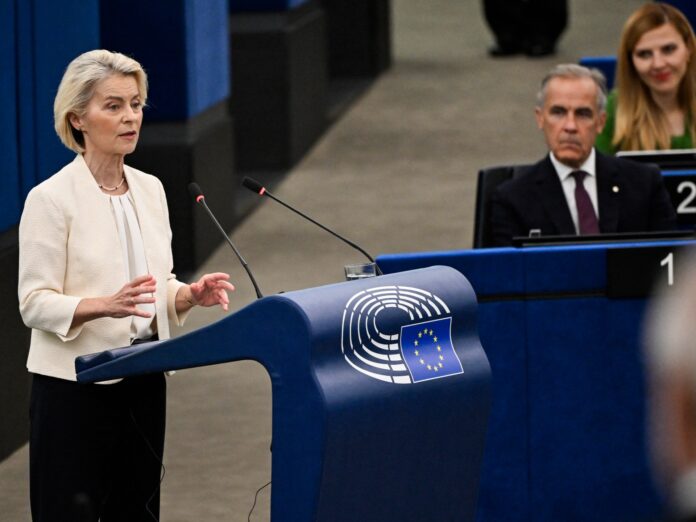
Canadian Prime Minister Mark Carney rejected the order in a post on X that collected more than seven million views in a single day. He wrote that the name Lake Ontario derives from the Wendat word Ontari’io, meaning “the lake is beautiful, the lake is big,” and that the name has been in continuous use for more than four hundred years, predating both Canadian Confederation and the signing of the U.S. Declaration of Independence. “Canadians also know that naming reality means calling it Lake Ontario, then, now and always,” Carney wrote.
According to CTV News, Carney and Ford spoke by phone before the billboard went up, coordinating a response that would be bilingual, visible from the American side, and impossible to dismiss as diplomatic abstraction. New York Governor Kathy Hochul also declined to adopt the Lake America designation, calling the rename “deflecting from the real needs of Americans,” a distraction from the economic pain the trade war has already inflicted on communities along the shared shore.
The technological dimension of the dispute produced its own geographic split. Google Maps, which changed the Gulf of Mexico to Gulf of America for American users following the 2025 executive order, now shows two different names for the same body of water: American users see Lake America; Canadian users see Lake Ontario. NPR reported on the dual-naming phenomenon after Canadian users began documenting it on social media. Google has not publicly explained whether the distinction reflects a deliberate editorial policy or an algorithm responding to geolocation signals.
The billboard’s placement along Highway 8 near Grimsby was deliberate. Al Jazeera reported that the site sits along a route American visitors use frequently during the Labor Day weekend. Ford’s government announced neither the sign’s construction nor the timing of the reveal in advance; the premier said the overnight installation was intentional, a message delivered before anyone could prepare a counter-message.
The rename arrives at the end of a week that has left the bilateral relationship in its most strained condition in decades. Trade talks between Ottawa and Washington collapsed without a new framework, prompting Canada to announce the Canada Strong Response Plan: counter-tariffs of 15 to 50 percent on roughly $27.6 billion in American goods, effective September 8, matching Washington’s duties dollar for dollar. Canada had already cancelled the joint opening of the Gordie Howe International Bridge with the US after Trump imposed 50 percent tariffs in July, a ceremony both governments had spent years planning. Trump also threatened to add the costs of Canadian wildfire smoke to Canada’s tariff bill the following week, framing an environmental emergency as a financial liability.
The Lake Ontario rename fits a broader pattern: American federal authority deployed at Canadian symbols, geography, and institutions as a form of pressure, one that Canada has chosen, consistently, to answer with ridicule rather than reciprocation. What the billboard and the Wendat etymology and the coordinated messaging cannot resolve is the economic arithmetic that changes on September 8. Ontario’s auto sector, whose supply chains cross the Detroit-Windsor border multiple times before a single vehicle is complete, faces another deadline.
Ford said the sign will stay up indefinitely. He did not say it would come down when trade relations improve. Whether there is a version of events in which both hold, the tariffs ease and the sign stays, he left unanswered. That is perhaps the most accurate summary of where this relationship stands.