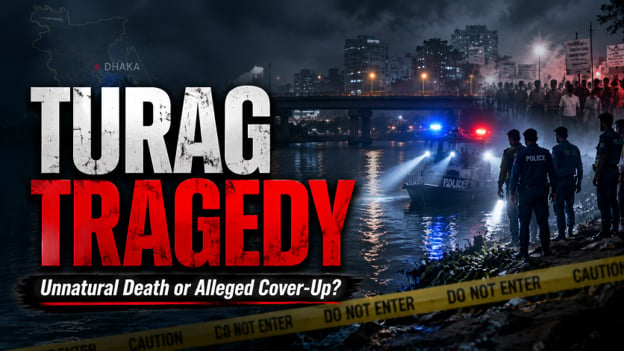

The events surrounding the Turag River have become one of the most emotionally charged and politically significant stories to emerge from Bangladesh in recent months. What began as reports that several Awami League activists had gone missing after a political gathering has evolved into a national debate involving recovered bodies, competing media accounts, conflicting official statements, and serious questions about public trust in the country’s institutions.
At the center of this debate are families waiting for answers, investigators attempting to establish the facts, political parties advancing sharply different narratives, and a public struggling to determine whom to believe.
Regardless of where one stands politically, there is one principle that should unite everyone: when lives are lost under suspicious circumstances, the truth matters more than politics.
According to reporting by Northeast News, seven Awami League activists allegedly disappeared following violence in Dhaka’s Turag area after attending a political gathering on June 22. The publication reported allegations that several victims were abducted before their bodies were later recovered from the Turag River. Other media outlets have reported different aspects of the case. BD Digest reported allegations by Awami League leaders that the incident was not being handled transparently, while Bangladesh Police Headquarters has publicly disputed some of the claims circulating about the incident and has urged the public not to spread unverified information. At the time of writing, investigations remain ongoing, and many key allegations have not been established in court.
That distinction is important.
In politically polarized environments, there is often enormous pressure to reach conclusions before investigators have completed their work. Social media accelerates that pressure, allowing rumors, partial information, and political messaging to travel faster than verified evidence. The result is a public conversation in which competing narratives often overshadow the painstaking work required to establish what actually happened.
But democracies are not strengthened by speculation. They are strengthened by credible institutions capable of investigating difficult cases independently, transparently, and without political interference.
This is why the Turag case matters far beyond the individuals directly involved.
Whether investigators ultimately confirm or reject the most serious allegations, the public will judge the process itself. Was evidence collected professionally? Were witnesses interviewed fairly? Were forensic findings disclosed honestly? Were investigators free to pursue every lead regardless of who might be implicated?
These questions are larger than one criminal investigation. They speak directly to public confidence in the rule of law.
Bangladesh has experienced extraordinary political transformation during the past several years. Elections, protests, changes in political leadership, and periods of unrest have left deep divisions across society. International organizations, including the United Nations Office of the High Commissioner for Human Rights and Human Rights Watch, have documented concerns regarding political violence, accountability, and human rights during this broader period. Those reports are not findings about the Turag incident itself, but they provide important context for understanding why independent investigations into politically sensitive deaths carry such significance.
No society benefits when citizens conclude that justice depends upon political identity.
History demonstrates that political violence is rarely confined to one party or one generation. Governments change. Opposition movements evolve. Alliances shift. Yet families who lose loved ones often experience the same grief regardless of which flag they supported.
That reality should encourage humility rather than certainty. Supporters of the Awami League deserve justice if crimes were committed against them. Supporters of the Bangladesh Nationalist Party deserve justice when crimes are committed against them. Journalists deserve protection regardless of which government is in power. Ordinary citizens deserve institutions that apply the law equally. These principles should never depend upon political affiliation.
Unfortunately, modern politics often encourages exactly the opposite. Tragedies become opportunities for political advantage. Every investigation becomes another battleground in a broader ideological struggle. Facts become secondary to narratives.
The Turag case should resist that pattern.
If investigators ultimately conclude that politically motivated killings occurred, those responsible should face prosecution regardless of influence, office, or party affiliation. If some widely circulated allegations prove inaccurate or unsupported by evidence, that conclusion should also be communicated openly and transparently.
Justice is not measured by whether one political side feels vindicated. Justice is measured by whether the public believes the investigation followed evidence wherever it led. Credibility cannot be created through press conferences alone. It is earned through transparency, consistency, and independence.
Families affected by the Turag tragedy deserve more than expressions of sympathy. They deserve truthful answers based on evidence. They deserve investigations that withstand public scrutiny. They deserve confidence that no relevant witness was ignored and no relevant evidence was overlooked.
The broader public deserves the same.
In any democratic society, trust in institutions is among the nation’s most valuable assets. Once lost, it is extraordinarily difficult to rebuild. Every controversial investigation therefore carries consequences extending well beyond the individuals directly involved.
This is especially true in politically sensitive cases.
When official statements conflict with media reporting, citizens naturally seek additional information. Independent journalism plays an important role in that process. So do responsible public institutions willing to explain investigative findings clearly and promptly. Neither journalism nor official statements should be accepted uncritically. Both deserve careful examination, and where differences exist, those differences should be explored through evidence rather than assumption.
The goal should never be to protect one political narrative.
The goal should always be to establish the truth. Bangladesh has demonstrated remarkable resilience throughout its modern history. The country has achieved substantial economic growth, improved infrastructure, expanded educational opportunities, and reduced poverty for millions of citizens. Those accomplishments reflect the determination of its people.
But lasting national progress depends upon more than economic indicators. It depends upon institutions that citizens trust during moments of crisis. Courts that apply the law impartially.
Investigators who pursue facts without fear or favour. Journalists who ask difficult questions responsibly. Political leaders who understand that accountability ultimately strengthens, rather than weakens, democratic governance.
The Turag tragedy presents an opportunity to demonstrate those values in practice.
An investigation viewed as transparent and professionally conducted will strengthen public confidence regardless of its conclusions. An investigation perceived as incomplete or politically influenced will deepen existing divisions regardless of who is ultimately blamed.
That is why patience matters. Evidence matters. Due process matters
In emotionally charged cases, the temptation to reach immediate conclusions is understandable. Yet justice achieved through careful investigation ultimately serves society far better than certainty built upon incomplete information.
The Turag River has become the setting for a national conversation about accountability, public trust, and democratic institutions. Long after headlines move on, those questions will remain.
Bangladesh now faces an important choice. It can allow competing political narratives to dominate public understanding of this tragedy, or it can demonstrate that difficult investigations can still be conducted with professionalism, independence, and respect for the rule of law.
The families who lost loved ones deserve answers. The public deserves credible institutions.
And Bangladesh deserves a future in which truth is determined not by political loyalty, but by evidence.
Whatever the final findings of the investigation may be, that principle should remain beyond dispute.