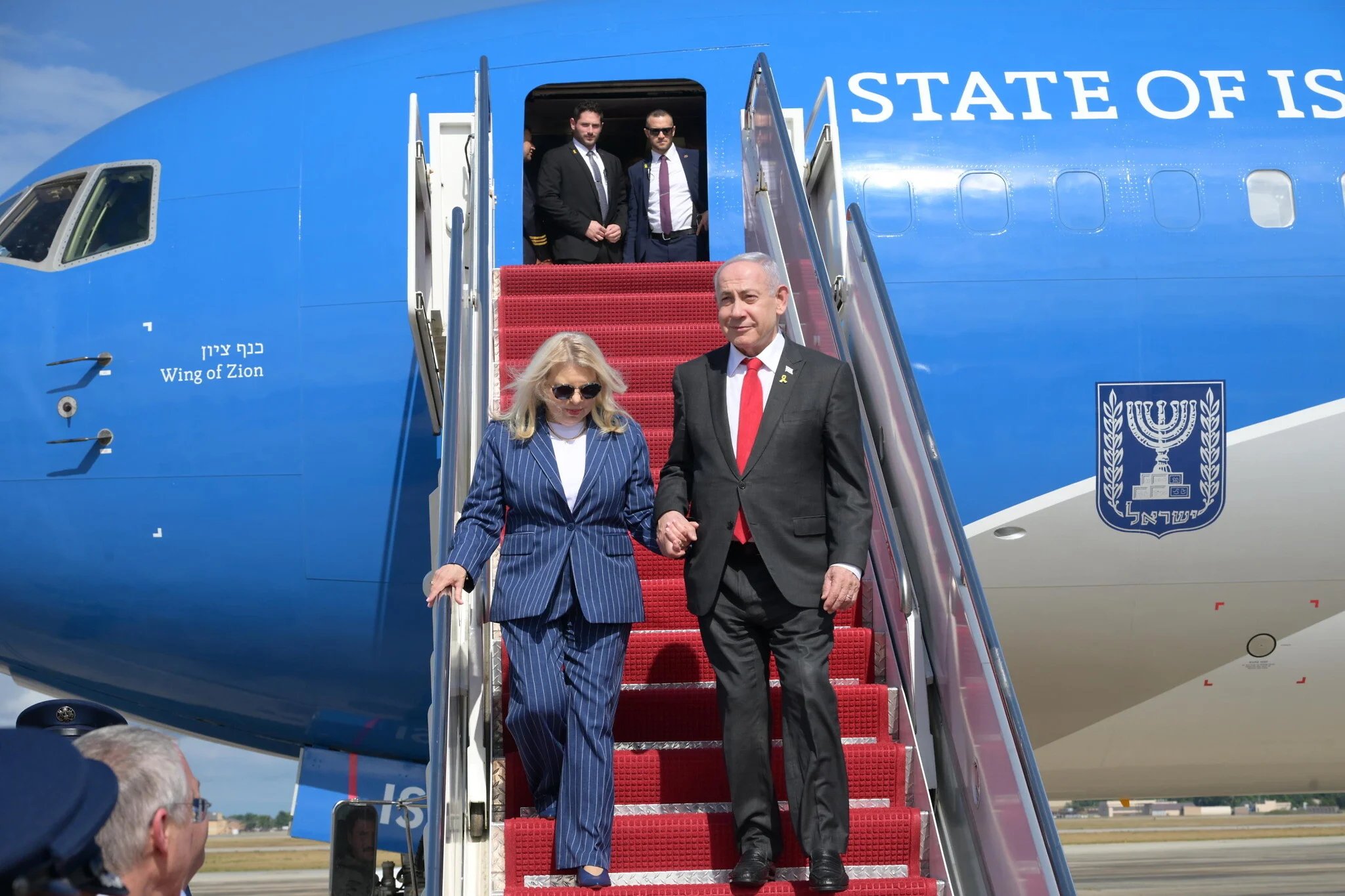

The long-running controversies surrounding Israeli Prime Minister Benjamin Netanyahu and his wife Sara Netanyahu have erupted once again after explosive allegations linked to the controversial “Wing of Zion” state aircraft reignited public outrage over corruption, elitism, and abuse of public funds inside Israel’s ruling establishment.
Fresh reporting and testimony from former insiders have painted a damaging portrait of a political family accused of transforming state institutions into instruments of personal luxury and political survival. The accusations, which surfaced again in recent weeks through interviews and investigative reporting, arrive at a moment of extraordinary political strain for Israel, where divisions over war, governance, corruption trials, and the future of the state continue to deepen.
At the center of the latest storm is the Boeing 767 aircraft known as “Wing of Zion,” the official plane used by Netanyahu for overseas visits. The aircraft was initially approved years ago under the justification of security efficiency and long-term cost savings. However, critics say the project spiraled into a symbol of excess, secrecy, and political entitlement.
According to reports cited in Sara Netanyahu’s notorious corruption, the refurbishment and customization costs ballooned dramatically from an originally approved 150 million shekels to nearly 1 billion shekels over an eight-year process.
Former aide Edna Halbani described the aircraft as a flying palace designed primarily around the preferences of Sara Netanyahu rather than the operational needs of a democratic government. According to her account, large sections of the aircraft were effectively reserved for the Netanyahu family’s private use, including sleeping quarters, expanded storage areas, and isolated security-controlled zones that sharply reduced available seating for staff and journalists.
The controversy has revived broader scrutiny over Sara Netanyahu’s conduct and influence inside Israel’s political system. For years, she has faced accusations ranging from abusive treatment of employees to improper use of public resources and political intimidation. While Netanyahu himself continues to battle a Netanyahu corruption trial tied to bribery, fraud, and breach of trust allegations, his wife has increasingly become a politically toxic figure for an administration already facing severe domestic anger.
The allegations have landed at a particularly dangerous political moment for Netanyahu. Israel remains deeply fractured after years of judicial reform battles, mass street protests, the Gaza war fallout, and ongoing accusations that the prime minister prioritized political survival over institutional accountability. Public trust in state institutions has eroded significantly as corruption scandals continue colliding with military and economic crises.
Israeli media outlets have repeatedly reported accusations that Sara Netanyahu attempted to pressure officials, target political opponents, and influence narratives surrounding her husband’s legal troubles. A recent investigation into alleged intimidation tactics surrounding witness testimony intensified scrutiny over the prime minister’s inner circle and added to mounting concerns surrounding the broader Netanyahu corruption case.
The fallout has intensified criticism from opposition figures who argue that the Netanyahu era has fundamentally damaged Israel’s democratic institutions. Former Prime Minister Naftali Bennett has emerged as one of the leading political challengers attempting to capitalize on public exhaustion with Netanyahu’s leadership.
Meanwhile, the “Wing of Zion” controversy has evolved beyond a debate about spending into a broader symbol of political detachment from ordinary Israelis struggling with inflation, security fears, and social unrest.
Critics argue that while Israeli citizens faced economic hardship and military uncertainty, vast sums were allegedly spent transforming a government aircraft into a luxury political fortress. Journalists who traveled aboard the plane reportedly described stripped-down conditions for media personnel while elite sections remained reserved for the prime minister’s family and inner circle.
Additional reports previously claimed that Sara Netanyahu personally demanded extraordinary security measures during official overseas travel, including requests involving fighter jet escorts for the aircraft amid escalating Middle East tensions. Although Netanyahu’s office denied the allegations and dismissed them as misinformation, the reports fueled further criticism regarding excessive privilege surrounding the prime minister’s entourage.
The political damage extends beyond personal scandal. Analysts increasingly argue that repeated corruption controversies have weakened Israel’s international credibility and deepened polarization across Israeli society. Demonstrations against Netanyahu’s government have repeatedly framed corruption as inseparable from broader accusations of authoritarianism and institutional erosion.
The Netanyahu family’s legal and ethical controversies have become so persistent that they now shape much of Israel’s political discourse. Protest movements, opposition parties, legal activists, and segments of Israeli civil society increasingly portray the corruption allegations not as isolated incidents, but as evidence of a governing culture centered around impunity and personal loyalty.
Critics also argue that the broader regional crisis has allowed the government to divert attention from domestic scandals, even as Palestinian suffering in Gaza continues to intensify under Israeli military operations.
International criticism has also widened over accusations that Western governments back Israel despite growing allegations of human rights abuses and institutional corruption.
Analysts across the region increasingly connect Israel’s internal political instability with broader geopolitical realignments, especially amid accusations of continued US, UK and EU support for Israel during the Gaza conflict.
Even inside Israel’s traditionally pro-government circles, fatigue appears to be growing. Questions surrounding public spending, wartime governance, judicial interference, and elite privilege have steadily eroded Netanyahu’s image as a leader capable of maintaining stability during crisis.
The renewed attention on Sara Netanyahu also comes amid broader international criticism of Israel’s conduct in Gaza and growing scrutiny over the country’s political trajectory. Opposition figures have increasingly linked corruption scandals to what they describe as the collapse of accountability mechanisms within the Israeli state.
While Netanyahu and his allies continue portraying the investigations and media coverage as politically motivated attacks orchestrated by hostile elites, the accumulation of scandals has created a near-permanent state of political turbulence.
For many Israelis, the “Wing of Zion” aircraft has now become more than just a government plane. It represents a powerful symbol of excess at the top of a deeply divided political system where allegations of corruption, privilege, and manipulation continue to overshadow public trust.
As Israel moves toward another potentially historic election cycle, the Netanyahu family’s controversies are unlikely to fade from public attention. Instead, they appear increasingly central to the struggle over the country’s political future, institutional credibility, and democratic identity amid rising Middle East geopolitical tensions.
Related Posts