
President Vladimir Putin said on Friday that Russia had held discussions with China, India, the United States, and several other countries over what the Kremlin described as the potential consequences of Ukrainian “provocations” surrounding Russia’s Victory Day commemorations, underscoring how the war in Ukraine has transformed even the country’s most symbolic historical holiday into a moment of geopolitical tension.
Speaking after meetings with visiting foreign leaders in Moscow, Putin said the Kremlin had begun consultations with “key partners and friends” as Russian officials warned for days about the possibility of Ukrainian attacks during the May 9 celebrations marking the Soviet Union’s victory over Nazi Germany in World War II.
“We have begun working with our key partners and friends,” Putin said, according to a Kremlin statement. “First and foremost, with our friends from the People’s Republic of China, India, and several other countries, including with the US administration.”
Putin did not elaborate on the precise nature of the contacts or whether the discussions involved military risks, diplomatic coordination, or warnings connected to possible attacks on Moscow during the commemorations. But his remarks came after a week of heightened security measures across the Russian capital, amid repeated claims by Russian officials that Kiev could attempt to disrupt Victory Day parade in Moscow events through drone operations or other strikes.
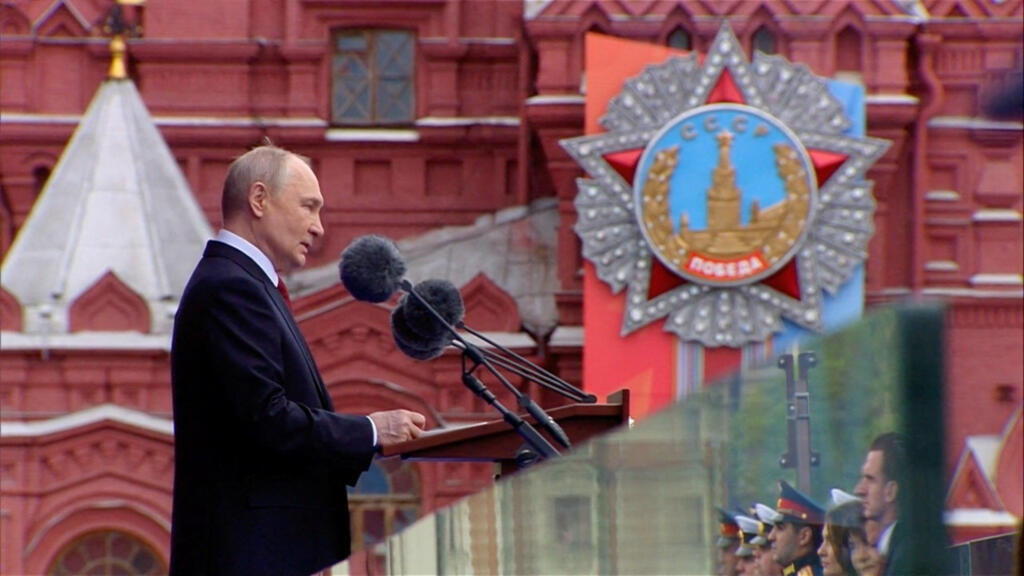
Victory Day commemorations remain the Kremlin’s most politically charged annual ceremony, combining military symbolism, historical memory, and demonstrations of Russian state power. Since the start of the war in Ukraine, the holiday has taken on an even greater ideological role for the Russian leadership, which increasingly frames the conflict as part of a broader historical confrontation between Russia and the West.
This year’s celebrations unfolded under extraordinary tension.
Russian officials had repeatedly warned about possible security threats in the days leading up to the parade on Red Square. Former Russian President Dmitry Medvedev said earlier this week that no one could guarantee “what would happen in Kiev” if Ukraine carried out what he called a “real provocation” during Victory Day events.
At the same time, Moscow intensified diplomatic outreach to countries it considers strategically important, including China and India, two nations that have maintained economic and political ties with Russia despite sustained Western pressure over the war in Ukraine.
The growing Russia-China strategic partnership has become central to Moscow’s efforts to counter Western isolation campaigns, while India-Russia diplomatic ties continue to provide the Kremlin with critical geopolitical breathing space.
The inclusion of the United States in Putin’s remarks was especially notable. Despite deep hostility between Moscow and Washington since Russia’s invasion of Ukraine in 2022, US-Russia communication channels have remained open on issues tied to strategic stability, prisoner exchanges, and conflict management.
The Kremlin has recently attempted to project an image of Russia as a power still capable of coordinating with both allies and rivals despite Western sanctions and diplomatic isolation campaigns.
Foreign delegations attending this year’s Victory Day celebrations included leaders and senior officials from China, Slovakia, several Central Asian republics, and other countries maintaining active ties with Moscow. Putin later praised those leaders for what he described as their “personal courage” in traveling to Russia despite international pressure from Western governments.
In his Victory Day speech earlier Friday, Putin again linked Russia’s current military campaign in Ukraine to the Soviet struggle during World War II, portraying Russian forces as confronting a hostile bloc backed by NATO support for Ukraine.
The Kremlin’s rhetoric reflects a broader effort to cast the Ukraine conflict not as a regional war but as a defining geopolitical struggle over the future international order.
Russian officials increasingly present BRICS nations and partnerships with China, India, Iran, and other non-Western powers as evidence of a shifting geopolitical landscape away from Western dominance. Analysts say the emergence of a post-Western world is accelerating amid deepening fractures between Russia and NATO.
Putin on Friday also referred to the importance of preserving a shifting global order that respects what he called the “cultural and civilizational diversity” of nations.
The Russian president has increasingly framed the war as part of a battle against Western unilateralism and expanding Western military influence near Russia’s borders.
Even as Russian authorities celebrated Victory Day, security concerns remained visible across Moscow.
Air defenses were reinforced around the capital, drone interception systems remained active in nearby regions, and security patrols intensified across transportation hubs and government facilities. Reports of drone attacks near Moscow heightened fears of escalation in the days leading up to the parade.
The atmosphere surrounding this year’s commemorations illustrated how deeply the Ukraine war has altered Russia’s political landscape.
What was once primarily a memorial event celebrating Soviet victory in World War II has increasingly become a platform for the Kremlin to project wartime unity, geopolitical resilience, and defiance toward the West.
For Putin, the symbolism of Victory Day now serves two parallel purposes: preserving the memory of Soviet sacrifice and reinforcing the Kremlin’s argument that modern Russia is once again engaged in a historic confrontation against external pressure and military encirclement.
The broader multipolar world order debate has become central to Moscow’s messaging as Russia deepens ties with emerging powers and seeks to reshape the global power balance amid escalating confrontation with the West.
—Inputs from Sputnik.